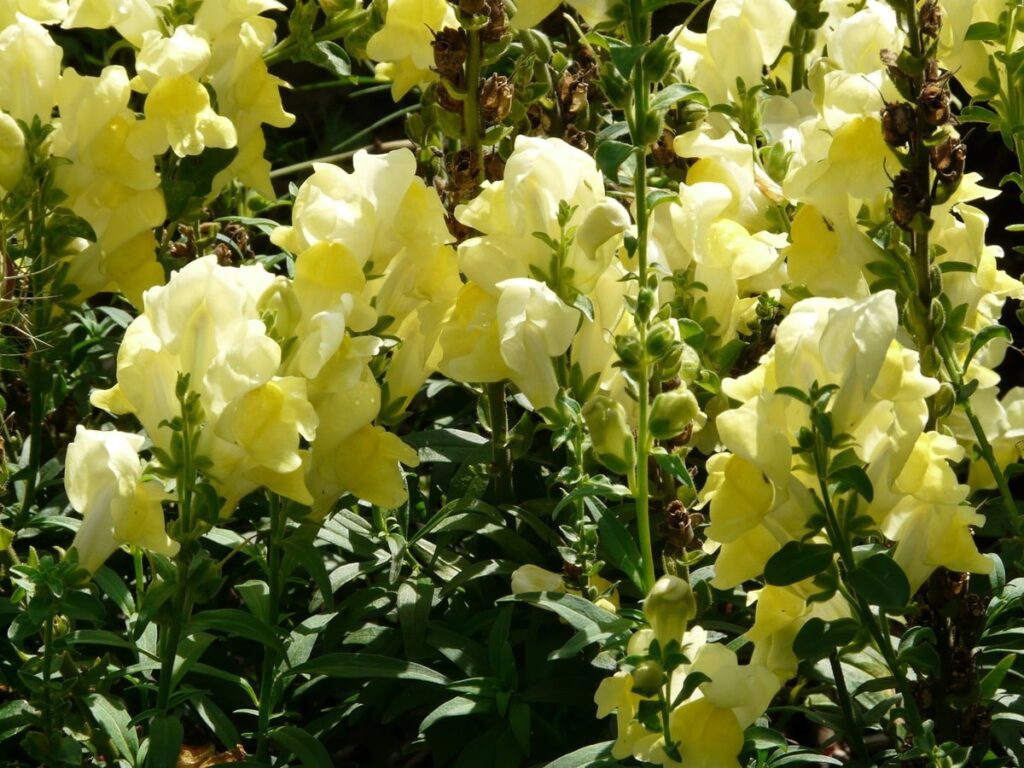

The plant known as snapdragon is a herbaceous plant that is very desirable to grow in pots or planters, as well as, of course, in the ground. It is small, produces very beautiful flowers, and also does not require special care. However, sometimes we make a mistake with something, and it starts to dry up.
Although its lifespan is very short, it should last at least a few months before wilting; If this does not happen, we will have to wonder why the snapdragon flower dries up before its time.
How long do snapdragons live?

Image – Wikimedia/Michael Apel
Snapdragon is a herbaceous plant which, depending mainly on the climate, can be perennial (meaning it can live for more than two years), biennial (two years) or annual (one year). But even in the worst case, from the time the seed is sown until the flower fades, at least spring and the whole summer must pass.
In other words, its lifespan is short, but it must have enough time to grow, reach adult size (between 0.5 and 2 meters in height depending on the variety), flower and, if all goes well, bear fruit. If it dries out soon after you buy it, for example, we don’t take good care of it.
Why is it drying up and how can we recover it?

Image – Wikimedia/Yercaud-elango
It is a small plant, and therefore it can quickly have a very bad time if you make a mistake with something; that is, if we neglect irrigation, or if on the contrary we keep the soil permanently moist, or if when applying the fertilizer we add a higher dose than indicated on the package . So, We are going to see in detail why it can dry out, and what to do to try to recover it:
watering problems
Watering the snapdragon is very important, but whether we do it too often or forget to rehydrate it, we can cause it a lot of problems. In fact, it is best to check the humidity before watering, with a stick for example.
Lack of water
Whether we have it in a pot or in the ground, the lack of water causes the plant to dry out very quickly. In the hottest time of the year, you can even see that it starts to mold overnight.and more so if it is in a plastic container exposed to the sun at all hours of the day.
In these conditions, it needs to be watered oftenbut without exaggerating because otherwise we will end up causing a bigger problem, which is the death of the roots as a result of excessive watering.
Excess water
Excess water is something we must always avoid when growing plants of any kind (unless, of course, we are caring for aquatic or semi-aquatic plants). But the snapdragon is not the one who can bear having “wet feet” all the timethat is why it is a mistake to plant it in a pot without holes (or in a pot that has holes, but then put a plate underneath) or in very compact and heavy soil, with poor drainage.
How do we know we’ve spent watering it? well in this case we will see that the soil is very wet, the leaves are starting to turn yellow and the plant looks “sad”. Also, if it is in a pot, when we pick it up we notice that it is very heavy.
for Save her, what we are going to do is temporarily stop watering it and treat it with a systemic fungicide (on sale here) that we will apply on the plant and also on the roots.
Likewise, if we have it in a pot, we will take it out and wrap the root ball with paper towel. We will leave it like this overnight, and the next day we will replant it in a new container that has holes in the base. And from there, it will be necessary to water less.
too much compost

Image – Wikimedia/Plenuska
Sometimes it is thought that if you add more fertilizer than the manufacturer says on the package, better results will be obtained, such as more flowers or faster growth, but it doesn’t work that way. The more you add, the more damage we will cause to the roots, since we will “burn” them.
Therefore, if we want to save it, or at least try, from an overdose of manure or fertilizer, what we will do is water it – only with water – to wash the root system. You have to pour enough water on it so that the soil remains soaked. But yes, if the plant is in a pot, it is very important that it does not have a plate underneath, because said liquid must be able to come out; if this were not the case, this “cleaning” would be useless, because the water, with the excess of manure or fertilizer, would remain stagnant in the plate, in contact with the roots.
And that does not mean that we could run the risk of losing it due to excess water as we have already mentioned before.
Therefore, whenever we go to pay it, we must read the instructions for use and follow them to the letter. Only then will we get the expected results.
As you can see, a dry snapdragon can recover, but only if caught early.