
This time we are going to move on to another Salvia, in this case ornamental with small flowers, but very abundant and showy for long periods of the year.
Characteristics of the genus and habitat of Salvia microphylla
If you know this kind of plants, it is safe because of the common sageof which we already have a detailed article on its cultivation, care and medicinal properties, which are not uncommon.
The genus Salvia belongs to the family of Lamiaceae. It is a very large genus of species. There are currently 986 accepted species of Salvia, although there are over 2000 scientific names, half of which are synonyms of these first 986, which are the taxonomically accepted ones. It is so large that within the Lamiaceae family it is the largest of all.
Here we have the distribution of this species according to data from GBIF.org. Central and South America and Spain mainly. Their the origin is from Central America. There is something in the Mediterranean region but not as abundantly as in Spain. We’re surprised it’s not found in more places around the world due to its hardiness, but the data is what it is.
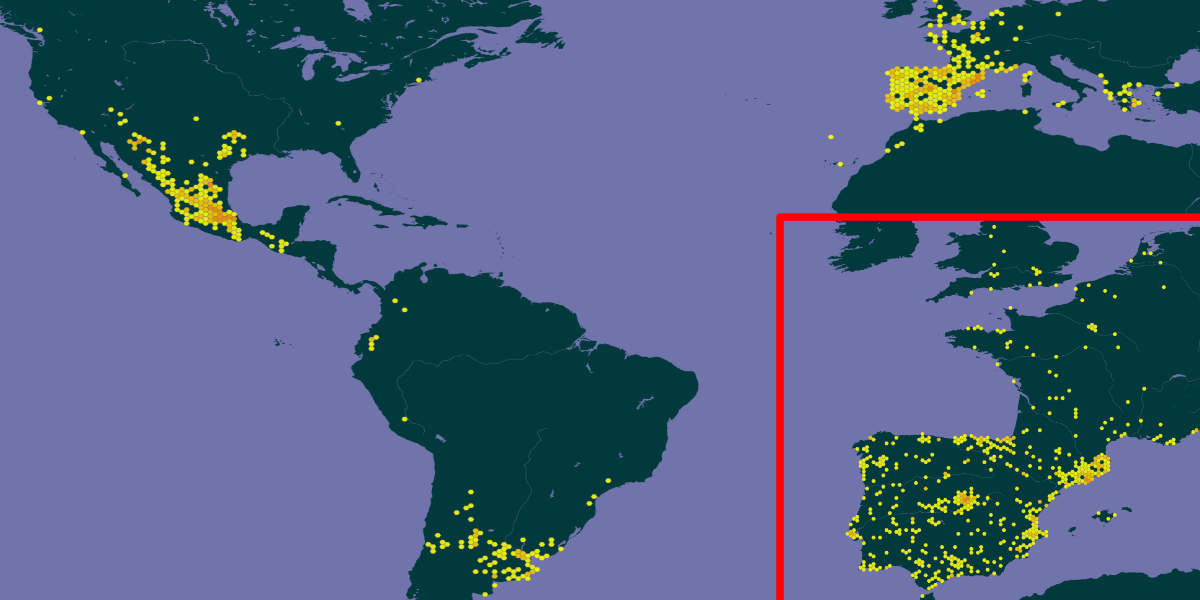
Don’t you have properties like your sister S.officinale?
We have not found any current medicinal references, although it has been used as a medicinal plant. In Mexico It is a very abundant plant (see map) and the tea is made with.
Its leaves are very aromatic,
The fact that species share a genus does not mean that they must necessarily produce similar substances or have similar properties. There are some studies (references below), where its insecticidal capacity is evaluated on certain pests with unremarkable results, but there is no exhaustive scientific bibliography on the properties beyond the chemical analysis of its constituents. of essential oil. If you know of any proven medicinal uses, let us know in the comments.
Do not despair. It attracts a lot of pollinators, and that’s important
Salvia microphylla It is a plant that attracts many pollinators and is very good for your garden or orchard. Its extended (over time) and abundant and striking flowering allows many pollinators to prowl cheerfully in the hedge, or the bush that you have planted. For concrete reference, a recent study this year in California evaluates the need to choose ornamental plants that attract pollinators in more urban environments, where diversity is lost due to the lack of these insects. They speak of several species and among them, the Salvia microphylla.
Lavender is another example of a very attractive plant for pollinators.
Care and cultivation of Salvia microphylla
It is a shrubby plant that does not exceed meter high or meter and a half and a maximum of one meter in length. It is persistent light green. As you can see on the previous map, it is a plant that adapts very well to all kinds of weather: interior, coastal, mountain, plateau. In Spain it is distributed throughout the geography.
temperature and brightness
Its optimal range is approx. between 15 and 25ºC.
It is a frost tolerant plant but it is not a wonder either. According to the USDA hardiness scale, it could be between 8a and 8b, being able to withstand cold down to -5°C or -10°C. This should always be taken with a grain of salt. The minimums don’t tell us how long they can withstand that temperature. If they are very persistent, it will not hold.
Besides being quite hardy in harsh winters, it is quite tolerates periods of drought and heat. In the area where a server lives, we have very harsh winters of several degrees below zero and summers of over 30°C some weeks and there, it’s hard like a boar. This is a photo taken in October, when the cold begins to show.
For optimal growth, it should be sited with a good dose of daily sun, especially in those where the cold presses more than the heat. In hot climates, some shade is recommended so that it can withstand the summer months well.
 Salvia microphylla “hot lips” variety in October in autumn
Soil and humidity
Substrate universal that meets the three basic parameters of a floor:
- Rich in available nutrients and organic matter.
- Good structure -> airy soil -> uncompacted soil
- Drainage since the smothering of the roots is one of its weak points.
It may turn outSensitive to moisture in winter, both environmental and soil. If frosts are to be expected, it is better to leave the substrate dry and not to water.
Irrigation
It appreciates weekly waterings in summer to resist drought, being able to stretch up to 2 or 3 weeks in winter.
Plagues and diseases
The spider, the whitefly, the mealybug and the aphid are the most common pests that can be prevented and controlled in different ways.
Plant pests and diseases.
size of the Salvia microphylla
one is required spring pruning to keep the bushy habit compact and filling. If not pruned, it scatters and thinning, bald areas will appear over time. Lateral regrowth must be favored so that it gains in density. Basic tips.
- Remove stems that are in poor condition, diseased, broken or dry.
- Prune the bulk of the plant by removing the apical stems to promote lateral growth.
- In summer, remove dried flowers and stems of cut flowers. You can make one second size very light in summer to promote subsequent flowering
Other salvias that we talked about in Agromática
If we have already said that the genus Salvia has almost 1000 species, in Agromática we had to talk about others. Only three! Tell us in the comments which Salvia you want us to talk about.
References
- Nabors, A., Hung, KLJ, Corkidi, L. and Bethke, JA (2022). California native perennials attract a greater abundance and diversity of native pollinators than non-native ornamental plants commercially available in Southern California. Environmental entomology, 51(4), 836-847.
- Romo-Asunción, D., Ávila-Calderón, MA, Ramos-López, MA, Barranco-Florido, JE, Rodríguez-Navarro, S., Romero-Gomez, S., … & Rico-Rodríguez, MA (2016). Juvenimetic and insecticidal activities of Senecio salignus (Asteraceae) and Salvia microphylla (Lamiaceae) on Spodoptera frugiperda (Lepidoptera: Noctuidae). florida entomologist345-351.