The phalaenopsis orchid is one of the most popular flowering plants around the house for a reason. They bloom for months and will bloom again year after year if cared for properly. But when your orchid produces a new flower spike, it’s important to take good care of it to ensure you get the most spectacular blooms. One of the most important things to do is nail down the orchid’s stem properly to shape and protect the developing flowers.
How to stake an orchid – Once the new orchid stem has grown more than a few inches in length, carefully insert a stake into the potting mix next to the developing tip. Use clips or wire ties to gently secure the tip of the flower every few inches, avoiding knots in the tip. Add more clips as the tip grows, placing the last clip 1-2 inches below the first shoot.
new tip care
Once you see a flower spike forming, you can watch and wait for it to reach 4 to 6 inches in height. It normally takes a few weeks before it is first visible to reach this size. At this point, it’s time to do some work.

How to stake an orchid – step by step
- When the orchid’s stem is 4 to 6 inches long, it’s a good time to start planting and tip shaping.
- You will need a sturdy stake to insert into the growing medium and some clips or bands to secure the flower stem to the stake.
- I usually use a straight bamboo or plastic pole. Store-bought orchids almost always come with a suitable insert.
- Insert the stake into the growing medium on the same side of the pot as the new flower stem. I usually place the stake against the inside of the pot to see the roots and avoid putting them in the middle. If you come across a carrot, step back, twist the post a bit, and insert it at a slightly different angle. Never force the post or you could damage a root.
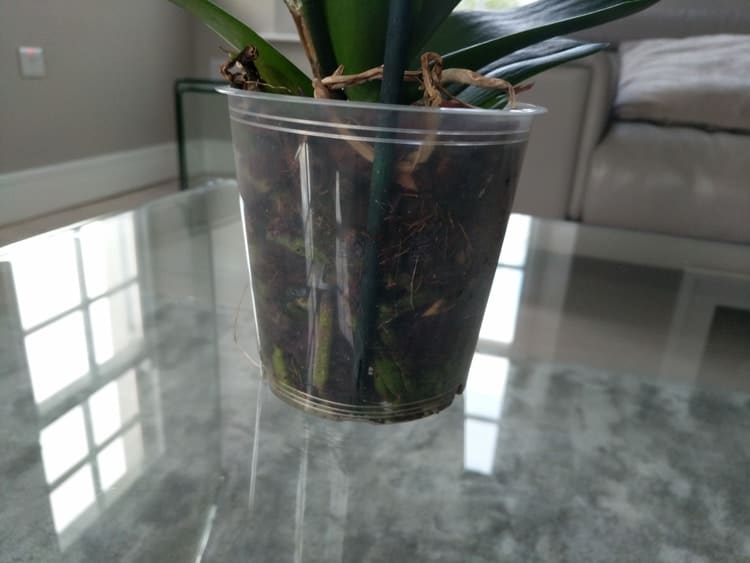
- Once the stake is securely in place, you can use a paper clip or wire tie to secure the growing flower to the stake. You can use plastic clips or ties. Do not use wire or anything that might damage the delicate stem of the flower.
- Keep in mind that the stem of a new flower is flexible, but very delicate. Be careful not to damage or break it, as it will not recover from damage. After the flower stalk grows, it will harden and become much tougher and more resistant to damage.
- Place the first clip just above or below the first node on the flower stem. The floral spike can sometimes produce a secondary spike from one of these nodes, or produce a second spike from a node after the main spike has finished flowering, so try to avoid tying clips at knots as this may cause damage or a second stud may prevent casting.
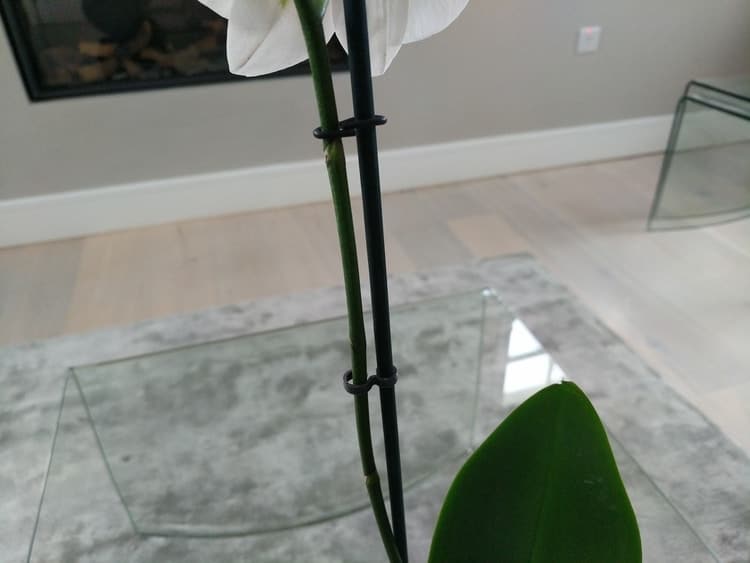
- Each time the flower stem grows a few more inches, attach another clamp to secure the flower stem to the stake. Try to grow the flower spike vertically.
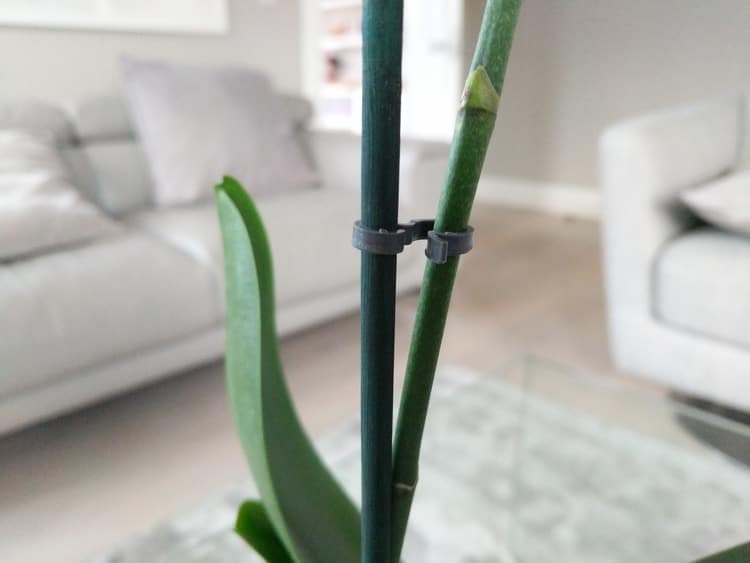
- When the flower stalk is sufficiently developed, it will begin to develop buds. It’s a good idea to place the last clip about an inch below the first bud on the flower stem. After that, you can carefully bend the stem of the flower to hopefully create a beautiful flower arch.
- An important point to keep in mind is to keep the orchid facing the light source in the same direction as the flower spike, and especially the developing buds. This will cause the flowers to bloom in the same orientation, in a row. If you move the orchid repeatedly at this stage, the buds will constantly try to readjust and you’ll have flowers in different directions, which doesn’t look very nice.
- When all the flowers are open, you can move your orchid as you wish, the position of the flowers will not change afterwards.
Is it an orchid root or stem?
Over time, Phalaenopsis orchids will produce more and more aerial roots that rise from the growing medium and overflow the pot. It’s easy to mistake a new aerial root for a new flower spike until you’ve seen a few to know what they look like.
orchid roots they have green, rounded ends, but are usually silver-gray throughout their length.
orchid spikes they are usually green along their entire length and appear between the orchid’s leaves, rather than emerging from the middle of the pot or the base of the stem. The tip of a flower spike will also be flatter and more irregular, resembling a small mitten.
Either way, don’t worry too much because you can just watch and wait to see what unfolds. The flower spike should become easier to identify as its length increases to 4-6 inches.
curved orchid vines
If you want to venture out, you can try using a curved orchid stake to produce a more unusual or potentially impressive orchid bloom. This technique allows you to create an arch of phalaenopsis flowers, which can look really impressive.
Should I bet the orchids?
Although almost all phalaenopsis orchids you will find in the store have flower spikes attached, it is not essential to do so. An undeveloped spike will grow more horizontally as gravity pulls it to one side of the plant. It’s much more like nature, where a flower stalk hangs lazily from the plant.
Most people risk their orchids as it is common practice to do so and it has some key benefits. Most orchids are kept in small pots and the flower stalks are heavy compared to the weight of the whole plant. A cob growing horizontally can easily topple a plant unless placed in a heavy pot.
Additionally, vertical spikes are often more aesthetically pleasing and allow you to display orchid flowers in a way that shows their beauty to the fullest. Whether you choose to stake your own orchid is up to you.
What makes a new orchid spike grow?
New flower stalks usually form on orchids in response to cooler temperatures and/or shorter days. For this reason, I always move my phalaenopsis orchids to a cooler area after they finish flowering, to try and stimulate the next floral spike.
Phalaenopsis orchids naturally produce flower spikes in late fall and winter for this reason, but regardless of the time of year, you can artificially lower the temperature of an indoor orchid to make it to bloom.
How long does it take to grow an orchid spike?
Orchid spikes grow quite slowly, usually over a period of 2-3 months. The speed of development depends on two main factors. temperature and light.
More light increases the plant’s ability to photosynthesize and generate energy that can be used to grow the new flower spike.
Additionally, higher temperatures increase an orchid’s metabolism and can accelerate flower stem development.
However, keep in mind that this is a double-edged sword. Phalaenopsis tend to flower longer in cooler conditions due to reduced metabolism, so keep this in mind if you want to enjoy your beautiful orchids for as long as possible.
Why do some orchids have more flowers than others?
There are two main factors at play here.
The first factor is genetics. Some orchids are just born to have lots of flowers on their spikes. Genes from other individual plants may have significantly fewer.
The second factor is the quality of care. All living things thrive when their care needs are met, and orchids are no different.
If an orchid receives less light, water, heat, and fertilizer than it needs, it will produce fewer flowers on its flowering stem, even though it has the genetic ability to produce more. So if your orchid isn’t producing many flowers this time around, be sure to give her everything she needs to be happy.
Also, when buying an orchid, be sure to choose one with lots of flowers, because once it has produced that many flowers, you can reproduce it on the next flowering cycle if you take good care of it.
The reality is that most commercially produced orchids are kept in ideal conditions and it is difficult, but not impossible, to get them to bloom as profusely as when they were first purchased.
How long does it take for an orchid to bloom again?
A phalaenopsis orchid normally needs about 6 months from the end of the last flowering cycle until a new flower spike begins to emerge. The time scale depends on the conditions in which the orchid is kept and how well it is cared for.
Above all, phalaenopsis orchids need cooler temperatures to stimulate them to produce a new floral spike. Expose your orchids to cooler temperatures, especially at night, up to 60-65 degrees Fahrenheit for a few weeks to encourage the development of new flower spikes.
Do you cut the stems off dead orchids?
You should not cut a flower stalk immediately after an orchid has finished flowering. Instead, wait until the top of the flower spike turns brown, then cut it off just above the third or fourth node. This allows the flower branch to produce a side branch from one of the nodes, leading to another crop of flowers.
Also check out my other orchid care articles. I have a special interest in phalaenopsis orchids and have lots of useful information in the orchid section of this site.