
Perhaps this scenario is familiar to you:
Your favorite plant just keeps growing and growing and growing…
And it grows almost too long.
Actually too long!
Accept! You decide to make a cutting.
Proud of your bravery, you take the cutting of your beloved plant and place it in a glass of water.
You wait and you wait…
And wait.
And yet wait…
Sometimes nothing happens at the moment. You cut the plant, took the cutting and put it in water, but even after what seems like an eternity, the cutting barely took root.
Unfortunately, this can happen. Anything can go wrong and your cutting won’t root. We are going to show you the reasons why rooting may not be successful.
Reason 1: Your cutting is not rooting because you only took one
It may be that one root cutting is better, that the mother plant is healthier and stronger in one shoot than the other, or that not all the cuttings are as viable as the others.
There are many reasons, but one thing is clear: if possible, always take several cuttings from the same plant to increase the chances of rooting success.
And if they all take root, so much the better! 🥳
Reason 2: Your plant is not suitable for propagation by cuttings
Not all plants are suitable for propagation by cuttings. Of course, many classic houseplants are doing very well: ivy, monstera and philodendron, for example.
On the other hand, UFO plant, alocasia or succulents such as elephant foot and aloe vera are propagated by suckers or young.
Unfortunately, you cannot fix this problem yourself. Plants will produce suckers when they are particularly happy under your care.
Reason 3: Your cutting is not rooting because your mother plant is unhealthy
The mother plant must be strong and healthy to take the hits. This means that it should not be infected with bugs, for example.
And if so, you should provide first aid to the mother plant before tending to the young plants. Yes, it’s similar to how you handle oxygen masks on an airplane.
It won’t be bothered by the cutting process if your mother plant is in great shape. Plus, your babies have more energy to fend for themselves, or in our case, for their roots.
Reason 4: Your cutting is not rooting because you are using unsanitized tools
You may have heard or read this before; the scissors or knife you cut with is very important.
Your cutting tools should be sharpened and properly sanitized beforehand, not just a quick wash with alcohol or another sanitizer.
Using unsanitized tools can cause disease in the mother plant or the cutting. The same goes for cutting multiple plants without cleaning the tools in between.
So always work with clean tools and disinfect them between cuts.
Reason 5: Your cutting is not rooting because you are cutting in the wrong place
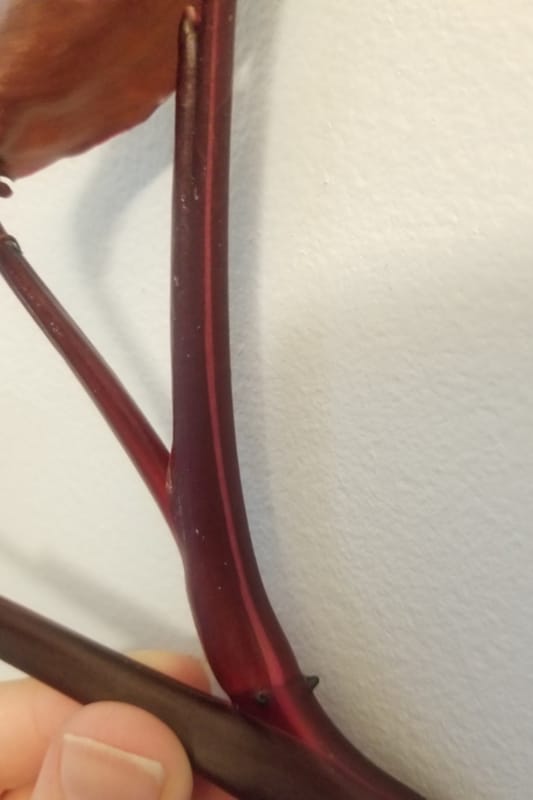 The connection between the stem and the leaf is called the leaf node.
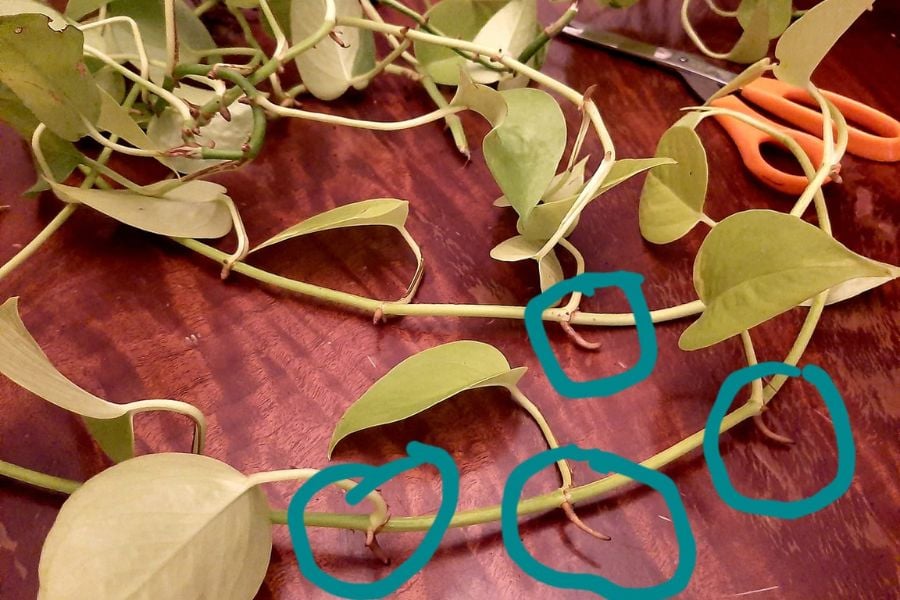 Find the small bumps on the stem, called nodes, where leaves emerge and cut just below a node.
To ensure that your cutting forms long, healthy roots, it is essential to include an eye (a knot or knot) when cutting. Without one, no roots can form.
Reason 6: Your cutting is not rooting because it is too long
If you cut particularly long pieces like cuttings, they may not have enough energy to form roots.
The longer the cut, the more moisture or water the “plant” needs to be supplied. If your cutting is busy with this, it has little energy left to develop healthy roots.
The ideal length for a cutting differs from plant to plant. A good guideline is the distance between two nodes (experts call this an internode).
So remember: your fragment must be at least one internode long.
It’s best to take many small cuttings, one node at a time, so to speak. If they take root and you plant them all together in a pot, you will get a bushier plant later.
Also, I recommend making sure no leaves are submerged in water. They cannot photosynthesize there and can easily rot.
Reason 7: Your cutting is not rooting because you let it dry out too long
Do not mistake yourself. Your cut should definitely dry out a bit.
Many plants can even dry out overnight. Especially for those that have sufficient moisture reserves in their stems and leaves.
Drying is important to prevent infections, such as mold growth. Alternatively, you can sprinkle cinnamon on the cut end to sanitize it.
But if you leave the cutting too long (i.e. a day or more), it can dry out and die before it has a chance to reproduce.
You can sprinkle cinnamon on the cut ends to prevent the cuttings from drying out. Cinnamon has natural antifungal properties that can help prevent root rot and promote root growth. learn more about use cinnamon as a rooting hormone in this article.
Reason 8: Your cutting is not taking root because it does not receive enough light or because you have chosen the wrong season
Like the parent plant, the cuttings need enough light to photosynthesize and grow big and strong. This can quickly become a problem in the fall and winter when it’s darkest.
So try to take cuttings only in spring or summer and find a bright place without direct sunlight for them.
If you don’t have a light point in your house, you can always use an additional plant light.
By the way, it is just as important as the light to make sure your cuttings are warm and not cold. An unheated room or a cold windowsill (especially if the windows are not completely sealed) can quickly stunt root growth.
Well, that makes sense when you think about it. You wouldn’t want to settle in a cold place, would you?
Reason 9: Your cutting is not taking root because the air in the house is too dry
This problem also affects mature plants when the humidity in the house is not high enough.
Remember where your plants come from, their roots, so to speak. Many indoor plants come from tropical regions with high humidity.
For a cutting to grow big and strong, it also needs more moisture.
So create a pseudo-tropical environment for your moisture-loving plant and cut by maintaining high humidity. Your cutting will thank you with vigorous root growth.
However, this does not apply to all plants. Some can handle lower humidity very well. In a plant encyclopedia, you can find out what is best for your plant.
Reason 10: Your cutting won’t root because it’s exposed to drafts
Your cutting is fragile at a young age (it’s practically a newborn) and may be particularly susceptible to drafts, which can stunt root growth.
Eliminate this problem by placing your cutting in a place protected from drafts.
Keep this in mind:
- Drafts can form near windows, especially if they are not properly sealed.
- It is normal to ventilate your room (by opening the windows). However, if your cut is particularly small and sensitive, you can move it to another location while you air out the room.
Mother plants can also be sensitive to drafts. Monsters, for example, can quickly develop stress points from drafts. In a plant encyclopedia, you can easily check whether your other plants can withstand drafts.
Reason 11: Your cutting is not taking root because it is rotting
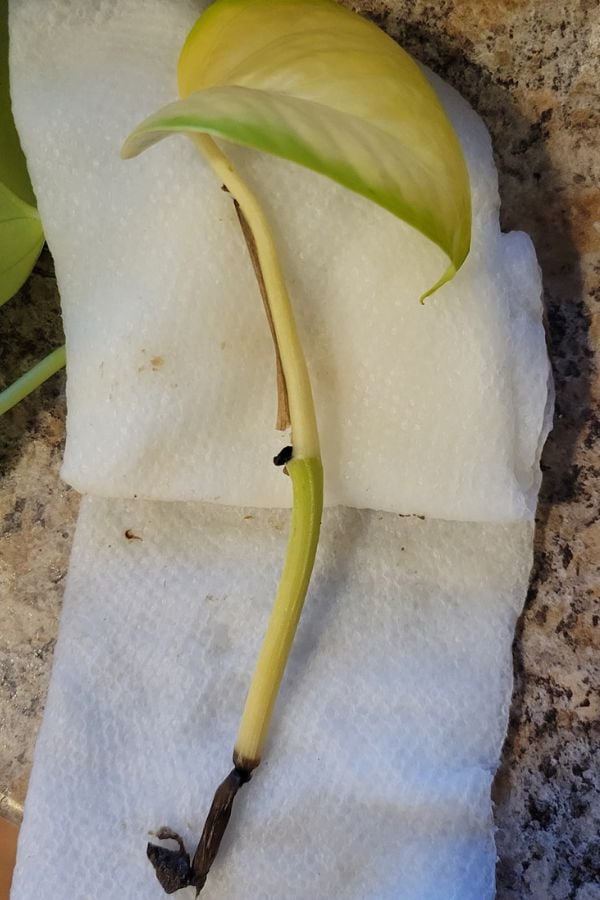 Lack of oxygen can cause pothos cuttings to rot due to the growth of anaerobic bacteria, which thrive in low oxygen conditions.
This is your reminder that cuttings are delicate creatures.
Because of this, they can easily succumb to the dreaded rot. Change the water about 1-2 times a week to avoid this. It is especially necessary when the water becomes cloudy or begins to form small bubbles.
As you’ve heard before, use sharp, sanitized scissors or knives when working with cuttings.
Reason: Your cutting is not rooting yet because you are too impatient
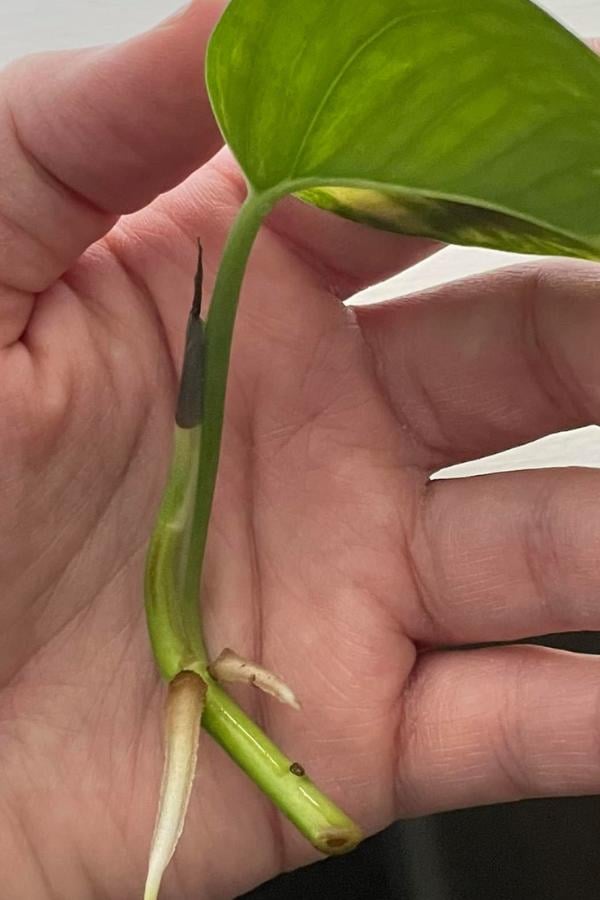 My Pothos cuttings root after ten days
Finally, a reason that we know very well: you are too impatient!
Honestly, sometimes I feel the same! As soon as I take a cutting from a plant, I immediately check for signs of root growth.
Give your plant a little extra time to impress you with its roots.
The good news: if your cutting looks healthy and shows no signs of rot or other diseases, you’re good to go! And if it goes well, it will probably take root over time. So he won’t come after you.
So if you can rule out all of these 11 reasons why you can’t see roots in your cutting, you might just have to wait a little longer.
A little point of view for you
So that we don’t just focus on the negative in this blog post, here’s a glimpse (and a silver lining for you) of the wonderful things that happen after your cutting successfully takes root.
Once your cutting’s roots are at least 1-2 inches long, you can transplant it into an ideal seedling soil and finish by watering or misting it.
If you’ve let the cutting root for a while (we’ve all forgotten about cuttings) and there’s a tangle of roots in the cup, you need to cut them off first.
Cut off the parts where the individual roots have intertwined. If you planted it like that, it wouldn’t develop a good root system.
Sharing is caring!