

Pink is a color that we always like to have in a garden or on a terrace. When paired with very positive things, such as kindness, empathy, and generosity, it’s easy for plants that produce flowers of this hue to enchant us.
Luckily, there are many species of plants that give pink flowers: trees, shrubs, herbaceous plants… Knowing their names will only take you a moment, although if you want to know their characteristics and care, we invite you to stay a little longer with us.
mountain alder (Hormathophylla spinosa ‘Roseum’)

Image – Wikimedia/Ghislain118 (AD)

Image – Wikimedia/Ghislain118
Formerly known as Thorny alyssumIt is a perennial herbaceous plant that forms mounds up to 30 centimeters high. Its branches are thorny and small greyish-green leaves emerge from it. At the beginning of summer it produces flowers grouped in clusters and they are pink.
If you live in an area where there are usually droughts, this species is ideal for you. Put it in a sunny spot, in well-drained soil, and water it sporadically. Withstands down to -7ºC.
tree of love (Cercis siliquastrum)
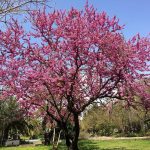
Image – Wikimedia/Zeynel Cebeci
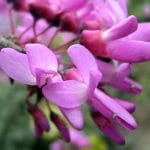
Image – Wikimedia/Kousvet
The love tree, also called the loco carob tree, is a deciduous tree whose trunk tends to bend a little over the years and which It can measure up to 6 meters high.. Its crown is very branched, so it is an ideal plant to provide shade. Its leaves, rounded and light green on the upper side and glaucous on the lower side, appear after the flowers. These flowers are pink-lilac and appear in spring.
It grows in sunny locations, in rich, well-drained soils. It is not a demanding plant. It is somewhat drought resistant, and it is not damaged by frosts down to -18°C.
curly cistus (cistus crispus)

Image – Wikimedia/Xemenendura
The curly cistus is a perennial herbaceous plant which reaches 50 centimeters in height. It has small leaves, densely covered with short whitish “hairs” and pink flowers that appear singly or in groups in spring.
It is very easy to care for, as it is a species that can withstand summer droughts as long as it has been in the ground for at least a year. It is also ideal to have it potted with substrates that drain water quickly, such as a mixture of peat with 50% perlite.
If there’s anything negative we have to say about her, it’s that she’s afraid of floods. But moderate frosts do not harm it (down to -7ºC).
pink mallow (trimestris lavatera)

Image – Wikimedia/Kor!An (Корзун Андрей)
The rose mallow is an annual herbaceous plant whose life expectancy is very short, less than twelve months. The seeds germinate in the spring, its flowers appear in the summer and when the seeds ripen they begin to wilt until they die back in the fall/early winter. It is still very interesting to save these seeds every spring, because the normal thing is that they all germinate quickly. Moreover, reaches a height of 120 centimetersand produces pink flowers about 4 centimeters in diameter, which makes it very, very pretty.
Plant it in a sunny spot, either in the garden or in a pot. Water it regularly but avoid waterlogging. It is also advisable to fertilize it from time to time during flowering, especially if it is kept in a container, with fertilizers for flowering plants.
Drunk stick (ceiba speciosa)
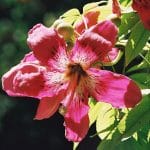
Image – Wikimedia/Dick Culbert

Image – Flickr/mauro halpern
The ceiba speciosa (before Chorisia speciosa) is a towering deciduous tree. Reaches a height of 25 meters or more, and its bottle-shaped trunk can measure up to 2 meters in diameter. It is usually covered with thick conical spines and has a rather branched crown. In spring, and if the climate allows it also in summer, it blooms producing flowers with pink petals.
In countries like Spain it is grown a lot in gardens, but it needs a lot of space to be able to develop normally. Likewise, it is important that it receives direct sun and that the soil drains water well. Resistant down to -7ºC.
Genus Prunus
Prunus are deciduous trees that can reach a height of about 10 meters on average. Many species are grown in orchards because they produce edible fruit, such as almond (Prunus dulcis), the plum (Prunus domestica), or cherry (avian prunus). But there are many others that are known for their beautiful pink flowers, like these:
Prunus glandulosa ‘Roseo Plena’

Image – Wikimedia/David J. Stang
It is a cultivar that grows as a deciduous shrub up to 1.5 meters tall. Its leaves are alternate and light green, and it produces a large number of double pink flowers in spring. It is a real gem for gardens, but also to enjoy in pots.
It grows both in the sun and in partial shade, it tolerates drought and frosts down to -20ºC. But be aware that it can be attacked by fungi such as mildew when overwatered.
Prunus serrulata

Image – Wikimedia/Nino Barbieri
The Prunus serrulata It is a deciduous tree known as the Japanese cherry tree or Japanese cherry blossom. It grows up to 7-9 meters, with a solitary trunk and a densely branching crown covered with leaves that turn yellow, red or purple in autumn. Its flower clusters appear in the spring and can be white or more commonly pink. If you want to play it safe, the ‘Kanzan’ variety has them in the latter color.
Due to its great ornamental value, it is a plant grown in all types of gardens, although it grows best in temperate climates and slightly acidic soils. Water it often during the summer so it doesn’t become dehydrated, and that’s it. Resistant down to -20ºC.
Prunus x subhirtella ‘Pendula Plena Rosea’
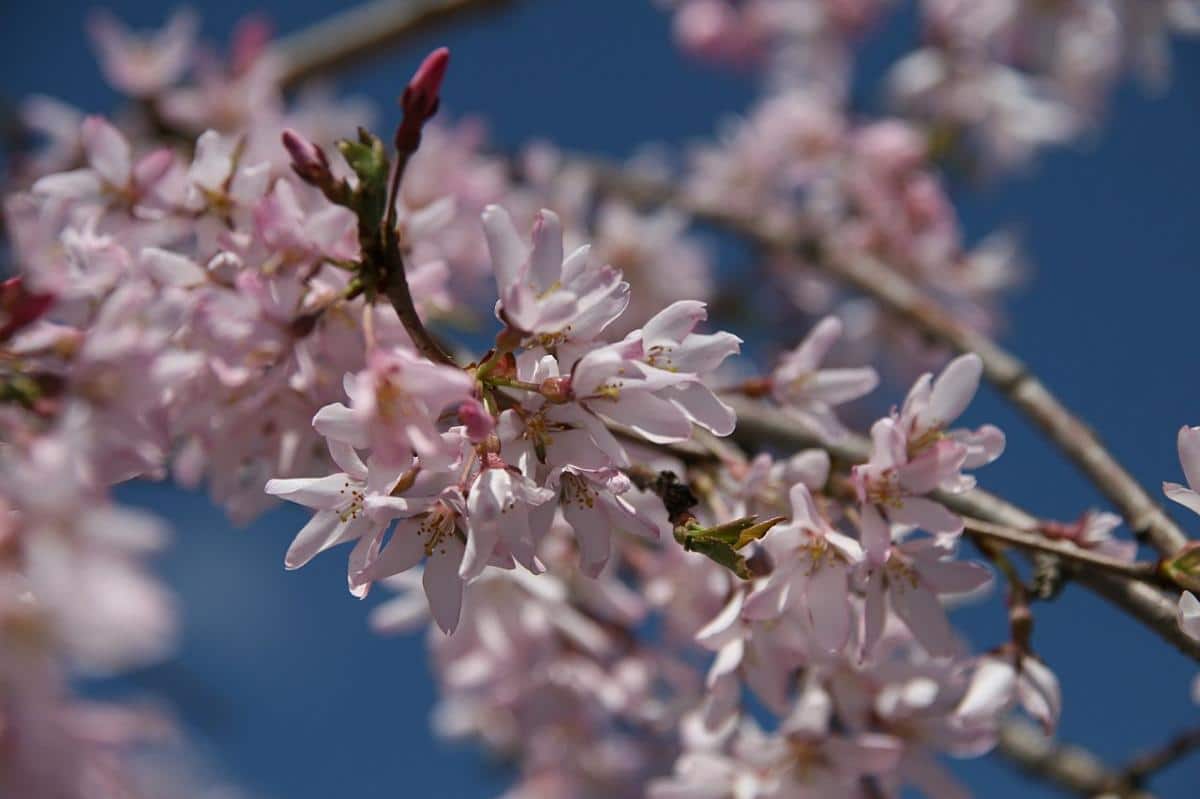
Image – Wikimedia/David J. Stang
It is a variety reaches a height of 4 meters, with green leaves that turn yellow, orange or reddish in autumn. It produces its flowers in the spring, shortly after resuming growth after winter dormancy.
It tolerates many types of soil, such as sandy and calcareous; It also withstands down to -26ºC without sustaining damage. Of course, it needs moderate irrigation and mild summer temperatures.
China Rose (Hibiscus rosa sinensis)

Image – Wikimedia/Forest & Kim Starr
The China rose is a deciduous shrub that can measure up to 5 meters high, although it is usually lower (maximum 3 meters). The leaves are oval to lanceolate, shiny green, turning yellow in autumn before falling. Its most beautiful thing are its flowers: they are 6 to 12 centimeters long and can be red, yellow or orange; single or double (double crown of petals). Some varieties with pink flowers are ‘Pink Versicolor’ and ‘Dainty Pink’.
It is a plant that must be kept in places with a mild climate, since it does not withstand moderate frosts (only down to -3ºC, and as long as they are punctual). It lives both in the sun and in partial shade, and in soils rich in organic matter.
Rosales (Rosa sp)

Roses are thorny shrubs that are grown in pots or in the garden, and can reach more than 1 to 2 meters, except vines that are more than 5 meters. These plants flower almost all year round, from spring to fall in mild climates, and do not require much care. If you are looking for varieties with pink flowers, you have for example the “Ballerina” which gives small but very fragrant flowers, or the “Carefree Wonder”, with semi-double dark pink flowers.
They do well whether you have them in full sun or partial shade, although I recommend placing them in a location where they receive at least 4 hours of direct sunlight. This way they will produce more flowers. Of course, they must be watered very often, because they are not drought resistant. As for the frost, they support up to -7ºC.
Taray (tamarix gallica)
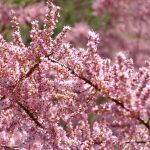
Image – Wikimedia/Javier Martinlo
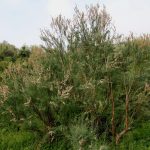
Image – Wikimedia/Zidat
Tamarisk is a deciduous tree or young tree that measures between 6 and 8 meters high. Its branches are long and flexible, almost pendulous, and although it has leaves, they are very small and scaly. In spring, and sometimes also in summer, it fills with white or pale pink flowers, which attract insects that are very beneficial to the garden, such as bees.
It is a highly recommended species to grow in places near the sea or the coast, since it lives very well in sandy soils and tolerates slightly saline soils well. Of course, it can be grown further inland, in well-drained soil and always in full sun. It resists drought and frost down to -7ºC.
Which of these pink flowering plants did you like the most?