
If I had to give any advice to all budding gardeners, it would be this: Whenever your plant’s leaves start to turn yellow, you should revise your watering schedule. And don’t stop there.
Also check the roots of the plant for signs of damage. Because? Yellowing is often a sign that your plant is not getting enough nutrients, which is often the result of root damage.
And this can be due to excessive watering, which leads to rotting of the roots, or even the burning of fertilizers.
Does this general rule also apply to bromeliads? Yeah! If your bromeliad is showing signs of yellowing, excess water is likely to blame.
The main causes of yellowing bromeliad leaves are excess water, pests, poor humidity regulation, aging and inadequate lighting. I describe how each of these affects your bromeliad and how to treat each cause:
Why are my bromeliad leaves turning yellow?
A bromeliad that turns yellow, you probably didn’t think of this when planting the bromeliad.
Instead, you’ve been looking forward to seeing the colorful bracts light up your space for months. So what could have gone wrong and how can you fix it?
Aging
 People have found ways to keep old age at bay. Everywhere you look there’s a new potion, injection, or even treatment to help you look and feel younger.
And while it works for humans, we haven’t yet found a way to slow plant aging (at least for the most part). So sometimes the yellowing you see on your bromeliad can mean that its life cycle is coming to an end.
But how can you be sure that this is the case? Simple! You check to see if the plant has new growth. New leaves should be green and healthy.
If they also look yellow and are not even fully developed, aging is not the cause in this case. Instead, you should consider the factors I’ve included below.
But if the yellowing only affects mature leaves that are about to drop, aging is to blame.
How to cure aging
There’s nothing you can do to age, it’s a natural process. However, you can defer it by supplying the plant with its essential needs.
But it only works for so long. Eventually the yellowish color will show through and you will have no choice but to accept it. If it’s a big problem, you can cut the yellow leaves with a sharp, sterilized knife.
It allows the plant to redirect its energy to the new leaves, thereby stimulating overall growth. I wouldn’t go so far as to prune the old leaves, but if that works for you, go ahead and cut the leaves.
You may also be interested in: How Big is a Bromeliad?
excess water
Like many other houseplants, bromeliads don’t like to stay in water for long. Although it is a tropical plant, it still has to adapt to constantly moist soil. So what can bromeliad water?
1) Water the plant when it does not need water
Bromeliads prefer moist rather than soggy soil. Ideally, you should only water it when the topsoil is dry.
And usually the plant can tolerate dry soil for a few days without wilting.
If you water the plant too often or too much, the roots will stay in the water too long, resulting in root rot and damage.
2) Using the wrong soil
Your choice of bromeliad potting soil should drain well. Otherwise, it will retain too much water, which is a recipe for root damage.
3) Inadequate drainage holes
Excess water will remain in the pot if you use a pot with clogged or inadequate drainage holes. And it’s only a matter of time before this humid environment becomes an ideal home for root rot-causing fungi.
Poor lighting also affects how quickly a plant uses water. Without adequate lighting, a plant will not take up much water because transpiration and evaporation rates are reduced.
And therefore, bromeliad can still turn yellow, even if you water the plant only when needed. I will cover lighting in a later section.
You may also be interested in: Why Is My Bromeliad Plant Turning Brown?
How to fix excess water
Since there are so many reasons that can lead to overwatering, let’s address each cause individually:
1) excess water
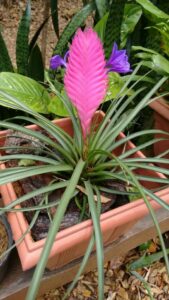 If you have overwatered the plant, water less. Water the plant only when the top centimeter of soil feels dry to the touch.
You can test this by digging into the potting soil and judging how dry or wet it is. I know this can be tricky, and I recommend getting a moisture meter to help you get an accurate reading.
2) The wrong soil
While bromeliad prefers well-drained soil, it should not drain so much that it leaves the plant without adequate moisture.
The easiest way to balance this is to mix one part sand with two parts peat. This allows water to pass easily and retains just enough to support plant growth.
A pot with few or clogged drainage holes
Always check your plant’s pot to make sure the drainage holes are not clogged.
Also use pots with enough drainage holes and make sure the pot is not submerged in water, this can lead to increased water absorption.
How to deal with a bromeliad with root rot?
If your bromeliad has suffered from root rot, you should inspect the severity of the damage by assessing what remains of the roots.
If most of the roots are intact, use a sharp, sterilized knife to cut off the damaged roots, then drench the plant in a fungicide.
Transfer the plant to a suitable potting soil (one part sand and two parts peat-based potting soil) and water the plant just enough to soak the soil. Then leave the plant in a place with enough light and give it time to recover.
In the future, stick to the correct watering schedule and, if in doubt, do not water the plant.
bad lighting
Did you know that lighting affects your plant’s performance? Your bromeliad needs light to produce food, which gives it the energy it needs to produce more leaves, grow and form bracts.
And in the absence of sufficient light, the plant cannot sustain such activities. It therefore uses the remaining energy to grow longer stems, resulting in leggy growth while seeking more light.
But such a plant will not show yellow leaves. Instead, it will have dark green leaves. A plant that receives too much light can burn from direct sunlight, reducing its ability to produce food. Then such a plant shows yellowing.
How to Fix Bad Lighting
The lighting needs of bromeliads are different. Some prefer bright, indirect light, while others do well even in direct sunlight.
Since this is a general article about bromeliads and not about your specific species, I will use a general rule.
If you notice your bromeliad showing signs of yellowing, consider this a sign that it needs less light to meet its needs. But if the plant shows signs of elongation in combination with dark green leaves, you need to increase the lighting.
For more information on lighting, see our lighting article. light requirements of bromeliads.
pest by pest
Pest attacks are not common on bromeliads. However, it should be borne in mind that pests attack plants with weakened immune systems.
For example, if a plant does not get enough light and cannot produce enough food, it is weak. And that makes it susceptible to pests like flatscale insects and aphids.
pest control
If you suspect your plant has suffered a pest attack, inspect it closely. Most pests cannot be seen with the naked eye, so you will need to use a magnifying glass to assess the plant.
If you notice signs of infestation, isolate the affected plant and spray it with a mixture of warm water and dish soap.
Keep in mind, however, that the best management method comes down to the pest in question. Scale, for example, is best treated with alcohol.
Here’s an easy way to keep pests from bothering your plant: Use neem oil on bromeliads. It will be some time before they call back.
But to be on the safe side, give your plant what it needs, which will boost its immune system.
If you like this article, check out our article on the 6 great benefits of a bromeliad at home.
low humidity
Bromeliad is a tropical plant and therefore grows best in warm, humid conditions. When the humidity falls below what is acceptable, the plant suffers as the leaves dry out quickly.
Initially the leaves respond by drooping and then browning at the edges. And if you don’t do anything at this point, they’ll start to turn yellow, allowing them to brown more before the leaves drop.
How to deal with low humidity
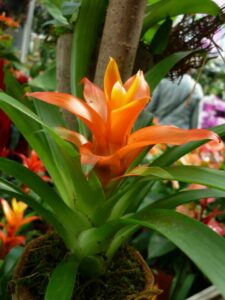 Bromeliad prefers humidity of at least 60%. And you can be sure:
- water regularly,
- Install a humidifier in the room,
- Leave the kitchen and bathroom doors open and
- Place a container of water near the plant.
These measures increase the rate of evaporation in the room, giving the plant more water vapor.
final thoughts
If you can master these techniques to prevent yellowing from becoming an art, your plant should only turn yellow due to aging. Happy gardening!