
If you can provide comfortable conditions for the dracaena, it will remain healthy with long leaves of a rich dark green color, uniform along their entire length.
Curled leaves are the most common problem you may face when caring for dracaena.
If suddenly the leaves of your dracaena curl, it is worth taking immediate action so as not to lose the plant.
To solve the problem, you must first identify the causes.
Dracaena curls due to low humidity or exposure to temperature extremes. Other causes include excessive light, improper watering, salt buildup in the soil, overdosing on fertilizer, lack of nutrients, insect infestations, and disease.
Now let’s dive into the details.
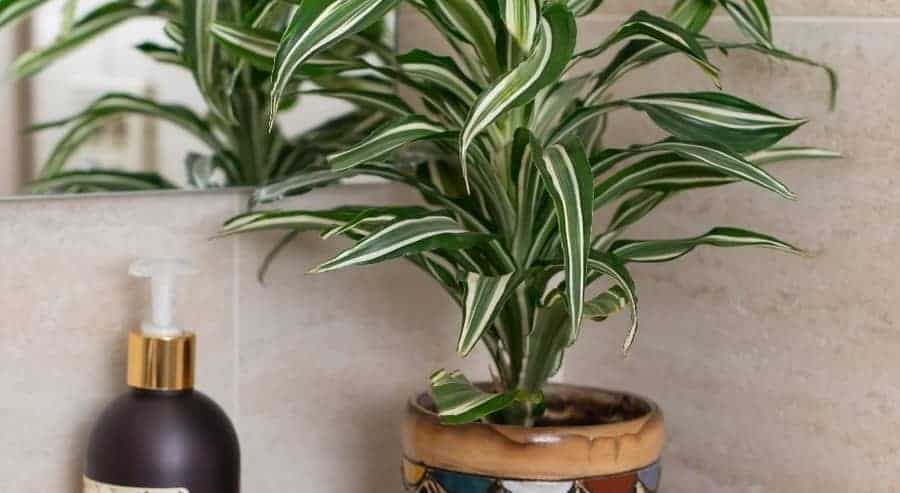
Dracaena leaves curl due to dry air
The edges of the leaves curl up and sometimes dry out. Twisting plant leaves is a self-defense measure because it reduces the surface area of the leaf and allows less water to evaporate.
This happens when the plant is in a place that is too hot or receives little water.
In this case, you need to water the plant until the soil is completely saturated, or immerse it in water and keep it. Choose a cooler location for your dracaena.
Dracaena leaves curled due to excess light
Another cause of curling dracaena leaves is too much light. If your dracaena is on the windowsill and exposed to too much direct sunlight, the leaves may curl.
Excessive light means higher temperatures. Photosynthesis and other physiological activities stop when the temperature increases.
So when the temperature increases, the plant uses all its water to cool its tissues by evaporation. As a result, the leaves curl due to lack of water.
Dracaena Leaves Curl by Heat
Too high air temperature negatively affects the physiological process of dracaena. If your indoor temperature is high in the winter due to the heater, your dracaena leaves may show curling symptoms.
Heat and dry air cause the plant to evaporate more water. Because that’s how it gets cold as a defense mechanism. As a result, the leaves of dracaena curl.
Dracaena leaves curl from excess water
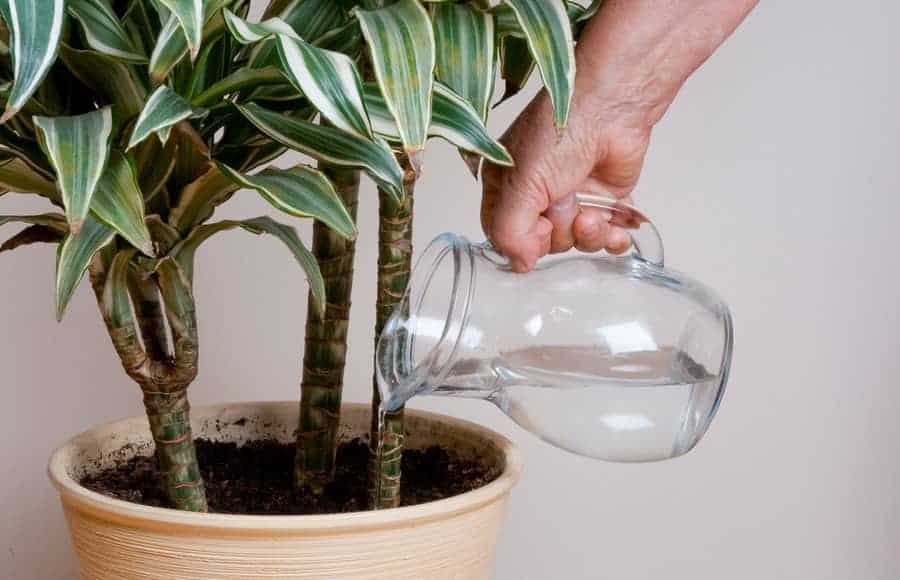
You need to water regularly to keep your dracaena healthy. but you have to run watering frequency depending on the season. Standing water in the pots is also dangerous for the plant.
Overwatering and standing water will cause root rot on your dracaena.
Thus, the root cannot absorb enough nutrients from the soil.
This makes the plant unhappy and results in curled leaves. Have a working drainage system.
Dracaena leaves curl due to lack of water
Another reason for curling the leaves of dracaena plants is lack of water. If you don’t water your plant enough, the plant will show symptoms such as curled leaves or dehydration.
You should let the soil dry out between waterings. Periodically check soil moisture. The top layer of soil 2-3 cm thick can remain dry until the next watering, but then you need to water the soil.
Salt buildup in the soil can cause leaf curl
Tap water contains other mineral salts that accumulate in the soil. You may know that salt makes nutrients unavailable to plants.
Thus, the plants do not receive enough nitrogen and phosphorus to thrive in their green leaves. Eventually the leaves begin to show symptoms such as curling.
To avoid this, try using filtered or settled water. Please keep normal tap water for 24 hours, then it is ready for use. Because during this time, salt minerals settle to the bottom.
Dracaena leaves curling from an overdose of fertilizer
Excessive nutrition will also lead to the loss of the normal state of the leaves. The plant shows the symptoms by rolling up the leaves.
An overdose of fertilizer is considered harmful to the plant. They can burn the roots, and the dracaena will not be able to supply nutrients to other parts.
Curling Dracaena Leaves Due To Lack Of Nutrients
Nutrients are necessary for your dracaena to grow properly. Nitrogen plays a vital role in blooming rich green leaves. Nitrogen is also needed, especially for the formation of green leaves. Lack of nitrogen causes curling of the leaves of dracaena.
To restore curled leaves, it is necessary to fertilize with liquid fertilizer with a high nitrogen content. It is useful to use water-soluble fertilizers for dracaena.
Fertilize your dracaena once a month in spring and summer. You can also split the dose twice a month.
You may also be interested in: Why Do Monstera Leaves Curl? (And how to fix it)
Dracaena leaves curl due to insects
Pests do not usually infect the dracaena, sometimes you will find scale insects, thrips, scale insects, aphids and spider mites to infest the plant.
Let’s get into the details of how to identify errors and get rid of them.
mealybugs
These are very small 2-4 mm insects, covered with a grayish or yellow shell with a waxy coating. They suck sap from stems and leaves, which turn pale, curl and dry.
You can eliminate this insect with an alcohol solution or soapy water. Dip a clean sponge or cloth in soapy water and clean the infected areas with it.
I have found neem oil to work very well against scale insects. You can also use commercially available insecticides.
Warn!
Watch out for insecticides. Before application, read the instructions and safety precautions.
thrips
Very small (1-2 mm) insect-forming colonies on the underside of the leaf plate. They suck the juice from the leaves. High temperatures and dry air are favorable conditions for this insect.
You can simply prevent thrips by pruning your dracaena. Prune the infected part of the plant to control the attack of thrips on your plant.
You can also opt for a mild insecticide like neem oil or soapy water. These work great and are organic ways to control bugs.
spider mite
A small reddish-brown insect does not exceed 0.5 mm. You will find the affected parts tangled in a barely perceptible web. This is a clear indication that your dracaena is infested with mites.
You will eventually find leaf chlorosis and also brown or yellow spots. Plant growth is slowed down and more susceptible to disease.
In addition, the mites themselves are carriers of a number of diseases.
You can treat your dracaena infected with spider mites by treating it with warm soapy water (about 50°C/122°F) and then spraying with acaricide.
As before, neem oil is a great option for these soft-skinned insects.
mealybugs
The most common type of harmful dracaena. These insects love plant sap. Collect on a tray and suck up the juices.
Then the growth of the plant stops and the leaves curl up. It is quite easy to find them on the leaves. These insects are white, they also leave a powdery white coating on the dracaena.
You can remove this type of mealybug manually. Again, soap solution remains one of the main insecticides needed to control soft-skinned mealybugs.
Spray soapy water on infected dracaena leaves. Repeat the procedure every 14 days.
Important!
You can significantly reduce insect infestation by maintaining a certain level of humidity in the room.
Diseases are the most common cause of curling.
Various bacteria, fungi and parasites become the causes of Dracaena diseases.
Among them, fusarium leaf spot and root rot are the most common diseases you will encounter on your plant.
If you do everything correctly and create optimal conditions for the dracaena, your dracaena will be happy and healthy.
Now we know the causes and solutions of curling dracaena leaves. Better to prevent it from happening. Let’s find out how to avoid this.
Turn your Dracaena Marginata into a unique masterpiece with my guide on maintenance, folding and shaping techniques. Don’t miss it; read it now!
Prevention
You need to ensure that your dracaena is constantly taken care of. This way you prevent your plant from being affected by diseases and pests. Here is the step-by-step procedure:
- Place your dracaena in a location with bright indirect light;
- Excessive sun exposure can damage the leaves of the plant;
- Dracaena grows successfully in shady conditions;
- You should maintain moist soil with a high organic matter content with a pH of 6.0 to 6.5;
- You should use settled water when the topsoil is dry.
- When transplanting your dracaena, you should choose a pot 3 cm wider and 5 cm higher than the previous one.
- Regularly wipe the dust off the leaves. spray the plant from the spray bottle and wipe the leaves with a damp cloth. Proper watering is one of the most important points in the care of dracaena.
conclusion
Now you know why dracaena leaves curl up, and therefore dry up and fall off. In fact, there are many reasons for a plant to be affected.
Saving the plant is easy if you follow the basic rules of caring for dracaena. I hope this article will help you in this difficult task.
Sharing is caring!