
If you purchase an item through links on this page, we may earn a commission. Our editorial content is not influenced by commissions. Read full disclosure.
If you can’t get enough of the look of tulips, how about a tree covered in tulip-like flowers? Growing tulip poplars, also known as tulip trees, allows you to add fast-growing shade and color to your garden.
These magnolia relatives have bright yellow flowers that resemble the familiar ground tulips that appear each spring.
Native to North America, these trees combine massive scale with delicate beauty. Ready to know all about them? Let’s go!
Varieties of tulip trees

Tulip trees are not related to tulip flowers (tulip spp.) and are part of the magnolia family (Magnoliaceae).
There are two species of tulip trees: the Chinese tulip tree (Chinese Liriodendron) and American tulip tree (L.tulipifera). Chinese tulip poplars reach about 130 feet tall and are less hardy than the native North American tulip tree. Native to Asia, they are cultivated in North America.
American tulip trees grow up to 190 feet tall and are native from northern Florida to New York and as far east as Louisiana.
There are many cultivars of both that you can commonly find in nurseries:
- Ardis (L.tulipifera ‘Ardis’): compact growth to only 60 feet
- Majestic beauty (L.tulipifera ‘Aureomarginata’): shorter than the species with variegated yellow and green leaves
- Arnold (L.tulipifera ‘Arnold’): Early flowering with a columnar habit
- Fastigium (L.tulipifera ‘Fastigiatum’): Narrow form that is only 40 feet tall
- Contortion (L.tulipifera ‘Contortum’): Features twisted leaves with wavy margins.
Tulip trees are easy to recognize because they are among the tallest trees in eastern North America and their narrow, tall, green buds open into yellow, orange or white tulip-shaped flowers. You can expect the trees to bloom in spring and summer.
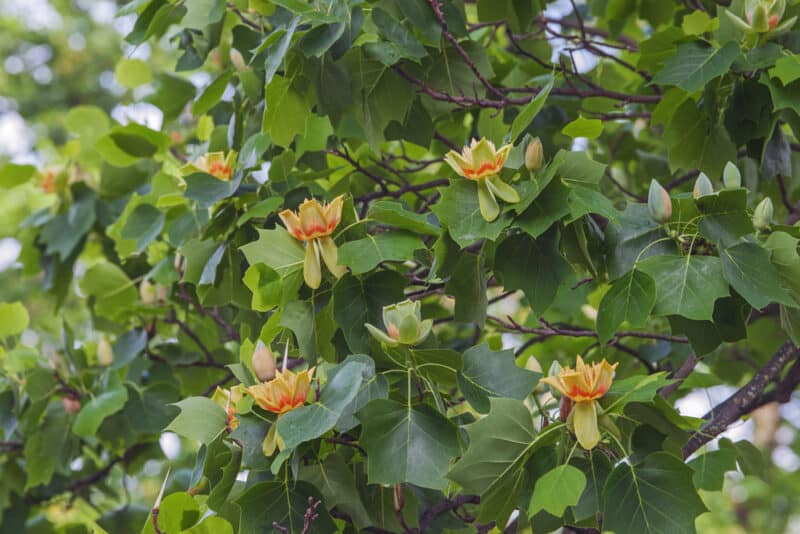
During their growing season, you will see lots of wildlife on the flowers, including butterflies, bees, and birds. Flowers are pollinator magnets. So, if you have young children, you can go butterfly watching with them when your tulip tree is in bloom!
The bark and roots have been used throughout history as a tonic and edible. Native Americans made beer from the roots and harvested the sap. You can also sip the abundant nectar from the cup-shaped flowers.
The leaves are large and can grow up to eight inches long. They have an unusual shape, resembling a heart or a bit square. The leaves are lobed with four horns.

As winter approaches, the leaves turn pale yellow before falling. Tall, graceful trees provide architectural interest even when bare. Growing tulip poplars means you get four season interest in your garden.
Spread
You have several options for propagating tulip poplars. You can buy a live or bare root plant from a nursery or online or propagate cuttings or seeds.
Grow cuttings
It is easy to successfully grow tulip poplars from cuttings.
Tulip trees should be propagated via softwood cuttings. Take a soft young branch from last year’s growth and cut off the five to six inch tip. Dip the tip in rooting hormone and remove all but the top two leaves.
Place the cutting in potting soil in a six-inch pot.
Cover the cutting in the pot with a plastic bag or other clear lid to retain moisture. Place the jar in indirect sunlight and leave it for about a month.
After four weeks, you can test the roots by tugging lightly on the cutting to see if it resists. When you feel the roots are established, you can transplant the plant into the ground after the last expected frost date and start growing your new tree!
Seed propagation

It is possible to propagate tulip trees with seeds, but it takes a little longer. Harvest the samaras (winged seeds) in the fall when they are brown and dry. The seeds are housed in long, pointy fruits that wildlife love, so grab them before the squirrels do.
Leave the fruits to dry, then peel them and remove the seeds. Store the seeds in a cool, dry place like a refrigerator or an unheated basement.
About five months before the last expected frost date in your area, place the seeds in moist sand and put them in the refrigerator. Keep the sand moist for the next 60-90 days.
Plant the seeds in potting soil in a six-inch container and moisten the soil. Keep the soil moist and place the containers in a sunny, indirect location. Germination takes a few weeks.
Harden off the seedlings and plant them in the ground after the last frost. Cheer! You grow tulip poplars from cuttings!
Plant tulip trees
The ideal position for tulip trees is a place exposed to the sun and protected from the wind. Remember that this tree grows quickly, so you don’t want to plant the tree in a small corner.
Plant after the last expected frost date in the spring when the ground can be worked.
Look at the root ball and dig a hole that’s twice its size to provide extra room for growth, but make sure it’s firmly seated in the ground. If you are planting a bare-rooted tree, soak the roots in water for a few hours before planting.
Then place the root ball in the ground and cover it with soil mixed with well-rotted compost. Water well to keep your growing tulip poplars happy.
Caring for and growing tulip poplars

Soil will make or break the quality of your tulip tree. In the right soil, the tree will grow quickly but not be weak, and you will have lots of happy flowers. The tree will be stunted in depleted or poorly drained soil, and it may not bloom well.
You need slightly acidic, well-drained soil. pH levels should be between 5.0 and 8.0, with rich, loamy soil preferred. However, they can tolerate some sand or clay, but the soil must be well-drained or the tree may suffer from root rot.
Fertilize your tree four times a year during the growing season, beginning in early spring. You can use slow release stakes or liquid fertilizer. You can find both liquid fertilizer and specially designed tree stakes. Jobe’s fertilizer spikes, for example, are perfect for the job.
Fertilizing young trees is especially crucial because they need extra nutrients to grow. You should always apply fertilizer to an older tree, but it’s not as vital, so if you miss a year or two, it won’t ruin everything.
Water and temperature
Pay attention to soil moisture when you first plant. Young trees are more susceptible to drought. As the tree matures, you don’t need to be so diligent. The tree will send out deep roots to find moisture.
Be prepared to take extra time to water your growing tulip poplars when summer begins.
A sign that your tulip tree needs water is if the leaves start dropping prematurely. If you notice the leaves dropping before winter, it could be a sign that you need to increase your watering schedule.
Otherwise, just use a moisture meter to check the moisture level in the soil. Water when the top three centimeters are dry.
USDA hardiness zones 4 through 9 are ideal for this plant.
Prune the tulip trees
Pruning is essential for the health of your growing tulip trees. These trees grow quickly and can quickly outgrow a space. Pruning helps you keep the tree at an appropriate height and allows you to keep the canopy open and in proper shape.
The branches of tulip trees can break in strong winds, so take the time to prune them. If you don’t have enough time for pruning, you can always consider hiring a service to come and take care of your trees. Don’t skip it, or you’ll find broken branches after the next windstorm.
You should remove dead or broken branches when you spot them. Winter and early spring are good times to prune your tree because the growing season hasn’t started yet, and you can clean them up during the warmer months.
Common diseases and pests of tulip trees
Fortunately, growing tulip trees are resistant to most pests and diseases, but some problems can still occur with this plant. Stressed trees are more susceptible to problems. For example, pests can attack the plant if the tree does not receive enough water, nutrients or light.
Yellow poplar weevils
Yellow poplar weevils (Odontopus calcatus), or sassafras or magnolia weevils, are small, blackish-brown insects commonly found on tulip trees. These pests leave large holes in the leaves and can burrow into the leaf tissue.
Use an insecticide to prevent or treat these pests and make sure the tree is properly pruned.
aphids
Aphids suck plant sap and leave behind a sticky honeydew that will drip onto your car, furniture, or anything else under your tree.
A large infestation will turn your tree’s leaves yellow and may cause them to fall off the tree.
Wingless tulip aphids (Illinoia liriodendri), in particular, love tulip poplars. Go to our guide to find out how to deal with these pests.
Tulip scale
Tulip scale (Toumeyella liriodendri) is not a disease but a soft scale pest.
A stressed plant will compound the damage these insects can cause, so you must prioritize the health of your growing tulip trees. Learn how to manage scale in our guide.
Beyond these pests, growing tulip poplars is quite simple. keep your tree
Was this article helpful?
Yes No ×
We appreciate your helpful feedback!
Your response will be used to improve our content. The more feedback you give us, the better our pages will be.
Facebook pinterest