
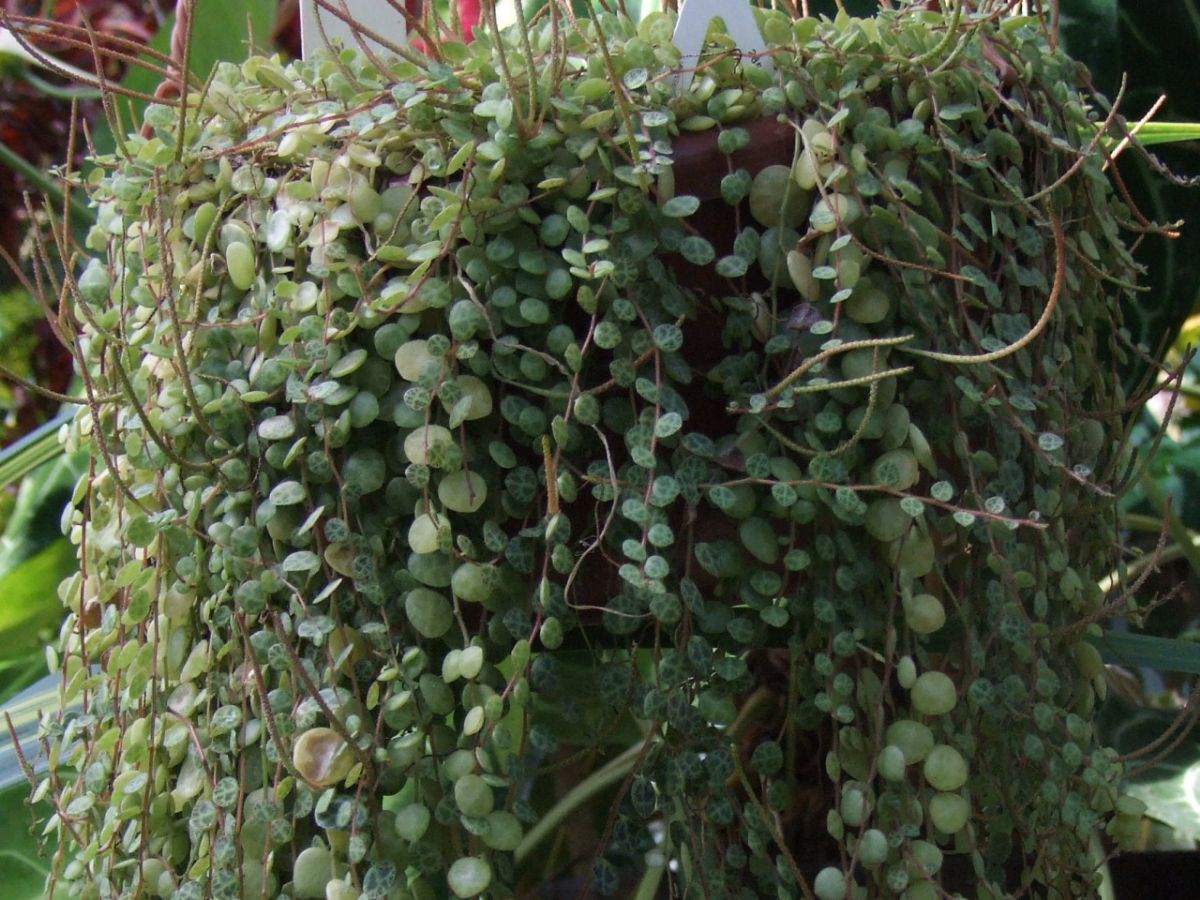
if you are looking a houseplant that has an exotic touch and at the same time is not too difficult to maintain, then Peperomia prostrata is what you have been looking for.
It’s one of the most attractive succulents and gets a lot of attention for its shape (and maintenance). Want to know more about her? So keep reading.
How is Peperomia prostrata
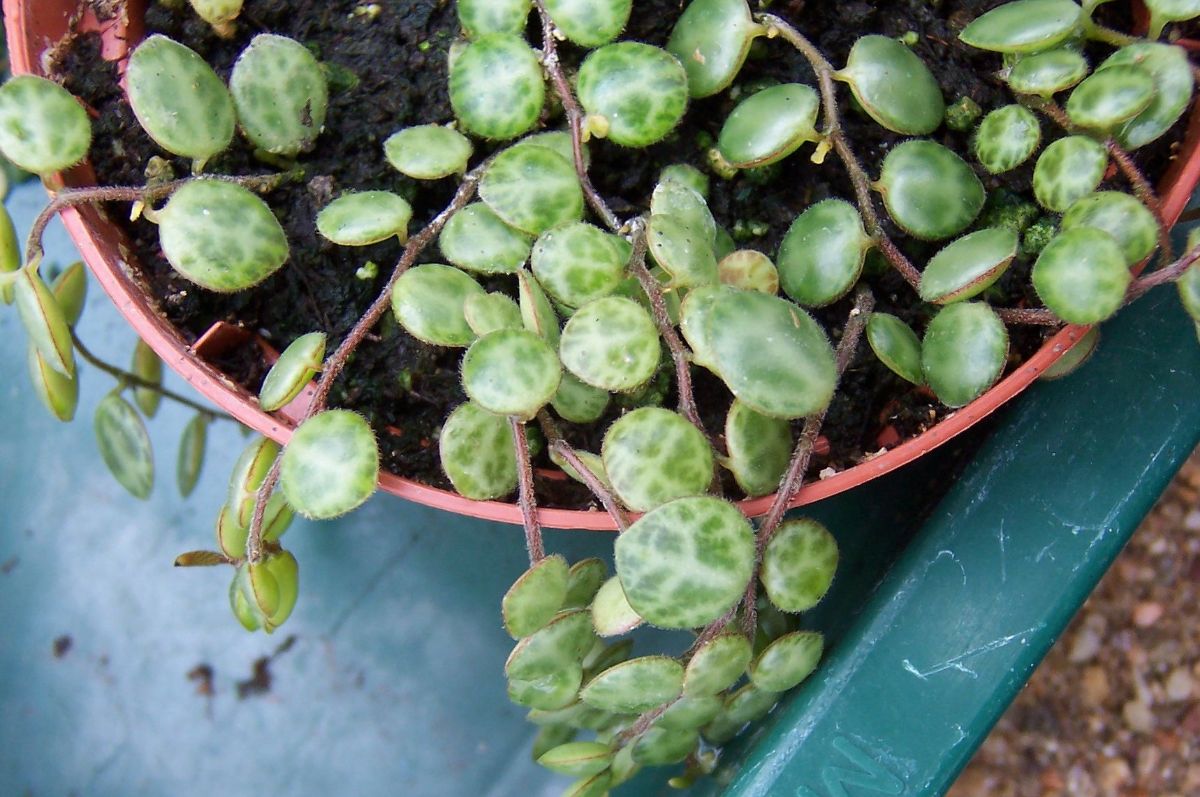
Peperomia prostate is considered a creeping plant. Its natural habitat bears little resemblance to that of succulents, in particular because, although it is native to Central and South America, it lives in humid forests and likes humidity. In fact, it usually grows leaning on the trunks of trees, which is why it is said to be an epiphytic plant.
Physically we have a plant that produces long green or cream stems from which the leaves come out, they are round and of different sizes. But the most beautiful thing about the plant is undoubtedly the pattern of thesebecause it has several shades of green (or green and white) that attract a lot of attention.
It is quite leafy, and for this reason when kept in a pot it is common for it to end up covered by those little stems that will cascade down with the “pieces” of leaves similar to the skin of a watermelon. .
Another of the names by which the plant is known is “chain of turtles”, because it is said that the design of the leaves resembles the shell of these.
And yes, if you are wondering, Peperomia prostrata is flowering. Although the flowers are beautiful, the truth is that the leaves are more so. Even so, these flowers are reddish (more brownish) in color.
Peperomia prostrata treatment

Have you ever fallen in love with Peperomia prostrata? Without a doubt, it is a plant that when you see it you want to have it at home. And being like a succulent, it’s easy to care for, although it does require some care for it to thrive.
Here we summarize the most important of all.
location and temperature
The ideal location for Peperomia prostrata is, without a doubt, outdoors, as long as you live in an area with mild winters and hot summers. He loves the sun! Of course, don’t put it where there is direct sunlight or where the environment is very dry because it won’t survive.
It is best to place it in a place with partial shade and plenty of indirect light.
You can also place it inside the house, but in this case look for the best place where there is humidity (a kitchen, a bathroom…) so that it gets the habitat it needs. he needs.
As for the temperature, the ideal for this plant would be between 18 and 25ºC. Inside the house it is not difficult to offer this temperaturebut outdoors it can be, especially in the summer, so a humidifier or similar will be needed to control the humidity.
Substrate
As Peperomia prostrata is a plant that needs moisture, and to keep the soil that way, you will need to plant it in soil with good organic matter. Bet on a mixture of peat with coconut fiber, the proportion being respectively 70-80 / 20-30%. This way you will get a light substrate.
As a tip, make sure the peat is a little acidic, he’ll love it.
Irrigation
As we have already told you, Peperomia prostrata is a moisture-loving plant. It is therefore essential to keep it in the substrate. Now, there’s a fine line between moisture and excess. And if you don’t keep the balance the only thing you get with it is that it rots (you’ll notice the leaves start to turn transparent like they’re soaked and they all start falling off until that the plant dies).
In fact, when we think of humidity, we tend to think that Peperomia prostrata needs an always humid substrate and the truth is that this is not the case. What you need is ambient humidity.
Therefore, if you have it outside, you can water it 2 to 3 times a week in spring and summer; while in winter one a week is enough.
Inside the house, you may need to space out the waterings a little more.
Subscriber

Occasionally, especially if the plant has been in the same substrate for a while, you can add a little fertilizer to give it more nutrients. A very enriching for this plant is liquid humusthat you can put it in the irrigation water and apply it.
Of course, only use it in spring or summer.
Now, if you see that the plant has yellowish leaves and it has not grown for a long time, then resort to a fertilizer rich in nitrogen because it requires it.
Size
Peperomia prostrata is not really a plant that needs pruning. But, to keep the stems the same height, many cut them to make everything even. Of course, keep in mind that these cuts can be used to get new plants.
Plagues and diseases
As an exotic plant that is, in addition to being succulent, Peperomia prostrata is a plant susceptible to pests. Specifically, those that can cause the most damage are scale insects. If you see them, we recommend that you spray the plant with Neem oil and potassium soap, and do this at least once a month to prevent them from approaching.
other option than this also works great using diatomaceous earth which you can mix in small proportion with the plant substrate (or place it in the top layer).
Multiplication
Finally, in terms of propagation, we must tell you that this is something that we recommend you do as soon as you buy your plant (if it is large, of course). And that’s it, being so picky, you can easily run out.
First, cut some leafy stem cuttings. Reserve them and look for an airtight container. Put the substrate there as a base and on top a few fine stones. Spray to wet everything well, then place the cuttings on the stones. You don’t need to plant them, just put them on.
Spray again and reseal so that no moisture escapes.
It must be placed in a place that gives it light, but without overheating. Within a few weeks they should be rooted and ready to transplant into pots.
Do you have questions about Peperomia prostrata?