
Citrus fruits like the orange tree are nutrient eaters. As they are usually grown on calcareous soils, it is common for them to suffer from micronutrient deficiencies after germination (most of them require acid pH soils), and it is very common to detect a orange tree with yellow leavesespecially in the budding season, after winter emergence.
However, the origin of chlorosis in the orange tree can be due to several factors, including elements such as macronutrients (nitrogen, magnesium or sulphur) and micronutrients (the most common, iron, manganese or zinc), or the sum of all. In this article, we will reveal how to detect the cause of yellowing leaves on orange trees and fix it quickly.
For this correction, you can use magnesium nitrate or magnesium sulfate.
read more: role of nutrients in citrus fruits.
Orange tree with yellow leaves, who is behind?
The main micronutrients in high demand for orange trees are iron, zinc and manganese. Precisely, this triad of microelements behaves very badly in soils with a pH above 7.5, which is very common in Mediterranean soils and in the southern zone, where limestone and carbonates predominate, the surface on which are intended most of the citrus growing in Spain. .
Especially iron, a metal which, under alkaline pH conditions, lose its solubility and changes from the ionic state Fe2+ (ferrous) to Fe3+ (ferric), practically insoluble and not resorbable by the roots of plants. Faced with this, we resort to the use of chelates or complexes that increase the pH range in which the mineral remains stable and assimilated by the plant.
For this reason, it is common for yellow leaves to appear on orange trees, where they often also add macronutrients such as nitrogen and magnesium, causing a very obvious chlorosis in any type of citrus fruit.
Macronutrient deficiency: nitrogen and magnesium

We also cannot forget a frequent cause of yellowing of the leaves of orange trees, and that is the lack of nitrogen or magnesium as major macronutrients. The nitrogen deficiency It is common early in the season because it has spent the whole winter without nutrition and the nitrate nitrogen is easily washed into the soil. Chlorosis due to lack of nitrogen produces smaller leaves and loses its original greenness, spreading throughout the plant.
In general, the orange tree is weak and not very vigorous, and it is easy to identify and correct, because nitrogen, especially the nitric and ammoniacal form, is very well absorbed by the roots, and the urea form, very well by leaves . An orange tree lacking in nitrogen responds very well and the deficiency is corrected in a few weeks when foliar treatments are carried out with this element.
In reference to magnesium deficiency, the visual symptoms of leaf yellowing can be confused with those of zinc or manganese. However, the magnesium initially creates inverted V-shaped chlorotic borders on the formed leaves. It’s the main difference: Magnesium chlorosis of adult leaves initially and symptoms of zinc and manganese chlorosis of new leaves, mainly.
To differentiate magnesium deficiency from zinc and manganese, which are obviously very similar, we will use the following trick:
- Deficiency in new shoots and young leaves: associated with zinc and manganese.
- Deficiency in adult leaves: associated with magnesium.
The presence of yellow leaves in orange trees is usually more common due to the lack of zinc and manganese compared to magnesium.
Micronutrient deficiencies: iron, zinc and manganese
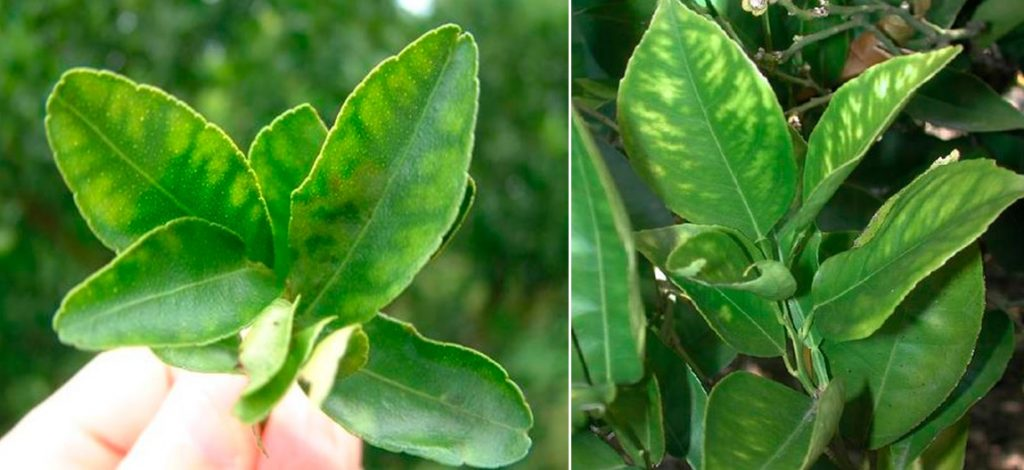
The zinc and manganese deficiency This usually goes hand in hand, as they behave very similarly in soil, exhibiting low absorption due to antagonisms with calcium complexes, carbonates and limestone.
Therefore, it is necessary that in soils with high pH (alkaline), zinc and manganese are protected in form of chelates or complexesthe most common and commercial being the EDTA chelate (for zinc and manganese) within the chelates or the gluconate or lignosulfonate for the complexes.
The appearance of yellow leaves in orange trees caused by zinc and manganese deficiency it is common after budding and stage after fruit set. This deficiency that causes the orange tree to have yellow leaves is detected relatively easily because an inverted v forms on the orange leaf, with irregular chlorotic spots on both sides of the leaf, especially on young leaves.
However, the correction of this deficiency is not as fast as in the case of nitrogen or magnesium, so it requires patience and continuous treatment.
iron deficiency

As for iron, this essential micronutrient has a very low mobility in soils that are also calcareous, which is why its application by EDDHA chelate is always recommended. The chlorosis of this microelement is much more evident, covering almost the entire leaf in yellow but respecting (only in the early stages) the green veins. This chlorosis initially occurs on leaves and young shoots.
The triad of micronutrients (iron, zinc and manganese) can also be corrected by foliar applications, but in this case we recommend the use of complexed trace elements to facilitate their assimilation by the leaf.
read more: keys to caring for a tangerine in a pot.
Other Causes of Yellow Leaves in Orange Trees
In many other cases, the origin of a yellow-leaved chlorotic orange tree may be due to other factors not related to nutrition and correction with fertilizers.
Yellow leaves due to lack of light
The absence of light in citrus fruits is the cause of a common and generalized chlorosis throughout the tree. We are talking about a tree with high light needs and even direct sun exposure, so we can think about what nutrient we will use to correct the yellowing of the leaves of our orange tree, but we will not solve anything.
In an orange tree planted in the garden, it is rare, unless we have done our homework badly, because should always be grown without any shady obstacles (large trees, houses, roofs, etc.).