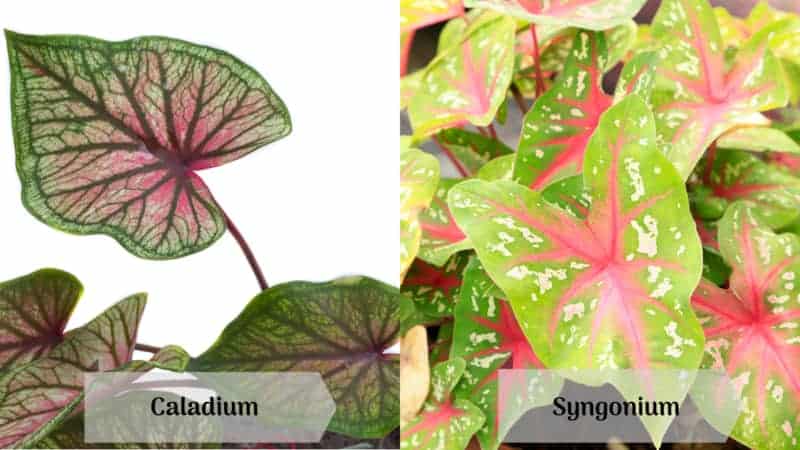
If you are wondering if you can take Caladium (Bicolor Caladium) or a Syngonium (Syngonium podophyllum), then this article will give you a guide on how to spot these plants to find out which ones are living rent-free in your home.
The main difference is that Caladium is grown from a tuber and Syngonium, on the other hand, is grown from adventitious roots and is more tolerable in its environment. Compared to Syngonium, caladium can be brighter in color and have different distinctive leaf shapes.
Are caladiums and syngonians the same plants?
Caladium and Syngonium belong to the aroids family. Considering they’re cousins, it’s no surprise that they look a lot alike.
Caladiums (Latin) Bicolor Caladium) are commonly referred to as the Heart of Jesus, Angel’s Wings, and Elephant’s Ear.
syngonium (Latin) Syngonium podophyllum) synonyms are arrowhead, houndstooth, and five-toed vine.
Caladium vs Syngonium: Differences
When it comes to very similar plants like this, finding out their differences is crucial.
Even though some details may not seem so important, believe me, they are! To grow a healthy seedling, you need to learn as much as you can about it.
Shapes, colors and varieties of foliage
Caladium plants produce leaves from spring to fall and rest through winter.
This process should not be confused with wilting, as it is a natural phenomenon that many tuberous plants experience.
Don’t worry, the leaves will grow back in the spring! They contain a ghost of very bold colors.
On the other hand, Syngonium has softer colors, usually rendered in a gradient.
According to research, caladium leaves have the highest level of diversity compared to other popular aroids, such as alocasia, philodendron, and even syngonium.
They usually come in one of three types: fancy, strap, and spear.
Fancy leaves are heart-shaped with three main veins arranged in an inverted Y shape.
These varieties are easily recognizable and the leaf size can reach up to 30 inches (76 cm). Therefore, these caladiums are usually planted alone.
I have the Red Flash variety in my living room and it is one of the most popular caladium varieties.
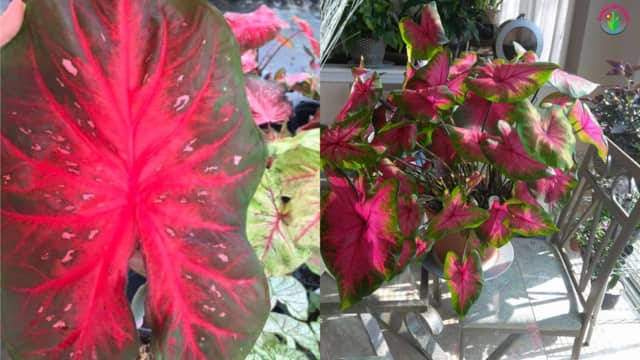
Dark red veining contrasts with dark green margins on 15 (38cm) long leaves.
The strip leaves are narrow, lance-shaped and have only one midrib. The petiole is attached to the edge of the leaf.
The leaf is much smaller, so you can plant several plants together and play with the colors.
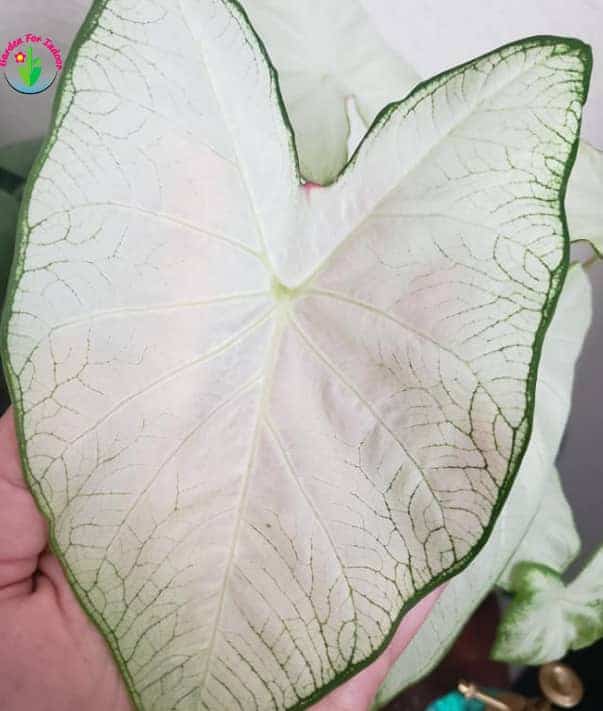
My favorite strain is Florida Fantasy. The leaves are brightly colored with a white background, green margins and striking purple veins.
Spear blades have a lanceolate shape, something between the shape of a heart and that of a belt. They are usually 20 cm long.
The most famous representative is the Lance Whorton variety with crimson veins, green edges and a hint of white dots. This tray paint palette can be grown individually or in batches.
Syngonium leaves are lighter in color and do not show as much variation as caladiums.
Since they don’t rest in winter, you can expect those beautiful leaves all year round.
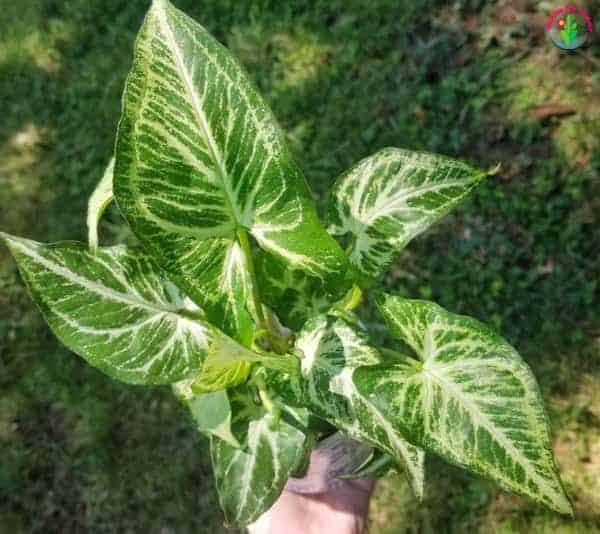
Juvenile foliage is more arrow-shaped, while mature plants have a five-lobed shape, hence the name five-fingered.
This shape changing activity compensates for the dullness of the colors and it is always interesting to observe the transition process.
The youngest leaves can be between 7.5 and 17.5 cm long and mature leaves can reach almost 19 cm in length.
The middle petal is surrounded by 3 to 11 elliptical leaflets, depending on the maturity of the plant.
They are all connected to the stem by petioles which can reach nearly 38 cm in length.
My favorite varieties are the Pink Splash Alllusion with green leaves with pink highlights and the small Glo-Glo Syngoniums with white veins on a green background.
Structure
Caladiums come from underground tubers. A tuber is a modification of the plant stem better able to store energy in the form of protein.
This organ ensures the rest of the plant during cooler days and rises when temperatures are favorable for growth. This is why the plant can reach its full size in one season!
Syngonium is an evergreen vine plant. Unlike caladium, syngonium grows from juvenile adventitious roots.
Young stems are bluish green, hairless and soft, while mature stems tend to harden and turn brown.
Size: Sleeper vs Climber
For me, this is the main difference between Caladiums and Syngonium. Caladiums do not grow as tall, although some cultivars can reach 50cm.
They usually grow to around 14 inches (35 cm) and then spread wide. Syngonium grows on vines, which means they like to climb.
If you keep the plant healthy long enough, it will climb any pole you place near it.
Only the sky is the limit! Some people use plastic ladders or poles for vines, but I prefer peat vines with bamboo cores.
They are recyclable and eco-friendly replacements that don’t take up much space.
Reading: Cut or Divide
Caladium’s rest period begins in the fall. The leaves fall and you are left with only the tuber.
This is the perfect time to section off mature tubers, with at least one bulb in each section.
Clean and store in sawdust or sand at temperatures above 55°F (13°C).
These tubers are now ready to be planted in subsequent growing seasons, so you have even more Caladium plants!
Syngoniums are even easier to propagate. I like to do it this way: find a new shoot with one or two leaves.
A few inches below the leaves should be a small bump called knots. Cutting an inch below the knots is fine.
Put your new plant in a pot of compost mix and keep it warm. Hooray, you now have at least two Syngonium plants!
Habitat
Syngonium and caladiums are native to tropical and subtropical forests in Central and South America, so moist environments with well-drained soil are especially good for them.
Since caladiums are grown from a tuber or bulb, they are more sensitive to low temperatures.
They need a temperature of at least 21°C to grow tubers, while Syngonium sprouts can germinate at a little lower temperature.
Cultivation of caladiums and syngonians: which is easier?
Each plant has different needs. To grow healthy, certain conditions must be met.
I will stress the importance of soil, water and sunlight exposure as you, the gardener, can directly influence these factors.
soil and water
Caladium does not require much attention. It is important to keep the soil moist at all times as it is a tuberous plant.
Be careful not to overwater the soil and leave it soggy. Larger plants can be watered 3 or more times per week, depending on your region.
As for watering your syngonium, it’s a good idea to keep the soil moist. Watering the plant 2-3 times a week should be sufficient.
If you live in a dry area, I recommend placing pebbles in the water under the pot.
In this way, the water slowly evaporates into the ground. The syngonium, however, is much more insensitive to drought than the caladiums.
Browning at the edges, usually on some larger leaves, is a common sign of lack of water.
Keep in mind that caladium and syngonium plants grown in small containers require more water, as they don’t have enough soil to retain moisture.
They share almost the same soil preferences. Caladiums like well-drained, slightly acidic soil.
I recommend a mix of compost and perlite in an 80:20 ratio. You can also add orchid bark for drainage!
Sun exposure
Caladiums are sensitive to light exposure. They can’t stand direct sunlight and they show it with brown spots on the leaves.
Its leaves are almost translucent, usually thinner than Syngonium leaves, so care should be taken.
Keep them in the shade and in indirect sunlight (away from windows). Syngonium is very flexible with regards to light exposure.
They don’t need a lot of sun and can be grown in shade, which is ideal for indoor gardens.
However, if you want to keep it in a dimly lit area, I recommend getting a variety with greener leaves, like Mini Alllusion. The greener they are, the higher the concentration of sunlight absorption.
Varieties like Glo-Glo have a lot of white on their leaves, so they can be placed in brighter, indirect light. Never expose them to direct sunlight as this may burn their fine leaves.
Similarities Between Caladium and Syngonium
Despite their differences, caladium and syngonium have many more properties in common.
Both are native to rainforests, so they prefer moist areas. I like to put their pots next to each other because they need the same amount of light.
As for watering, I like to water mature plants at the same time. Young people get special treatment.
comes from the same aroids family, they share common parasites and diseases, which means they also share the same remedies.
Finally, both count as monoflowering plants. Each petiole can produce only one flower, but most modern varieties do not even produce flowers.
Even if they do, experienced gardeners tend to cut them right off. This way most of the energy and nutrients go directly to the leaves.
Last words
Caladium and Syngonium plants are evergreen trees that decorate your home with colorful leaves. I always recommend them to both novice and expert gardeners.
It is important to know their differences, even if they seem very similar at first glance.
Caladiums are more sensitive to sun, water and temperature exposure, while syngonium is more forgiving.
This sensitivity is the result of growing the caladium plant from a tuber. Syngonium grows from a root and likes to spread over vines; a foam stick is highly recommended to ensure healthy climbing.
Despite the differences, they still come from the same family of dried plants. I like to keep them together in the same room with indirect sunlight. This way, you both get the attention and admiration you so wholeheartedly deserve!
(Source: Research Portal)