

Did you know there are plants that don’t need to be planted? Who lives “from the sky”? Called tillandsias, or air plants, they are becoming very famous and more and more people are taking notice of them. For this reason, in this case, we want to focus on a specific species, tillandsia ionantha rubra. Do you know how it is?
Its characteristics, the care you should give it and some curiosities is what you will find out if you keep reading. Dark?
How is tillandsia ionantha rubra
Source: Plants of the Little Prince
The first thing you need to know about tillandsia ionantha rubra is that it is a perennial. It is part of the Bromeliaceae family and, unlike other plants, this one is actually “aerated”, meaning that it does not need to be planted in the ground. One could say that it is a little “parasitic” since It usually grows on other plants or trees. But, unlike parasites, it does not feed on thembut only use them to stay hooked.
Its natural habitat is Nicaragua, although it can also be found in Central America.
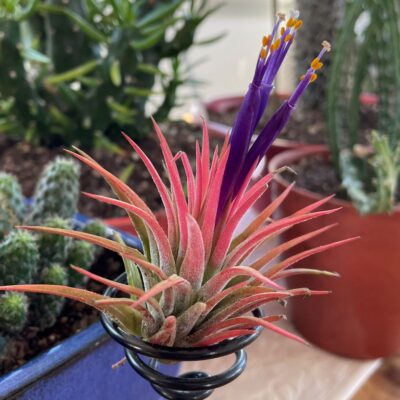
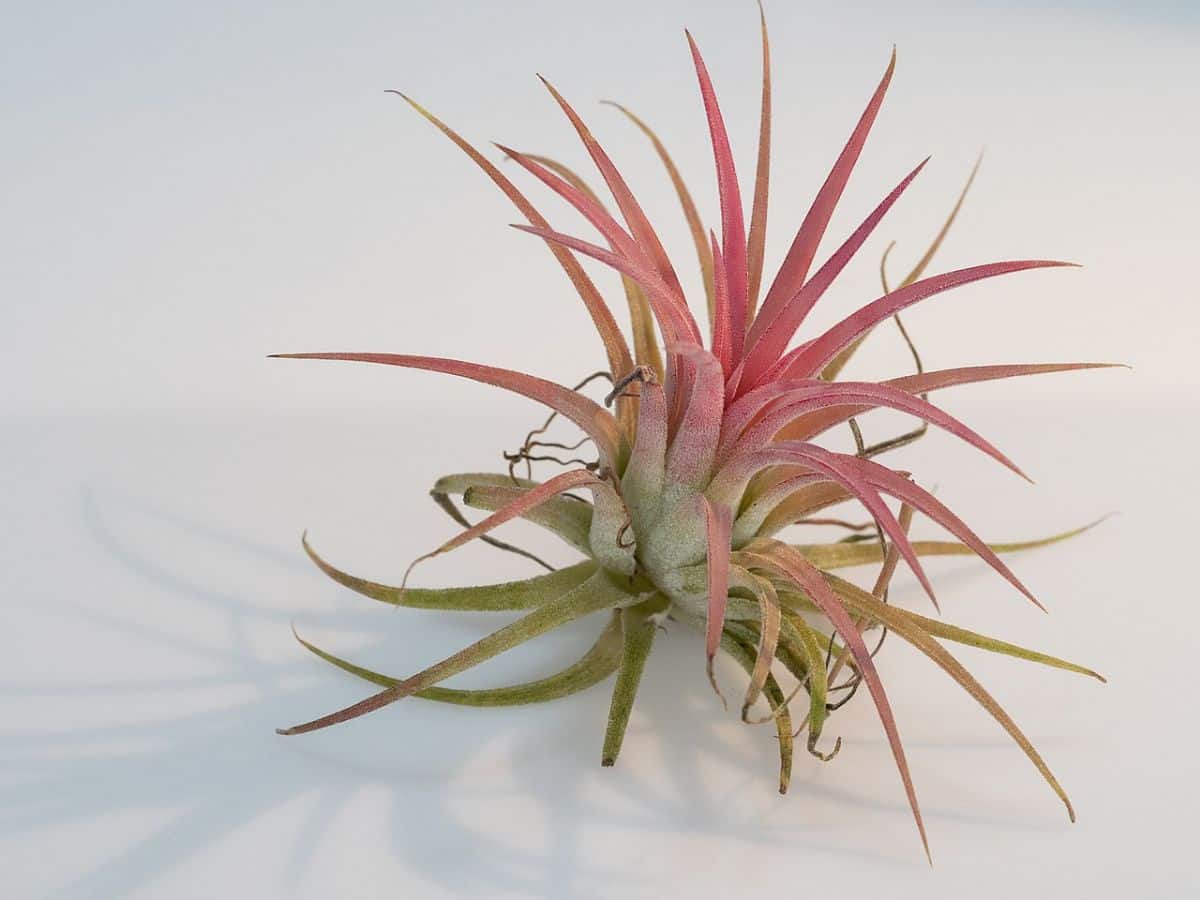
And how is? We are talking about a plant about 5-10 centimeters, quite small, which also grows very slowly and rounded. Throughout the year it has a greyish green color although as it approaches flowering many of its leaves turn pink (this is the most beautiful sight). In addition, it gives purple flowers.
As for the leaves, you should know that they are elongated and end in a point. They are flat but thick sheets. For its part, the flowers are tubular and quite elongated. The petals are dark purple with yellow stamens and can grow as a solitary flower or in a cluster of several.
Treatment Tillandsia ionantha rubra
Now that you know what tillandsia ionantha rubra looks like, how about we help you choose it? Its maintenance is very, very easy and the fact that you don’t have to water it or transplant it is a plus. But don’t worry, there are cares you need to provide for it to move forward. And then we will see them.
Flash
Air plants need lots of light. Some even tolerate a few hours of direct light, while others do not because their leaves burn. In the case of tillandsia ionantha rubra? Good It will need a lot of light, anything you can give it. If it has direct sun in the morning or late in the afternoon, don’t worry because it tolerates it well (but you must first get it used to the climate you have). In summer it is better to put it in more shade but with light so that there is no problem.
Temperature
It is a plant that It tolerates both low and high temperatures well. Although in these seconds it suffers a little more compared to other tillandsias. Still, you won’t have much of a problem with it.
Irrigation
As we have already told you, the irrigation of the tillandsia ionantha rubra is not the same as that which we know for the plants. It’s much “easier”. And it is that it feeds on air, and if you have a house in which humidity is present, you will never have to water it. In case you need it, just spray the plant once or twice a week with rainwater or without lime.
Inside, you always have to spray more than outdoors, but it will really depend on weather, drought etc. you have where you live. What you need to avoid is that there are still accumulations of water, because that will only cause it to rot.
Subscriber
The subscriber in this case is very necessary. And that’s because in the environment you’ll have it in, it won’t be able to absorb organic compounds from the air, so if you pay it once a month in the spring, and every 2-3 months the rest of the year, he will thank.
Now, although there are many fertilizers for these plants, many professionals use fertilizer for orchids which is closest to the needs of the tillandsias. The only thing is that you need to use less than half the dose to not have a problem.
Plagues and diseases
At this point, you only have to worry about illnesses. And of them only related to excess water, as this can cause the plant to rot. Therefore, it is better to control the irrigation well to avoid this problem.
the reproduction
One thing you should know about tillandsias is that when they bloom, they die. But they leave you a “gift”, which is the suckers around which, although they grow slowly, these are new plants that you will get from the original. And after a few years of growth, you can have them and enjoy them again.
Another option is seeds, but these take years to grow and are not used by many to grow tillandsias.
Where to buy a tillandsia ionantha rubra

Source: Etsy
We are not going to say that it is easy to find tillandsias, because in nurseries they usually do not have them, and in stores and supermarkets these plants are not yet seen. But the truth is that, thanks to the Internet, you have several places to find them. For instance:
- In stores specializing in tillandsias. They are the first option because these people are also experts in these plants and can advise and help you in your hobby.
- In plant stores. Not everyone you find online will have tillandsias, but you’ll be spoiled for choice. Of course, sometimes the price can be higher than in specialized establishments.
- In the forums. Plant forums are a meeting place for many garden lovers and also sell some specimens, cuttings, etc. Some even sell tillandsias.
- In Wallapop. Or similar. If you search for the name of tillandsia you can sometimes find it cheaper than on other sites.
And a little more. As you can see, the tillandsia ionantha rubra is a very easy-care plant that will give you no problem enjoying it. So you just have to put in the work to get it.