
Cultivate cacti in pots This is an option within reach of many, since the maintenance of this type of plant is minimal, although many people suffer from excess humidity. They are easy to multiply and bring a different and warm atmosphere to the house. In addition, they take up little space. Its slow growth means there is no need for continuous transplanting into larger pots.
especially the cacti Echinocactus grusoniiIt is an economical plant and easy to obtain. These cacti are native to the Mexican desert, so they need warm environments. It is classified as a fairly popular perennial that forms tall, rounded vines. It is full of fleshy pads and rows of pronounced spines. It is native to the Mexican state of Coahuila and is found in many arid and inhospitable regions.
If you want to start farming Echinocactus grusoniiIn this article we give you some useful tips.
read more: cactus top with flowers for your garden or terrace.
Characteristics of Echinocactus grusonii (mother-in-law’s seat)
Echinocactus grusonii is a cactus with a round shape and fleshy pads. It reaches up to 60 centimeters in diameter and even more, depending on the size in which it was planted. The upper part is covered with thorns and rows, while the lower part has tough, hardened bark.
| Order | Caryophyllales |
| Family | Cactaceae |
| Genre | echinocactus |
| Species | E. grusonii |
Common names: mother-in-law’s seat cactus, golden ball cactus, hedgehog cactus, golden barrel cactus.
Curiosities of the name “mother-in-law’s seat”
The curious common name for this cactus, known as Mother-in-Law’s Seat, is popular in Mexico and other parts of Latin America, as well as Spain. It’s because spherical shape of the cactuswide and flattened at the top, which simulates a seat or a cylinder where one can sit.
The term mother-in-law refers to the assholes she has, given the usual rivalry between mother-in-law and sons-in-law or daughters-in-law, inviting the mother-in-law to sit down so that she pricks and hurts herself .
Other terms by which it is known, such as the golden barrel or the golden ball cactus, are due to the color of its spines, which appear golden when reflected by the rays of the sun.
How long does it take to grow an Echinocactus?
The golden barrel cactus is a very slow growing species. You will need 2 to 4 years to have it with a diameter of 10 cm. However, in the adult stage, the process slows down and it can take more than 10 years to exceed 40 cm.
When does the mother-in-law’s seat bloom?
Flowering occurs during the summer months, emitting yellow, orange or even red flowers. The flowering period is very short and usually does not exceed 5 days or even less. The flowers are very attractive, located in the upper part of the cactus, in the crown.
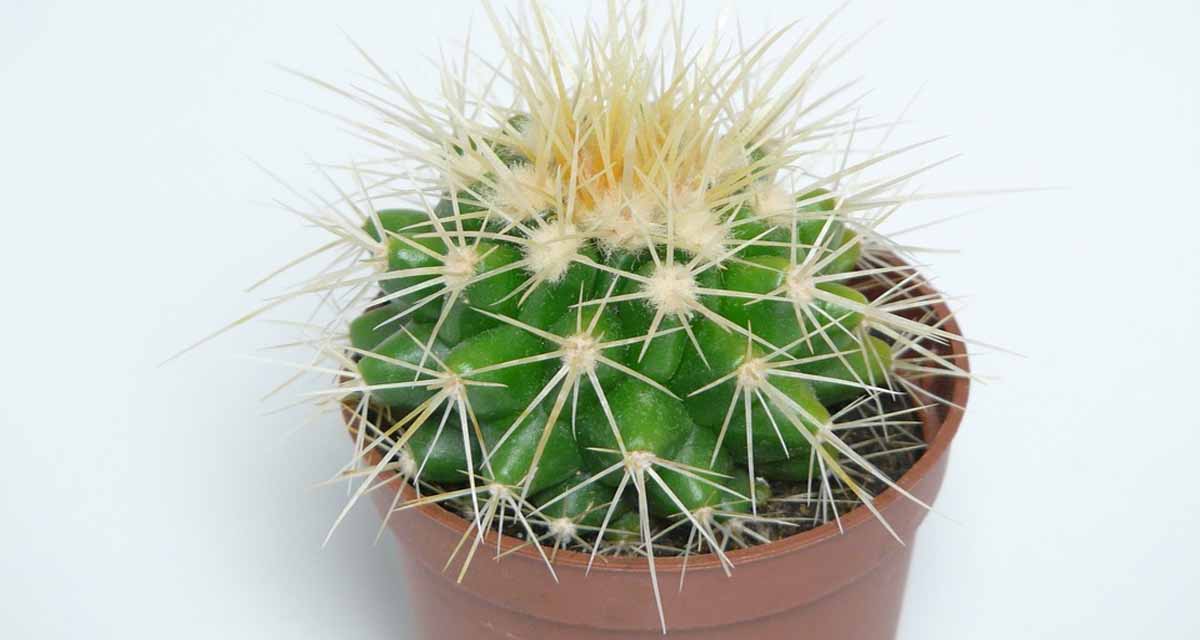 Its growth is very slow and it will take many years to move to a new pot.
how to grow Echinocactus grusonii?
Most cactus plants like the hedgehog cactus they are easy to maintain. The biggest problem facing these types of plants is the excessive care of their owners, supply water without measure no control and finish rotting of the base of the cactus.
With this type of species you have to have a surrender mentality, as we discussed. If they are used to growing in the desert, with almost no precipitation, you have to adapt to this system, bringing very little water to the substrate, with a few foliar sprays of mist water (simulating relative humidity) .
Weather conditions
Echinocactus grusonii is a very hardy plant It thrives in hot and arid climatic conditions. It requires direct sun, but avoiding direct exposure in the middle of summer in the hottest geographical areas.
Minimum temperatures: it is recommended that they be above 0 ºC, with a minimum in which the plant will not stop growing at 5 ºC. However, its resistance threshold is higher, down to -3 or -4 ºC below zero.
Humidity: normal or rather dry, with an appropriate relative humidity of 60% on average. It can grow in coastal environments with a higher concentration of water in the atmosphere, as long as the substrate is not very humid.
prefer it ventilated areas and with a little messy. Be sure that Echinocactus grusonii get enough hours of sunshine each day. This will ensure that she remains healthy and vigorous, increasing her chances of thriving in the future. when it blooms, mother in law seat They produce yellow or orange flowers that will add an extra splash of color to your interior.
type of substrate
Any soil, even not very fertile, is suitable for Echinocactus grusonii, which admits very well those with good drainage, sandy and light texture. The ideal soil for this should be a mixture containing fine sand or loose aggregate.
As for pH, it can grow in quite a high range, from slightly acidic pH to alkaline soils, common in the Mexican deserts where it grows naturally.
For pot culture, the choice of a substrate is very simple. You can buy ready-made mixtures ideal for cacti or prepare your own. A recommendation for a la carte substrate would be:
- 50% Universal Substrate
- 20% sand
- 30% coconut fiber
You can slightly increase the share of sand and coconut fiber and reduce the share of universal substrate, depending on how you see how the irrigation water flows.
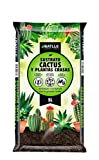
Cactus substrate 5l.
- good solid report
- high doses of magnesium
- Avoid root rot
- Made in Spain
How and how much to water Echinocactus grusonii
As the main summary of Echinocactus grusoniiIt needs little water. Irrigation should be scanty and provide a break between them, so that the soil settles and dries out before the next supply.
To clarify any type of doubt about cactus irrigation, we give 3 tips:
- Water only when the substrate is dry: when there is no more any type of humidity in the substrate and it is completely dry, we will add a little humidity to slightly hydrate it.
- Respect the winter rest period: cacti completely stop in winter, reducing watering to a minimum (1 time every 20 or 30 days) or, directly, not providing water.
- Watering frequency: during the hot period, water once every 15-20 days. If exposed to the sun, every 10-15 days.
- Amount of water: use a dosage of 1/10 parts of the volume of the pot, approximately.
Excess water is determined by the type of substrate. If in our pot of Echinocactus grusonii we have a very draining one, with gravel, sand or perlite, no matter how much water we provide, there will always be a remnant of moisture which is perfect for this type of cactus. Therefore, pay particular attention to the drainage quality of your support.
Use of fertilizer
The use of fertilizers in Echinocactus grusonii is recommended to very low doses, making spaced contributions from the beginning of spring to the end of summer. Nitrogen, potassium and iron requirements are high, and it often presents chlorosis or a loss of the original greenness due to the absence of these elements.
You can provide nutrients in pellet form or with liquid fertilizers. For this type of plants, granules are recommended since the substrate has little humidity, the the release is much slower but enough to keep your cactus in perfect condition Echinocactus grusonii.
Some references of these fertilizers are as follows:

COMPO Novatec Universal Fertilizer Blue, 5 kg
- NPK complex fertilizer (Mg+S) 12 + 8 + 16 (+3+25) with magnesium and sulfur + microelements + nitrification inhibitor, Ideal for all types of ornamental plants, shrubs, green plants, roses, citrus fruits, etc.
- The professional technology with the nitrification inhibitor (DMPP) ensuring the stability of nitrogen in the soil, guarantees the maximum utilization of nutrients in the plants and more abundant flowering. Up to 8 weeks subscription available
- Improved formula, with less phosphorus. Eco-friendly
- COMPO quality: raw materials selected according to the original COMPO recipe, Strict quality controls by independent laboratories and institutes, The best conditions for healthy plant growth
- Contents: 1 x COMPO Novatec universal blue fertilizer, 5 kg
Use a dose of 10 grams per pot, applying for the first time in early spring and repeating every 30 to 45 days, depending on whether there is no visible fertilizer left in the substrate.
If you prefer a liquid fertilizer, make sure it has a 2-1-3 ratio for nitrogen, phosphorus, and potassium. If they can include micronutrients such as ironmuch better, since cacti like the seat of the mother-in-law require it throughout their growth phase.
Possible pests and diseases
Grown at home and in pots, don’t worry as it is very unlikely to be attacked by pests, the main one being the cottony bug.
As for diseases, in case of excessive watering, it can suffer from rotting of the roots, which is often associated with fungi in the soil and in the crown of the plant, which are very difficult to eliminate.
When to transplant the hedgehog cactus
In general, it is not necessary to let the cactus completely cover the pot and the substrate is barely visible. This situation makes us lose control of the state of soil moisture and causes us to make mistakes.
read more: Guide to transplanting a cactus.
Always leave at least 1 finger of margin between the cactus and the edge of the pot. Don’t worry too much though, as this cactus’ slow growth means you won’t have to transplant it for many years.