Golden Pothos and Hawaiian Pothos are very similar. Trying to tell the difference between the two can easily leave you confused.
This is why it is essential to carefully consider these two types of pothos when growing them together.
The main visible difference between golden pothos and Hawaiian pothos is the color of the foliage and stems. Golden Pothos, on the other hand, has a much more vibrant and intense yellow hue. Hawaiian pothos, on the other hand, is a variegated plant with stripes of dark green, yellow, and white. While Golden Pothos prefer low light, Hawaiian Pothos prefer medium to bright light.
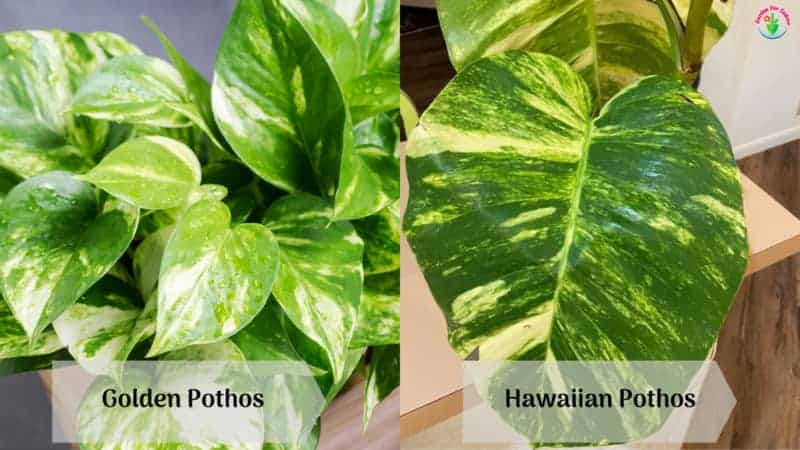 Difference Between Golden Pothos and Hawaiian Pothos
Difference Between Golden Pothos and Hawaiian Pothos
It is difficult to tell the difference between these two types of pothos at first glance. The most noticeable difference between these two is their color or hue.
Below, we’ll show you each of its different features so you can learn more about them.
Golden Pothos develops yellow vines
 Golden Pothos develops yellow vines
 With enough light, all Goldens will develop yellow vines. The one in this photo is right next to a crop panel. Some of my vines are even variegated.
Hawaiian Pothos, on the other hand, typically develops green stems when all growing conditions are met. If you are still unsure about the difference between golden and Hawaiian pothos, take a look at the image below.
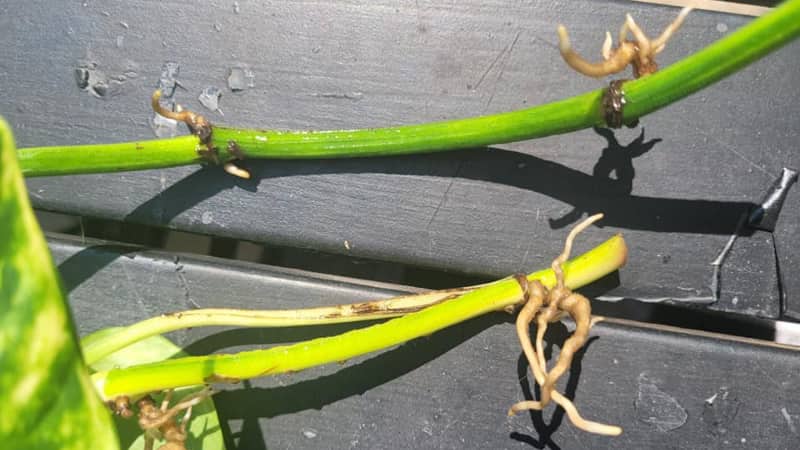 Stem Color: Hawaiian pothos is the one with the green stem and a golden pothos is yellow
Golden Pothos gets windows
 Golden Pothos gets windows
 You may be wondering what fenestration is? Plants like golden pothos and monstera, which are native to dense tropical forests, have leaves that split to allow sunlight to reach the lower leaves.
As you can see in the image above, my golden potus is now windowed. Their leaves open with maturity in their native habitat, allowing rain and sunlight to reach the roots as they meander through the jungle.
This may not happen often with your golden pothos, but if the conditions are right, you might be lucky to have one. Hawaiian pothos do not have these types of windows.
Leaf Color: Golden Pothos Vs Hawaiian Pothos
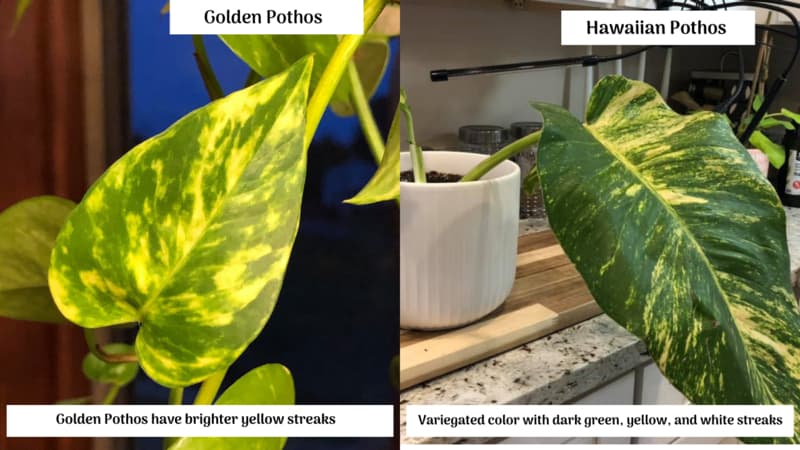
golden pothos
Hawaiian Pothos and Golden Pothos are almost identical except for the color of their variety. The leaves of Golden Pothos are striped with dark green, yellow and white, but are a brighter yellow.
hawaiian pothos
It has a variegated color with dark green, yellow and white stripes.
It does not go through the fall color change like all other plants. The color remains, but the intensity of green varies depending on the amount of sunlight received by the plant.
Similarities Between Golden Pothos and Hawaiian Pothos
Hawaiian Pothos is the cultivar of golden pothos, so it is not new to hear that they have similar qualities and characteristics.
The following will tell you more about these two varieties of pothos.
The scientific name of the pothos family is Epipremnum aureum. Golden Pothos and Hawaiian Pothos belong to the same species.
Their availability is more common in tropical countries as they are also known as tropical vines.
Plants like philodendron have this cataphyll, a thin, opaque, waxy sheath that covers new leaves. In contrast, there are no pods on the leaves of pothos.
New pothos leaves grow on their own, displaying a lighter green color that extends from the current leaves.
All types of pothos grow with creeping habits. It can usually reach 6 to 10 feet. But pothos in their natural habitat can reach 30 to 50 feet.
You will see giant pothos coming out of the forest, where they can drag the trunks of the tallest trees.
The arrangement of pothos leaves is alternated. You will see that there is only one leaf at each node as it grows in an upward spiral.
Pothos has a single leaf type with leaf lengths of 4 to 8 inches, 8 to 12 inches, 12 to 18 inches, and 18 to 36 inches.
Regarding the height of the pothos, it depends on the supporting structure. The longer the structure, the more it extends upwards.
On the other hand, pothos continuously spreads as long as there is soil for the leaves to multiply.
It grows quickly, so getting the right frame height based on your preferences is crucial.
- Propagate Golden Pothos vs. Hawaiian Pothos
Pothos of any type are easy to propagate. You can propagate it by cuttings and give them to your family and friends.
Alternatively, you can have your pothos section in your home to take advantage of its alluring, hanging look.
Moreover, you can propagate them both in soil and in water. To start, find a healthy vine 4 to 6 inches long with three leaves, then create a stem that you cut above the root node.
If you want to spread it in water, prepare a water bottle and pour water into it. Insert the cut and dip the cut ends into it.
If you want to plant it now, place the cuttings in a small pot with potting soil.
When talking about the care tips required for golden pothos and Hawaiian pothos, don’t hesitate because they belong to the family of Epipremnum aureum.
Perhaps the only difference is that the Hawaiian must retain its color, which sets it apart from other varieties of pothos.
Temperature: Golden Pothos and Hawaiian Pothos have the same temperature requirements. The ideal temperature for growing pothos is between 65°F and 85°F (18°C and 29°C).
Light: Since you are starting the cultivation of pothos, they do best in shade where there is enough light.
However, when it comes to Hawaiian pothos, you need to place them in medium to high light to maintain their variety. Keep it out of direct sunlight to protect the foliage.
Soil requirement: According to research by Edward F. Gilman of the University of Florida, pothos soil tolerances are slightly alkaline, clayey, sandy, acidic, sometimes wet and loamy.
Pothos care is popular with beginners because it grows in a variety of soil types.
Keep in mind, however, that this research is looking at what type of soil it can grow in, not where it can suck.
Pothos plants do not like to sit in wet soil. Therefore, you must ensure that the soil is well drained.
If the soil in your area has a clay texture, you can add more perlite, coco, and sand to improve drainage for the plant.
Packaging of the jar: Whether you want to place the pothos in a hanging basket or in a regular pot, the choice is yours.
If you like the idea of letting the leaves hang from the basket, hanging it from your ceiling might be a good idea. You can, on the other hand, use an ordinary pot and then put a foam stick in the middle.
As for your pot, make sure it has enough holes for better drainage. Otherwise, the root may rot in the process.
Water requirement: Pothos is not comparable to other types of plants where it needs regular watering. The best rule of thumb before watering is to stick your finger in the top two inches of soil to see if it’s already dry.
Allowing the top layer of soil to dry out before watering will prevent root rot and ensure that the roots are still moist.
Too much drought is not good for pothos, which can cause the leaves to wilt or turn brown.
Fertilizer: You can use a balanced houseplant fertilizer every month or two to make sure you’re providing enough nutrients to your potting mix.
You don’t need to use heavy fertilizer, as pothos aren’t very nutritious.
last words
Distinguishing between two types of plants in the same family can be both intriguing and confusing.
However, it can be satisfying to learn about the different types of plants, including their growing needs. Here are the three main points to sum it all up in this article:
- Hawaiian Pothos is a cultivar of Golden Pothos due to selective breeding. Its appearance is recognizable by the spots of yellow tones. The stem color is also yellow, while the leaves get bigger over time.
- While both varieties of pothos have similar growing requirements, Hawaiian pothos require medium to high light. This is to maintain its dark yellow color without endangering or drying out the plant.
- The way to propagate Hawaiian and Golden Pothos is the same. Cuttings allow you to multiply the number of your pothos plants at home. You can spread them in the ground or in the water.