
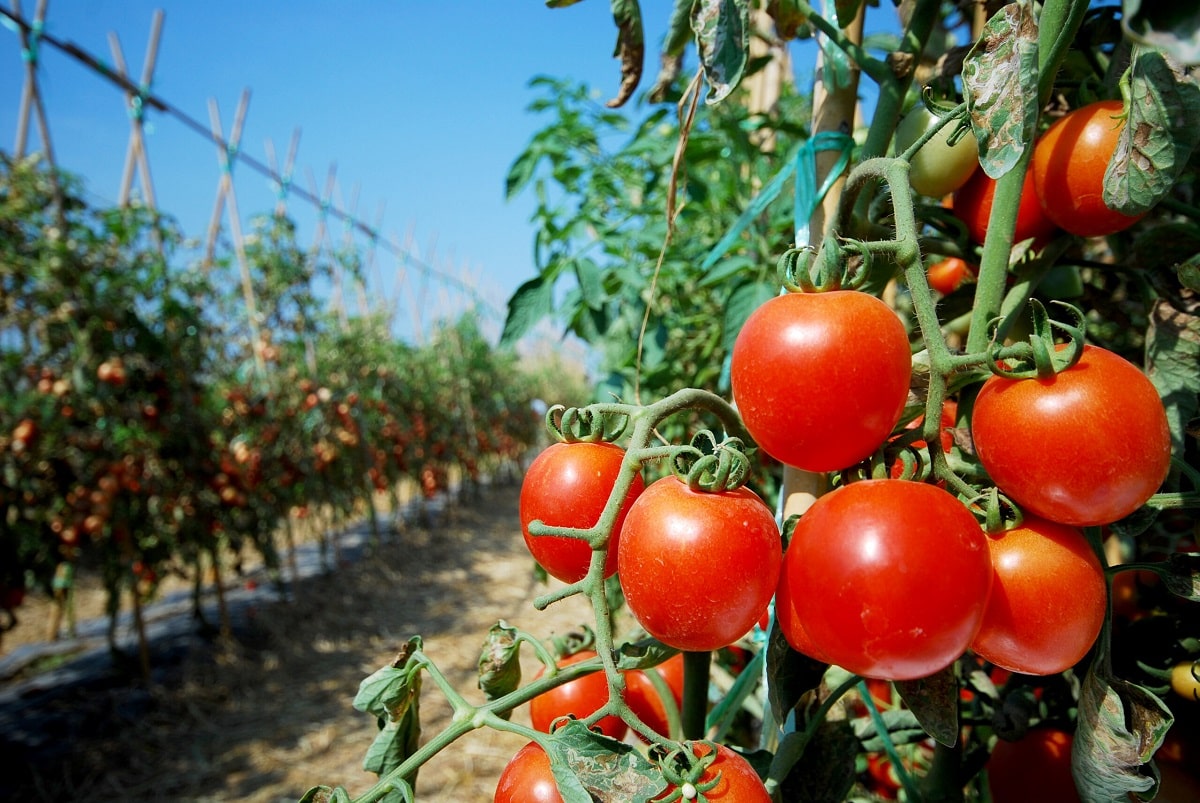
Tomato is one of the crops that require certain maintenance tasks in order to grow properly. Depending on the space we have for our crops, it may be good for us if they stop growing. In this case we will see how to prune tomato plants so they don’t grow.
In this article we will tell you how to prune tomato seedlings so that they do not grow, what aspects to take into account and what advantages it has to do so.
Why prune the tomato plant?

The purpose of pruning varies depending on the type of tomato we have. In some cases, such as cherry tomatoes, we are interested in having a lot of small tomatoes.
However, other times we want the tomatoes to be bigger. To do this, we will make cuts in some specific areas to redirect the nutrients that the plant takes to the tomatoes, which will be explained below.
Leaf pruning and branch pruning

Leaf pruning or defoliation consists of removing the oldest or damaged leaves from the lower parts. Thanks to this practice, a better ventilation, uniformity and coloring of the fruit is obtained. Pruning or pruning branches relies on removing buds (often called suckers). The suckers appear in the armpit of the rods, as shown in the picture below.
In both cases, pruning should always be done at the right time. It is recommended to cut the buds when they are about 5 cm. If we let the sprout grow too long, we will increase the risk of disease when we prune it.
Sometimes we can use the suckers we have cut to get new tomato plants. It remains only to plant the sprout and in a few days you will see how it takes root.
How to prune tomato plants so they don’t grow

Tomato plants can be pruned mechanically (with sterilized shears) or by hand. It is important not to prune when the plant is wet, because there is an increased risk of disease introduction. If we manage to do all these steps correctly, we will definitely add good tomatoes to our salad.
The first step in pruning our tomato plants is knowing what variety we are growing. As you may know, there are many varieties of tomatoes that vary in size, color, and shape. However, we can divide them into two broad categories: definite and indeterminate tomatoes.
Determinate tomatoes tend to be the more compact and bushy type. They stop growing when they reach adulthood, that is, they have a growth limit. An important characteristic is that they deliver all the fruit at the same time (the entire harvest must be done in one to two weeks). These varieties are recommended when we have little space or want to use our tomatoes for canning. Generally, they do not need to be pruned. Indeterminate tomatoes can grow indefinitely, so they should be controlled by removing suckers and cutting off the tops of the stems when they reach a considerable height. They need a stake for food and the tomatoes are staggered throughout the season. If we want all-season tomatoes, they are highly recommended. Some of the best known varieties are: muchamiel tomato, beefsteak tomato, black cherry, etc.
Trimming the tomato plant so that it does not grow can be useful if we do not have much space in our garden.
Aspects for how to prune tomato seedlings so that they do not grow
- Find and remove the suckers: in these tomatoes of uncertain growth, it is necessary to remove the shoots. Suction cups are small buds that appear where the branches meet the stem. The reason for their removal is that, if left to grow, they deprive the plant of energy, resulting in less fruit.
- Cut the branches of the tomato plants to leave only one root: the objective is to always leave a branch or a vertical growth guide from which emerge secondary branches with leaves and flowers. To do this, you need to select the best branch from the trunk and remove the rest. When this secondary branch (now the main trunk) has grown enough, we do the same thing again: we cut it and let one of the strongest branches continue to grow.
- Remove the leaves under the first flowering branch: this practice will help our plants to become stronger and more resistant. Plus, we don’t waste our plants’ nutrients on unnecessary branches.
- Remove the yellow leaves from the tomatoes: When you see yellow leaves on your tomato plants, especially the lower ones, you need to pull them off so your plants don’t waste energy and protect themselves from disease.
- Cut the tops of the stems at the end of the season: the upper part of the stem of the plant must be cut to take advantage of the last shoots of the season. This way we allow the nutrients to concentrate in the tomatoes.
When to prune tomato plants
It is necessary to distinguish between the different types of pruning applied to tomato plants in order to know when to do each one. So, to know when to prune tomatoes, keep in mind:
- Shoot size: in which the so-called suckers are removed from the tomatoes, is done once or twice a week during the warmer months. With the onset of spring, shapeless tomato seedlings begin to grow a large number of such shoots, which must be removed before they grow too large.
- Defoliation or maintenance defoliationby removing the leaves when they are withered or damaged.
- The escape This should be done when we believe that the tomato plant has not had time to fully develop new fruits. That’s about a month and a half before the worst temperatures in the warm months, or three months before the worst temperatures in the cold months.
Under no circumstances should pruning be done when the plant is damp or wet, as we can make it sick.
A few tips for sizing
Finally, here are some tips for pruning tomato plants so that they do not grow, whether they are cherry tomatoes or large tomatoes, whether they are in pots, greenhouses or in the ground.
- Still use sanitized tools to cut any part of a tomato. Also, especially if you smoke, wash your hands with soap and water before hand weeding.
- As soon as the first flowers appear, prune the branches below. Wash unshaped tomatoes directly and wait for the leaves to turn yellow if shaped.
- Most cherry tomatoes are of the stationary type and therefore do not require significant pruning. In addition, with them, quantity is more important than quality, so they can grow more.
- In greenhouse tomatoes, it is especially important to prune the lower shoots so that they do not shade the earth and air it more.
- Stems removed during weeding took root easily and new tomato plants sprouted in as little as 15 days.
Hopefully with this information you can learn more about how to prune tomato plants so they don’t grow.