
Koelreuteria paniculata it is a tree that stands out mainly for its yellow flowering. A few small flowers but that cover hundreds or thousands of this tree’s foliage during the summer months. It puts on a show all year round, both for its leaves, its flowers and its conical-shaped capsules in winter.
In this article we will tell you about the main characteristics and the method of cultivation of the tree commonly known as the lantern or porcelain soap dishcountry of origin of Koelreuteria paniculata.
main features of Koelreuteria paniculata
Koelreuteria paniculata spans almost all temperate regions of the world, preferably grown as an ornamental tree for its great beauty and the color it brings to the garden. In fact, in some cities it is common to see it in street lines, as it has no training pruning problems and is considered a hardy tree.
Among the sub-varieties that can be found in Koelreuteria paniculata‘September Gold’, which blooms in late summer, or ‘Fastigiata’ are the most chosen options in the gardens of the most experienced horticulturists.
Physical appearance of the lantern
Koelreuteria paniculata is considered a small to medium sized tree, deciduous and which generally has a height in the adult state between 6 and 7 m in height. Its foliage is rounded, dome-shaped, with compound and pinnate leaves of a bright and intense green and 15 to 40 cm long. They are compound because they form 7 to 15 leaflets 3 to 8 cm long.
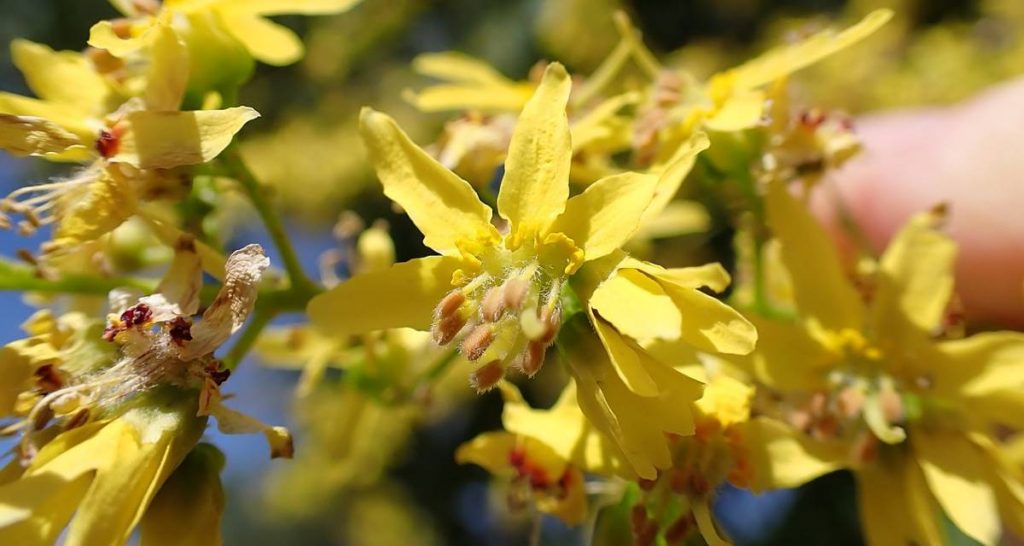
However, the most valuable thing about this tree is not its leaves, but rather its flowers, yellow and small in size, formed by 4 petals of asymmetrical shape and reddish tones at the base of the flower. From the fertilization of its flowers, Koelreuteria paniculata It forms capsule-shaped fruits (3-6 cm long and 2-4 cm wide), green at first and reddish when ripe in the autumn months, inside which it stores a cluster of brown seeds with a diameter of less than 1 cm.
Trunk: irregular development in its first years of life but more rounded and rectilinear behavior over the years. A large specimen can form a crown 10 meters in diameter, generating a lot of shade due to the high density of foliage in spring and summer.
Cortex: Light brown in color, rough to the touch and forming longitudinal streaks, tinged with ocher tones.
Branches: sinuous in shape, very numerous, horizontal in growth (hence its large crown diameter).
Leaves: compound formation of intense green color and made up of 7 to 15 leaflets with saw-shaped edges. In the first days of development, the leaves do not have an intense green appearance but rather pink tones.
fruits: Capsule form 4 to 5 cm long that forms from autumn and remains on the tree until early spring.
Flowering period: the flowering of Koelreuteria paniculata It is produced in the months of July and August, forming 35 cm panicles which group together a large number of small flowers 1 cm long.
Main uses: tree with ideal conditions for forming alignments in streets and avenues and as an isolated specimen in gardens.
taxonomy
| Order | sapindales |
| Family | sapindaceae |
| Gender | koelreuteria |
| Species | Koelreuteria paniculata |
Common names: Chinese soap dish, lantern tree, golden shower tree, polish tree, Indian pride tree.
Origin of the name :
- Koelreuteria: Created as a tribute to Joseph Gottlieb Kölreuter (1733-1806), a German botanist who was also a doctor and professor of natural history and later became director of the Botanical Garden in Karslruhe (Germany).
- panic: Latin epithet whose meaning is that it has panicles.
Main habitats of the Chinese soap tree
The Chinese soap eater is native to the Asian continent (China and Japan). It is widespread in many parts of the world, as it resists very well to urban pollutionfreezing temperatures (it is a deciduous tree) and dry and hot environments, common in inland towns during the summer months. In fact, its great hardiness makes it a kind of easy expansion throughout the territory, which is why in some areas of the United States it has been classified as Invasive species.
The shape of its crown and its aligned trunk make it a Very popular tree for small streetstolerates low humidity and urban pollution very well.
grow guide Koelreuteria paniculata
The Chinese soapbox is a tree of few demands and easy adaptation for green spaces, parks and street alignments. Its great ornamental value lies in its fantastic flowering in summer and that in winter, even losing its leaves, it retains the fruit capsules until spring.
Location
Koelreuteria paniculata It is typical of temperate climates, so it must be protected from very low temperatures in the first years of its development. Little by little it adapts and regulates its flowering so that it occurs far from the cold months.
It is grown in full sun, withstanding high temperatures, mild frosts and steady winds, making it a good option for coastal environments. In addition, it tolerates dry environments typical of inland cities in summer.
ground conditions
The ideal conditions for this tree are deep soils, with a slightly acidic pH. However, it can grow in infertile and calcareous soils. When transplanting is done, he greatly appreciates the addition of manure, compost or any other type of organic matter in the planting hole, in the amount of 5-10 kg, well mixed with the earth.
how to water
Drought tolerant tree with average needs. In gardens, 1 or 2 drippers of 4 L/h are usually incorporated, watering 2-3 times a week during the warm months and 1 every 7-10 days in autumn and winter, conditioned by rain.
Irrigation may be more spaced out depending on whether the soil type is clayey. Usually the soil is usually left to dry out before starting the next watering.
Use of fertilizer
Frequent incorporation of compost or organic matter annually or every 2 years is sufficient to maintain sufficient soil fertility. However, if you notice flowering problems or leaf chlorosis, it may need an extra boost with mineral fertilizers. A comfortable and convenient way to deliver nutrients is to use granular fertilizers, where we recommend a complete mix of macro and micronutrients.
This fertilizer is applied in early spring, coinciding with germination, at a dose of 0.5-1 kg/tree, well distributed in the shade of the area and near the dropper, repeating the application every 30-45 days until the end of September.
sales
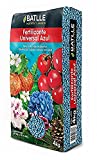
Blue Universal Fertilizer – 4kg bag
- Azul Batlle Universal Fertilizer is a complex granular fertilizer that contains all the nutrients from each grain of fertilizer
- Particularly indicated for outdoor plants, it provides the nutrients necessary for the optimal development of horticultural species, fruit trees and all kinds of ornamental plants, trees, shrubs and flowers.
- Its composition, low in chlorides, rich in micronutrients and very soluble, gives it optimal qualities for plant nutrition.
- Composition: EC fertilizer. NPK 10-12-18 + 2MgO fertilizer with trace elements
- Dosage: Apply by spreading evenly at a rate of 40g/m2
size
This tree does not require constant pruning and, in fact, is often not pruned at all. If so, the maintenance pruning should be gentle. Avoid cutting the thickest logs as, depending on moisture conditions, they have little self-sealing ability and may be prone to cankers and necrosis from fungi and bacteria.
Another aspect that makes intense pruning inadvisable is that its wood is very fibrous, which is why it tends to crack and makes it difficult to make clean cuts.
Plagues and diseases
The Chinese soap tree is considered a disease resistant tree except for fungi or bacteria that can get into cuts or wounds, although this is rare. At the pest level, it can be affected by whiteflies, mites or aphids.
Cover photo: Matt Lavin Made in Albuquerque, Bernalillo County, New Mexico.