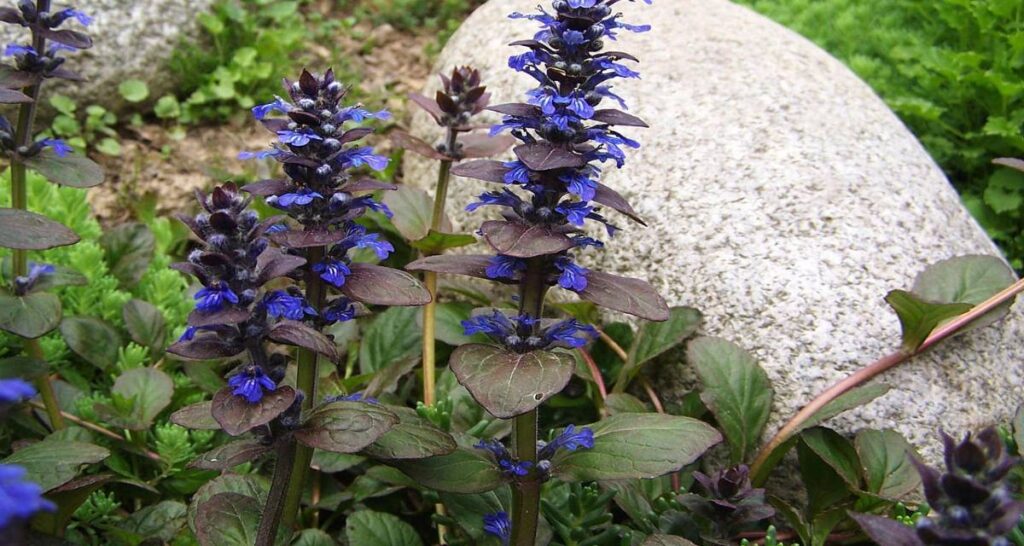
ajuga reptans it is a plant of the family Lamiaceae with a fantastic past as a medicinal plant. However, it is now relegated to the rank of ornamental plant, ideal for growing in pots, on the edge of the garden or even on embankments. Their spectacular flowering and its great adaptation to all types of environments makes the average comfrey a species of great interest.
In this article we make a compilation of the main data of interest on this plant. We will talk about the main characteristics, such as the habitat where it grows, its main care and the medicinal benefits that this plant has been used for many years.
Characteristics of ajuga reptans (half comfrey)
ajuga reptans it’s a attractive ornamental plant for its foliage and even more for its flowering. Although it physically resembles lavender in the inflorescence it produces, this plant needs higher humidity conditions. It was generally cultivated for its foliage and for the extraction of its active principles.
With modern medicine, this plant is no longer used for medicinal purposes except in isolated cases, but it has endured retain its ornamental value, emitting an attractive bloom of purple and pink colors throughout spring and summer. A peculiarity that this plant offers when growing in spontaneous environments is its easy to expand. ajuga reptans create rosettes of shiny leaves with the ability to produce roots as they spread, multiplying quite quickly.
Given its medium size, with a height of 15-30cm, it is perfect for covering bare spaces in the garden or directly in pots. Several cultivars are produced from the medium comfrey (each with a different bloom, with shades of purple, white and pink). The most common species that can be found in nature (ajuga reptans Atropurpurea. ) produces a blue and purple bloomdeveloping leaves whose whorl is also purple.
Cultivars and subspecies
In the genre ajuga there are about 50 species of perennial growth (such as ajuga reptans) and semi-evergreen, depending on the climate and how cold it is in winter.
Many cultivars have been selected for ornamental purposes. The one known as ‘Catlin’s Giant’ won the Garden Award of Merit from the Royal Horticultural Society.
taxonomy
| Order | lamiales |
| Family | Lamiaceae |
| Genre | ajuga |
| Species | ajuga reptans |
Common names: medium comfrey, silbote, ajuga, lechuguilla, búgula, corocha.
plant size: from 10 to 30 cm in height, although under optimal conditions it can exceed 0.5 m in height.
Bloom: It occurs in the months of March to September. The flowers come out in whorls between the bracts, with a tubular corolla, with two blue-violet lips, the lower one larger than the upper one.
Fruits: formed of four rough achenes.
Domain: short rhizome, with numerous stolons which produce new plants with relative ease.
common habitat
ajuga reptans It is native to the European continent and also to North Africa, also spreading to Asian countries with a similar climate. It is also distributed in warm regions of North America and even on the Australian continent.
Their common habitat is meadows and forest edges, especially in cool areas protected from direct sunlight. It is not usual to find common comfrey in dry environments where, due to the previous mention of lavender, it is. It proliferates easily in cool environments, with moist soils and medium to high relative humidity, typical of wooded areas where they are protected from the sun by tall trees (beech and oak).
 Average flowering of comfrey. Photography: Gaha
Ajuga growing conditions
ajuga reptans It requires moist and cool soils, most often in shade or partial shade. In this type of environment, it can easily cover all bare ground.
Temperature
The average comfrey tolerates low temperatures, even behaving like a perennial. Without formed inflorescences, it withstands freezing winter temperatures. In cases where the leaves are lost due to the cold, they sprout in the spring with the strength and energy provided by the roots.
the type of soil
Fresh soils, generally with a high content of organic matter produced by the continuous decomposition of the leaves of large trees, which fall in autumn and form a perfect compost.
The state of the soil in terms of pH is irrelevant.
water needs
It’s a moisture-demanding plantboth in the substrate and in the environment, but it does not require waterlogging, since this is one of the main problems that this species suffers when grown in pots.
Soil or substrate should be kept in slightly damp conditions constantly, without drying out the support, especially in hot weather. Maintaining lower humidity just before the flowering period stimulates the emergence of larger and better inflorescences.
Multiplication
ajuga reptans it’s a easy-to-breed species which, in a short time, can cover large areas of land, as a creeping or semi-creeping plant.
Multiplication takes place dividing the plants, separating the rhizome it produces. It can also be propagated by seeds, picking them from the fruits after fruiting.
Common problems in your crop
Poor irrigation control. In case of excess water, crown rot under extremely wet conditions and dieback of the plant under very prolonged dry conditions, being the only two major problems with this plant.
medicinal properties of ajuga reptans and current uses
Bugula has been used as a medicinal plant since ancient times. There are references to this medicinal plant in the 17th century, being recommended as treatment of open wounds, blows or trauma. Its use, in addition to wound healing, was also linked to a slight pain-relieving effect.
In the old days, ajuga reptans It was also called “carpenter’s herb” because of its supposed effectiveness in reducing bleeding, very common in the manual work of this trade at that time.
Main assets: tannins, saponin, organic salts.
Comfrey can also be used to improve internal health, use its leaves in infusion, with anti-inflammatory and astringent properties for gastric and intestinal pain. Of its leaves were also made mouthwashes to reduce the pain of wounds and soothe coughs.
This plant was also used in traditional Austrian medicine, in infusion formto treat diseases related to the respiratory system.
Cover picture: Jerzy Opiola (Own work).