

Surely you know the Alocasia macrorrhiza. However, Have you ever seen this alocasia with green leaves speckled with white? It is Alocasia macrorrhiza variegata and it is one of the collectible plants that most people seek for their home.
We are therefore going to tell you all the characteristics that you find in this plant as well as the care that you must give it so that it does not lose its variegation and even gives you completely white leaves. Do you want to know more?
How is Alocasia macrorrhiza variegata

Let’s start by talking about Alocasia macrorrhiza variegata. It is an evergreen plant, also called “Elephant Ear” because its leaves reach a considerable size. It is native to the South Pacific and can reach 3 to 4 meters high and between 1 and 3 meters wide.
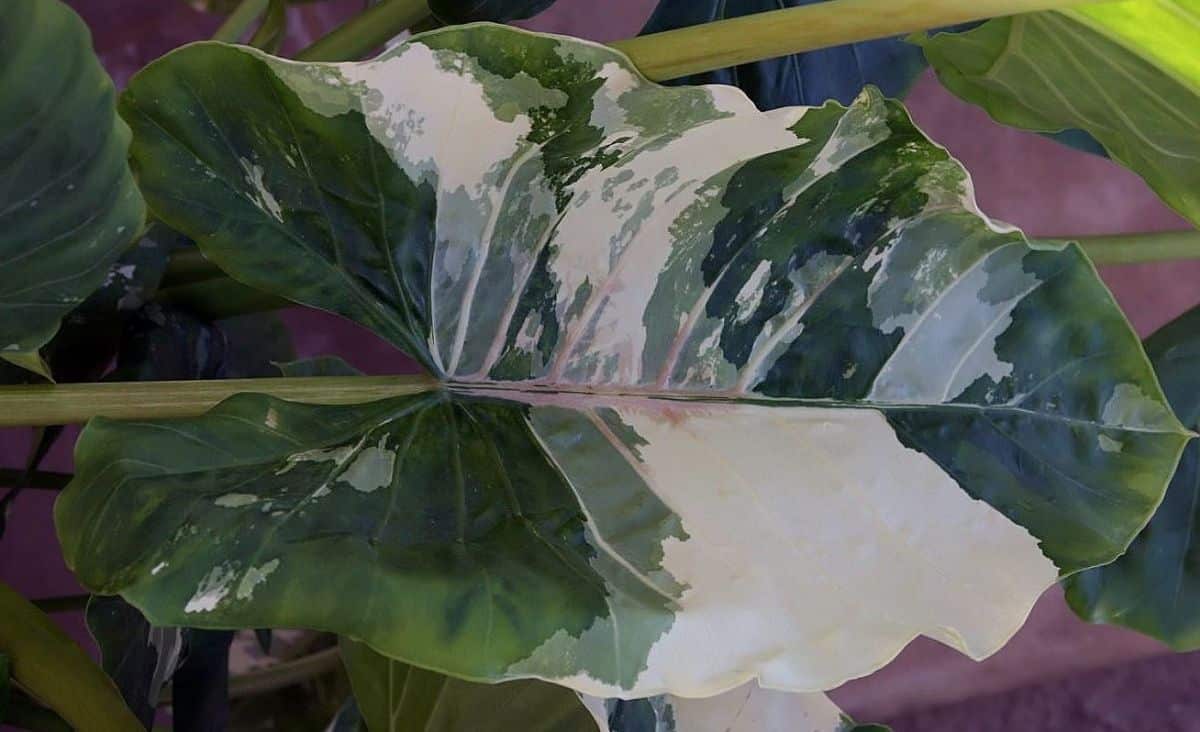
The most characteristic of this variegated plant are its leaves, which have a creamy green color combined with white variegation. This is what stands out the most about the plant and makes it one of the most demanded.
Of course, his variegation is not always perfect. There are times when the leaves come out with little white, and others when they can come out completely white. It depends primarily on the genetics of the plant, but also on the care you give the plant. Indeed, if it receives a lot of light and you take very good care of it, it is common for the plant to give you whole white leaves because it has enough light and photosynthesizes with the other leaves. Yes, white leaves are not useful for photosynthesis, hence the need for green parts.
In leaf size and pattern, it is very similar to that of the rest of Alocasias macrorrhiza. As for its shape, the leaves have a lance- or blade-like silhouette, with wavy white veins emerging from several stiff stems, usually green, although they can sometimes be variegated (hence the leaf becomes variegated). .
Another point you should know about Alocasia macrorrhiza variegata are its flowers. Although it is not usual for it to flower indoors, it can. It is usually a stalk of green spathe which, over time, turns pale yellow.
The flowers are very aromatic and those who have had the opportunity to see and smell them have been very impressed. Although we already tell you that they have no comparison with variegated leaves.
Is Alocasia macrorrhiza variegata poisonous?
As for Alocasia macrorrhiza, the variegated version is toxic to pets and children. This is why it is recommended to place it in an area where they cannot access it.
If by accident they bite the leaves or eat them, you should know that they may suffer from irritations, sore throats, etc. If the intake has been too high, it is essential to go to the doctor (or veterinarian) for treatment.
Care of alocasia macrorrhiza variegata
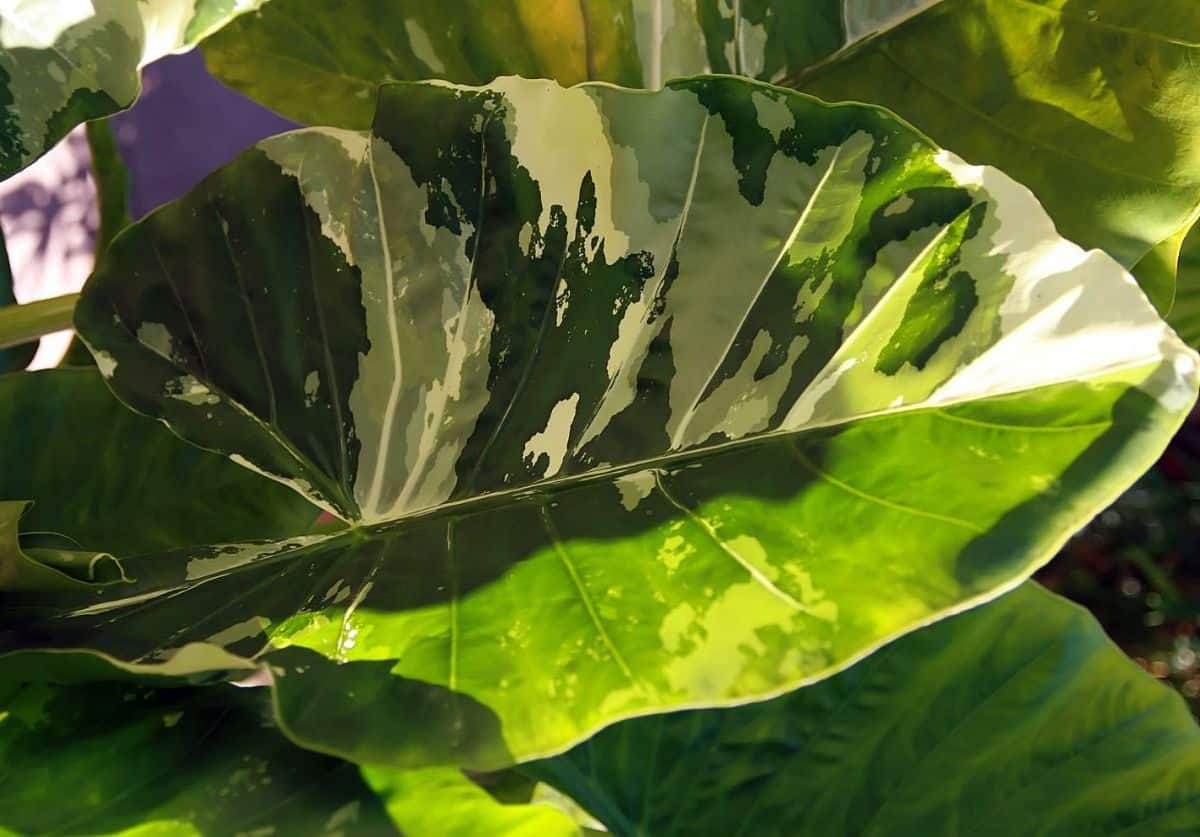
After learning a bit more in depth what Alocasia macrorrhiza variegata looks like, Would you dare to have one in your home? If so, here we leave you with the most important care you should provide to keep it healthy.
location and temperature
We start with the most suitable location for this plant. In this case, due to the delicacy of the leaves, it is not recommended to expose them to direct sunlight as they can easily burn. It is therefore preferable to place it in partial shade so that it has light but not directly.
That said, you should know that you can put it both inside the house and outside. As long as temperatures do not drop below 10 degrees Celsius (since, if so, the plant will suffer). Its ideal temperature is between 18 and 24 degrees. If this is higher, or lower, it is possible that the plant stops growing, and there you may have one of the reasons why it does not grow.
Substrate
Another important care for Alocasia macrorrhiza variegata is the ground to use. It is important that you provide soil with a pH between 5.6 and 7. In addition, it must be a soil that remains moist, so you can use earthworm humus and a universal substrate. But do not forget to put some drainage so that there are no accumulations of water.
Irrigation
Regarding the above, you will have noticed that the Alocasia macrorrhiza variegata needs to be watered often so that the soil is moist. But if you go too far, you can easily lose it. SO try to water only when the soil is dry.
In summer you may need to water it 2-3 times a week while in winter once a week is more than enough. Of course, everything will depend on the weatherwhere you are and what temperature you have.
When it comes to water, you should know that It is a plant that needs humidity. More precisely, between 60 and 80%. For this reason, it is practical to place it near a humidifier or a plate with pebbles and water to maintain this humidity.
Subscriber
During the spring and summer months you will need to apply fertilizer to meet your growth needs. It is good to take it once a month, but at a lower dose than what the container puts (to avoid overusing it).
During the winter, this is not necessary, as the plant goes dormant.
Size
Pruning should be seen as a way to clean the plant and help it grow. But in reality It’s only to remove the leaves that are damageddead or with black or yellow spots.
Plagues and diseases
Although Alocasia macrorrhiza is effective in controlling pests and diseases, the variegated version is more delicate with these And you need to be aware so that fungi do not affect it (due to root rot), as well as scale insects and mites.
In case you see the latter, the best remedy is to wash the plant with soap and water.
As you can see, Alocasia macrorrhiza variegata is a plant that anyone who loves variegated plants will love to have in their collection. And it is not as difficult to cure as the others. Would you dare to have it at home?