

Have you heard of Calluna vulgaris? Do you have any at home? It is one of the plants that most enriches autumn and winter because it blooms from mid-summer and lasts a long time, sometimes until January or February.
But what do you know about this plant? We present here a practical guide to get to know it better. Keep reading and find out!
How is Calluna vulgaris

Calluna vulgaris is the scientific name for common heather., also called heather. It is part of the Ericaceae family, although it should not be confused with Erica (which happens often).
Physically, Calluna vulgaris is an evergreen shrub. Its origin is in Europe, especially in the North and in the central part. Although the truth is that now it is also found in North Africa as well as in America.
It can reach between 30 and 50 centimeters in height. and in its natural habitat you can find it in areas with little insolation as well as in forest clearings. It is common to be in mountainous areas.
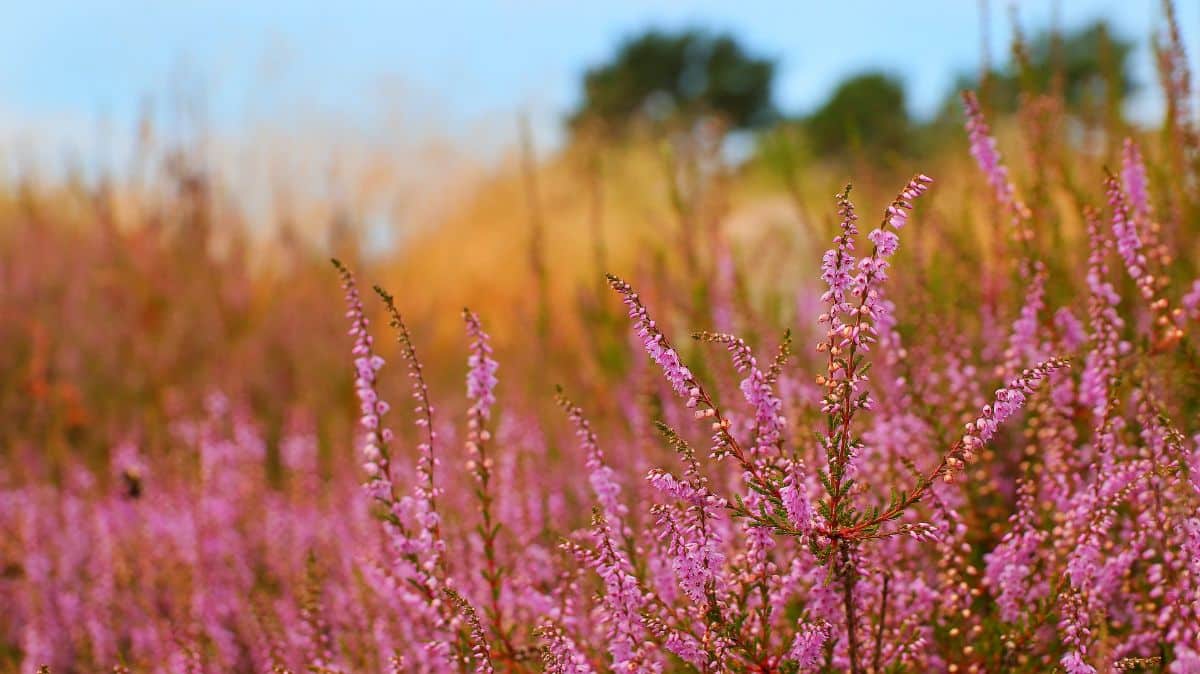
As for the branches, they will be erect and red-brown in color. It has very small leaves and many small flowers which, when August arrives, begin to bloom in pink-purple clusters. Actually, there comes a time when you will hardly see the leaves anymore, but only the flowers.
You should know that Calluna vulgaris is a plant that attracts bees as well as bumblebees and butterflies, feeding on the plant and helping them to pollinate the flowers.
Besides, It is not toxic to humans, cats or dogs.with which you will have no problem having it in the garden or on the terrace.
Calluna vulgaris care

Now that you know more about Calluna vulgaris, What if we helped you find out what care the plant needs? They’re easy to follow, so it won’t give you a lot of trouble:
location and temperature
Calluna is a plant that needs sun. If it’s direct, it’s better. But if the plant is very young, it may not be able to get full sun, and it is better to be in partial shade to avoid burning the leaves and flower buds. When it is more acclimatized, you can leave it in the sun without any problem.
Regarding the temperature, you should know that the calluna is a plant that resists the cold. But if it’s the first winter you’ve spent in your house, it is recommended to protect it so that the climate resistance of your house is not compromised. From this year you will have no more problems.
Substrate
The ideal soil for Calluna vulgaris is acidic soil. Now you don’t just have to fill the pot or the place where you are going to plant it with acidic soil and that’s it. It is recommended to mix it with crushed expanded clay as well as perlite, which will ensure sufficient drainage to have a light soil.
Irrigation
If you have the calluna in a pot, as if you had it in the ground, it will need to be watered regularly because it likes moist soil. Of course, try to use rainwater or without lime, because if it has the most normal thing, it will affect it negatively.
We cannot tell you for sure how many times a week you should water it, as it will depend on the climate you have. But minimum in summer 2-3 times a week.
Subscriber
In the spring, Calluna vulgaris could use a little fertilizer. Of course, keep in mind that they like acidic substrates, so the fertilizer must be adapted to it. And if possible it is rich in nitrogen and potassium.
Size
Did you know that Calluna vulgaris needs to be pruned? It is a mandatory activity to stay healthy. This should be done during the months of March and April, if possible in cloudy weather. What you need to do is cut at least halfway (don’t be afraid to cut off new growth).
Multiplication
The reproduction of Calluna vulgaris can be done by stratification. That is, press the sprout (where it is with the mother plant, cover it with soil and thus cause it to produce roots in itself, so that a new plant will come out of it. In this way, in spring (it should be done in autumn) You will already have it well rooted and you can cut it from the mother plant and put it separately in another pot.
Apps
Finally, we want to tell you about the uses of Calluna vulgaris. Traditionally, the calluna was used as a broom. And it was that bundles of briar were attached to a handle in such a way that they had a thick broom to be able to sweep. To give you an idea, it is said that thinking of witches’ brooms was more like thinking of this type of broom that was made with the plant.
Other uses for briar have been to stain wood and to tan leather. However, the most valuable use that still endures is “heather honey”. It is obtained at the end of the summerwhen bees collect nectar from calluna flowers and produce a very special honey.
Another of the uses of Calluna vulgaris is to serve as food. Sheep and deer usually eat tips, although in some cases also the seeds. Not only these animals, but also some types of butterflies feed on the plant.
At the medicinal level it must be said that Calluna vulgaris has been used since the 19th century to treat diseases of the respiratory and urinary tracts. Both by infusions.
But it is also can be used to improve skin irritations. It is an astringent and an intestinal antiseptic, but it is also used in homeopathy and acts as a central nervous system sedative.
Now that you know more about Calluna vulgaris, do you dare to have it in your garden or patio?