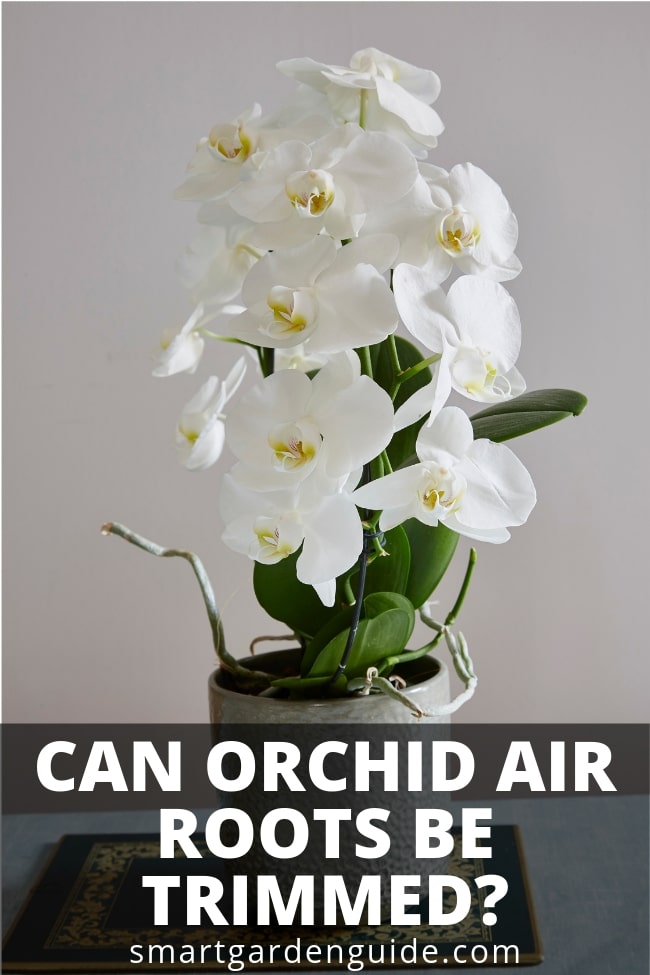
It is very common to see orchids whose roots come out of their pots and float in the air. Some people love the way they look, while others hate it. I am often asked if the aerial roots of orchids can be pruned. Well, here is the truth about these frequently asked questions.
Can you prune the aerial roots of orchids? The aerial roots of orchids should not be cut, as they are part of the system the plant uses to absorb nutrients and water. Pruning aerial roots can lead to difficulty or even death of the plant due to disease or an inability to absorb enough water and nutrients. There are several ways to deal with aerial roots, depending on your preference.
What are aerial roots?
Orchid aerial roots are roots that grow in soil. They may grow higher up the stem or emerge from the soil. Some orchids naturally produce many aerial roots, others relatively few.
Orchids are naturally epiphytic plants, which means that they grow on other plants and not on the ground. Roots are responsible for anchoring the plant in position, as well as absorbing water and essential nutrients.
What is the difference between aerial roots and normal roots?
In many ways, aerial roots are exactly the same as normal roots. Only the location of the roots is different. However, there are a few things to keep in mind.
Aerial roots are often among the healthiest roots in the entire plant, as these roots will grow in conditions closer to the orchid’s natural habitat.
Home grown orchids are usually potted in substrates such as pine bark or peat. Over time, this potting mix breaks down and the roots in this medium can often be under severe stress and have a high risk of root rot.
What should I do with Orchid Air Roots?
Opinions differ on the best way to deal with aerial roots of orchids. I guess the short answer and the one that will best promote the health of your orchid is to leave the aerial roots of the orchid alone. Let them grow out of the pot as they please.
Some people love the look of aerial roots drooping from their orchid pot, while others find them messy. If you want to reduce the visual impact of aerial roots, there are a few things you can do.
Double your orchids
It is a popular choice because many orchids are kept in light, well-drained pots to provide better light for the roots, then placed in a larger, non-draining ornamental pot. If aerial roots develop, you can encourage them to grow along the sides of the clear pot into the ornamental pot. This means the aerial roots should stay happy and healthy, but they won’t be too noticeable.
This option gives you the best of both worlds because the aerial roots aren’t planted in potting soil, which probably doesn’t promote the best orchid health, but also keeps them away.
Take care that the aerial roots do not end up in a pool of water at the bottom of the decorative pot. This can easily be avoided by properly draining the orchid after watering so that the ornamental pot stays reasonably dry.
transplant your orchid
Although many advise against this, as orchid roots tend to be less healthy when grown in potting soil, I think it’s a reasonable option if you really don’t like the look of aerial roots. I’ve tried this technique several times with success, although it wouldn’t be my first choice reader.
However, I think you should be aware that there is a chance that it could negatively affect your orchid’s health.
If you’re trying to get all the aerial roots into a new pot with potting soil, consider potting soil that won’t break down over time.
A good option is to place the orchid in pots with expanded clay granules, as they provide adequate air circulation and drainage, allowing the orchid to adapt.
If you decide to plant the aerial roots in pots, be careful not to overwater your orchid. If you continue with the same watering cycle as before, the orchid will receive more water as more roots are watered. There will also be some residual water around the roots that will stay longer because they are in a pot surrounded by potting soil.
How to prune the aerial roots of orchids
If you really want to get rid of aerial roots, can you prune them? Well, I guess you can, as long as you’re willing to risk it negatively affecting your orchid’s health.
If your orchid has only a few aerial roots and the rest of the plant and roots are healthy, the plant will likely survive without too many problems. If the plant has abundant aerial roots, removing them could really give the plant a hard time, and you should reconsider.
If you want to remove aerial roots, try doing so after watering the plant to ensure it is well hydrated and the aerial roots are softer and more flexible.
Use a sharp knife or thin secateurs. Thoroughly sterilize the blades in an alcohol solution or under a flame. The greatest immediate risk to the plant is open wound disease, so care should be taken not to introduce the disease if possible.
Cut as close to the stem as possible without risking damaging the stem of the plant. Confidently cut along the aerial root to make the cut as clean as possible.
Orchid aerial root care
The aerial roots of orchids do not require much specific care. If you take good care of your orchid, aerial roots will be happy. However, aerial roots can experience some of the same problems as normal roots, as well as some of the same problems as leaves and stems.
Do you need to water aerial roots?
It is not necessary to actively water aerial roots, but many people choose to mist or water them regularly. If the roots of the potting mix are well watered, the aerial roots should remain firm, firm and silver in color with green tips.
Aerial roots get moisture from the humidity in the air. Problems can arise if you keep your orchids in dry conditions.
I usually water my orchids by taking them to my sink and running hot water through the growing medium. I make sure to wet the aerial roots at this time and usually check the overall health of the plant at this time.
During the vegetative phase of orchid growth, I use a weak fertilizer solution every other time I water my orchids. I do not fertilize them during the flowering phase.
Moisture levels for healthy aerial roots
If your orchid has a lot of aerial roots, it will be more sensitive to humidity. Try to keep the humidity above 40% so the aerial roots don’t dry out too quickly. If your home has low humidity, consider placing your orchid in a humid container or using a humidifier.
Light Requirements for Orchid Aerial Roots
Orchid roots differ from many plants in that they actively carry out photosynthesis through their roots. The roots of orchids are usually dark green when wet and silver when dry. If your orchid’s roots are exposed to direct and indirect sunlight at the same intensity as the rest of the plant, it will benefit the plant.
However, in the same way, the leaves and flowers of orchids can be burned, as well as the roots of orchids. Leaving your orchid in direct sunlight for long periods of time can cause the roots to turn crusty and brown or black. See the photo below for an example of an orchid that spent months in a south-facing window during the summer.
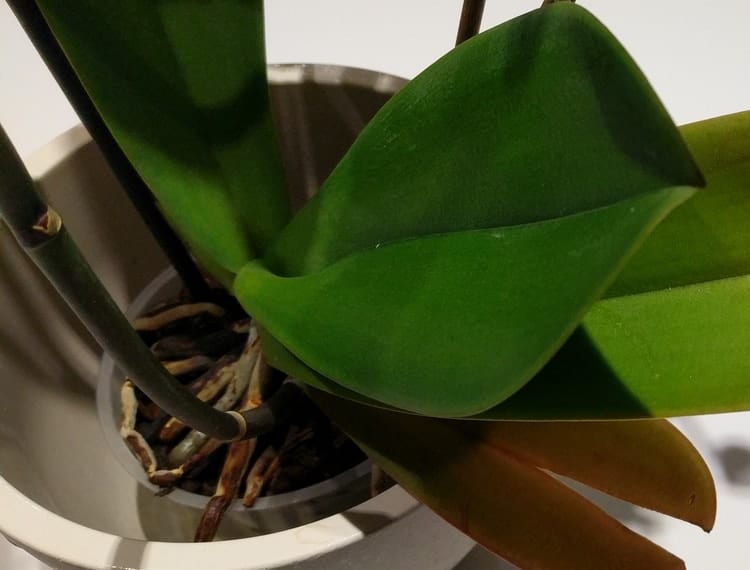
If this happens, the roots will not recover, but the plant can usually be saved by moving it to more appropriate light conditions. You may need to prune damaged aerial roots if this occurs.
What to do with overgrown orchid roots
Sometimes, instead of the aerial roots causing problems, it is the roots in the soil. If your orchid pot is full of roots, so much that they stretch into the pot and stick out of the middle, you should consider repotting your orchid.
Orchids generally like to be attached to the roots, so there is a high proportion of roots in the potting mix. However, there comes a time when the plant and the roots have grown large enough that the roots are struggling in the existing pot.
Now move on to a slightly larger pot. Remove all the potting soil from the pot and release all the roots. This is a great opportunity to test root health. Remember that healthy carrots should be plump and firm or tough. They should be green when wet and silver when wet. If some of your roots are mushy, mushy, brittle, and brown or black, you have root rot. If the carrots are gray, wrinkled and crunchy, they are dry.
Unhealthy roots should be removed with sterile pruning shears and not transplanted into the new pot, as they can negatively affect the health of the plant.
Be sure to use fresh potting soil because assuming you are using an organic medium, the old potting mix will start to break down, stressing the plant and increasing the risk of root diseases.
Can you mount orchids instead of growing them in pots?
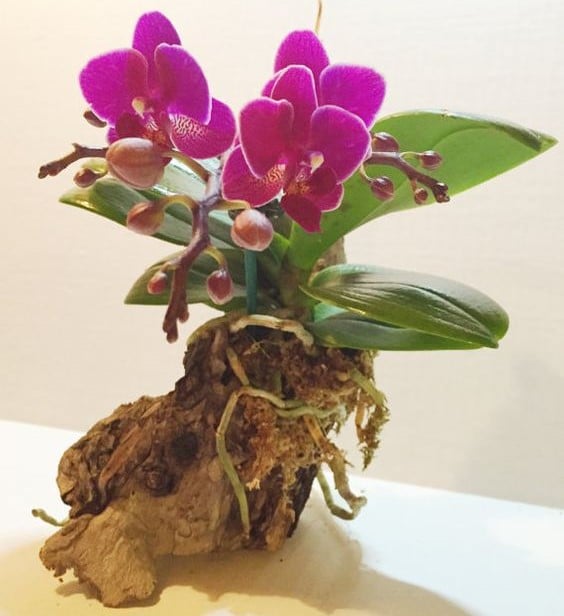
As mentioned above, orchids do not grow in potting soil in the wild. It is entirely possible, and often healthier for an orchid, to grow it on a tree, branch or artificial structure rather than planting it in a pot.
Most orchids are sold in pots because that’s the conventional way of doing things and it’s more forgiving of imperfect short-term care. It’s a little more work to care for a mounted orchid, but you can put on a great show with it.
If you want more information on orchid care, I have many other articles that you might find helpful. I have a special interest in phalaenopsis orchids and have lots of useful information in the orchid section of this site. I also have a free phalaenopsis orchid care ebook that I give away to anyone who subscribes to the Smart Garden Guide newsletter.