The Cherry tree It is a growing crop given the economic performance it currently produces and the fact that there are more and more varieties adapted to different climatic regions.
However, it is a stone fruit tree under heavy pest and disease pressure. Among them, the one known as cherry gummosiscommon in areas with high humidity, causes great damage because it is difficult to solve.
In this article, we present a guide for the identification and control of gummosis of cherries, caused by the bacterium Pseudomonas syringae.
Identification of cherry gummosis (Pseudomonas syringae)
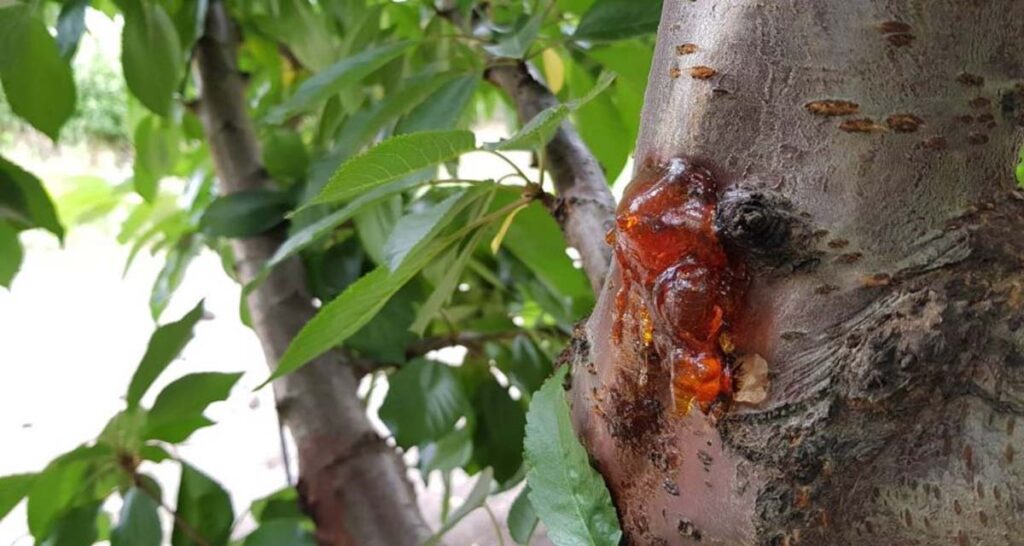
The symptoms of cherry gummosis are clear, producing on the wood the oozing of a brownish gum Of course, sticky at first.
The Progression of Cherry Gum Disease reduces sap mobility for the stems, drying whole branches and causing intense defoliation of leaves and flowers on affected branches.
The process can be slow and is enhanced by a increase in ambient humiditya fact that promotes the advancement and reproduction of the causative bacterium, Pseudomonas syringae.
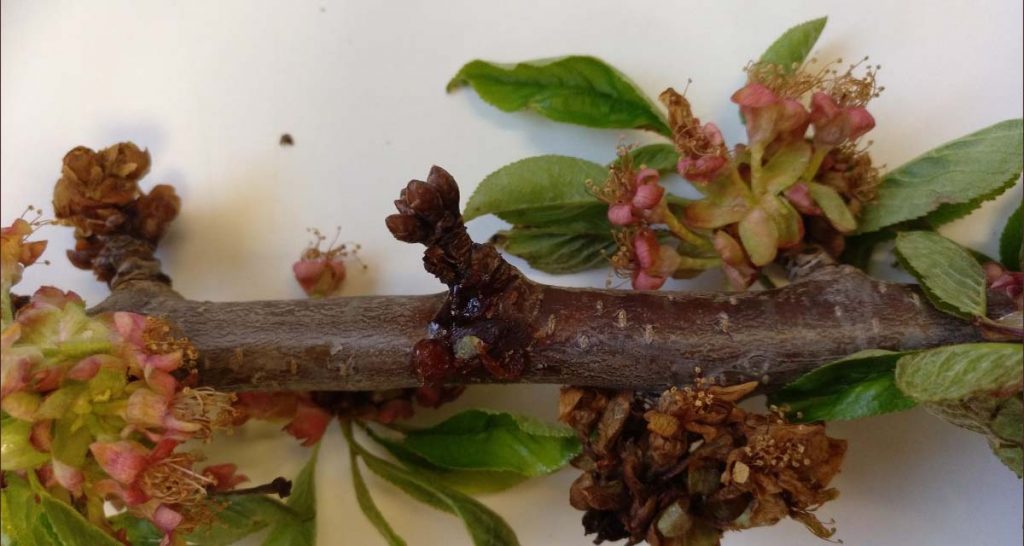 Credit: Carlos Lozano (@clozanoto)
Why does the disease appear?
Many diseases caused by fungi and, mainly by bacteria, take advantage of pruning woundsleaf or flower drop, hail damage or other mechanical damage to penetrate inside the plant.
all bacteria require high humidity conditionsas well as an average temperature, which is why in rainy conditions and relative humidity above 80%, it is very difficult to fight the disease.
Although we carry out strict pruning control and clean the tree properly, even the fall of the flowers in the spring (after flowering) or the fall of the leaves, well in the fall, are two possible entrance fireplaces of the bacteria, because small wounds are created through which the disease can enter.
For this reason, both moments are ideal to achieve preventive copper treatmentssince it is the only active ingredient authorized for this purpose.
You can also use foliar applications of nutritional coppersespecially those complexed (copper gluconate, heptagluconate, lignosulphonate, etc.), as they are not classified as phytosanitary products but have proven themselves in the prevention of diseases.
Therefore, it is important seal pruning wounds with putty or solutions impregnated with copper, which help heal the wound and provide a physical barrier to the entry of fungi and bacteria.
Cherry gummosis control
One of the current problems farmers face with bacteria is that there are not many products allowed because antibiotics were banned many years ago.
Currently copper is the only control mechanismand the difficulty of bringing metallic copper into contact with bacteria arises.
Products authorized for the control of cherry gummosis:
Additional tips:
- 1-2 applications with an interval of 19-21 days.
- Dosage per application by normal spraying with a tractor, manual with a backpack, a lance or a gun: 1.7-2.5 kg/ha.
- Volume of broth from 500 to 1,000 L/ha.
Preventive measures against gummosis of cherries
We always say that when it comes to crop diseases, prevention is better than cure. And this statement takes on much more force when talking about bacteria.
Copper formulations help to control the disease, but they are not a panacea, in particular because of their difficulty in penetrating wood, and even more so, affected or dead wood.
Some tips to prevent the appearance of gummosis of cherries caused by Pseudomonas syringae are the following:
- Avoid late pruning in cold, high humidity conditions.
- Choose disease-resistant varieties
- Apply intense pruning sealants or healing pastes, or do foliar applications with copper after this task.