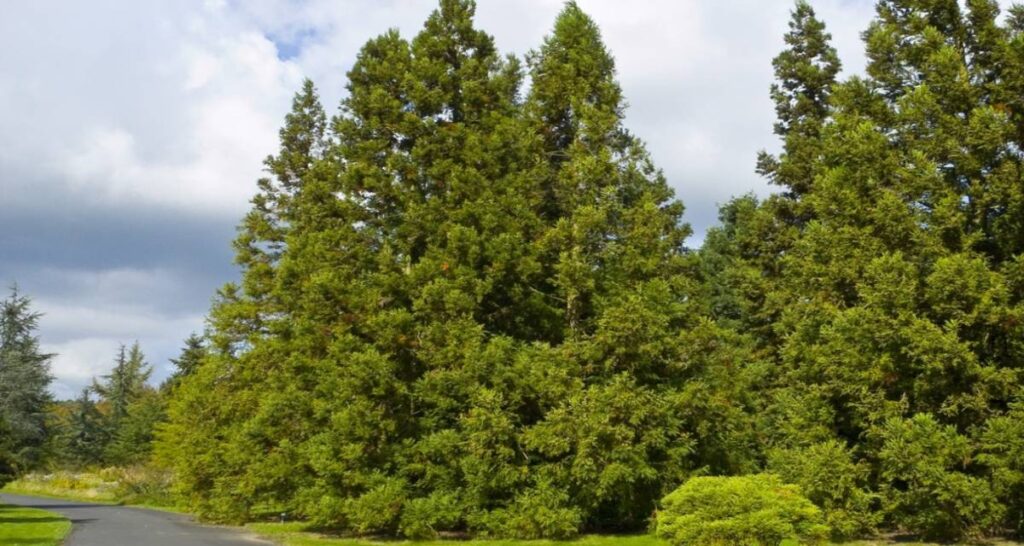
In Japan, we find the species of nature’s most impressive and oldest conifers. One of them and the best known in Japan is cryptomeria japonicaknown as suggested.
This gigantic tree, whose height easily exceeds 50-60 meters in adult species it has been part of the history of the land of the rising sun, for the use of its wood, and has been part of the religious rites of the island, being usually planted around temples.
Although it is a highly endangered tree, it is used as the main basis for forest reforestation in Asia, mainly in China and Japan, and also as an ornamental tree in other European regions (mainly the Great Britain) and North America.
For people allergic to conifer pollen, cryptomeria japonica It is one of main causes of allergies (allergic rhinitis) in Japan. The second cause is the Hinoki cypress (Chamaecyparis obtusa).
These conifers are capable of living for hundreds of years (some even thousands). In fact, on the Osumi Islands is the so-called Jōmon Sugi, a cryptomerism several years old, declared a “world heritage site” by Unesco.
characteristics of conifers cryptomeria japonica
It is an evergreen tree that reaches 70 m in height and 4 m in trunk diameter, with reddish-brown bark edged with vertical bands. It has spiral needle-shaped leaves 0.5–1 cm long; Seed cones globose, 1–2 cm in diameter with about 20–40 scales. It superficially resembles the giant sequoia (Sequoiadendron giganteum), differing in longer leaves (less than 0.5 cm in sequoia) and smaller cones (4–6 cm in sequoia), and harder bark ( fine, soft, spongy).
A long time ago in China, a variety Cryptomeria japonica var. sinensis (or even a different species, Cryptomeria fortunei), but they do not differ from the full range of faunal variation in Japan, and there is no definitive evidence for what happened in China.
Cortex: reddish brown with dark gray highlights, fibrous in appearance and brittle in the form of strips when pressure is exerted.
branches: whorled type, with horizontal or drooping development, with generally drooping branches, green juveniles and darker adults.
Sheets: usual needle shape in conifers that remain on the tree for 4 or 5 years, pale green color, spiral shape in 5 rows, spreading or directed forwards, subulate to linear, ± straight or strongly curved, adaxial and abaxial surfaces convex, rigid, lateral surfaces slightly flattened, keeled, stomatal bands with 2 to 8 rows of stomata present on the 4 surfaces, decurrent base, acute apex. Length of 1.4-2 cm and width of 0.8-1.2 mm.
Seeds: dark brown in color, producing 2-5 per scale, ellipsoid in shape and 4-6.5 × 2-3.5 mm in size. The seeds ripen in October.
Germination: aboveground type, pollinating in the months of February to April.
If you are looking for an ornamental conifer to decorate the garden, you can also choose cryptomeria japonica var ‘elegant’, with smaller dimensions (between 5 and 10 m in height) and greener and younger foliage. The most common cultivar is cryptomeria japonica ‘Black Dragon’.
taxonomy
| Order | Pinals |
| Family | taxodiaceae |
| Genre | cryptomerism |
| Species | cryptomeria japonica |
Common names: cryptomeria, Japanese cedar, Japanese cedar, sugi (杉).
Origin of the scientific name: the name is derived from the Greek kryptos, hidden, and meros, part (Vidakovic 1991)
natural location
The cryptomeria conifer is common on the Asian mainland, China and Japan, although the variety cryptomeria japonica He is only from Japan. Small populations of cryptomeria japonica in some European forests and in North America. It has also been naturalized in the Azores Islands (Portugal).
growing conditions cryptomeria japonica
Conifers, in general, are very resistant trees that do not lose their leaves at any time, stoically withstanding absolutely freezing temperatures, even below -24 ºC. They are slow-growing but continuously developing species.
Climatology
cryptomeria japonica It is very weather resistant, withstanding a very wide range of temperatures, even the hottest ones. Japan freezes in winter and suffers from very hot and humid summers. It can be grown in continental and coastal climates, withstanding strong winds.
Japanese cedars thrive in full sun to part shade. They can grow rapidly when first brought home from the nursery, due to the extra fertilizer they receive there, but within a year they settle and slow down in their habit of dense and compact growth.
the type of soil
Cryptomeria generally grows in deep, well-drained, fertile soils. The degree of pH is indifferent, although it prefers slightly acidic ones. If you cultivate this species in the garden, it is important to bring organic matter continuously to enrich the soil, especially the first year, in the planting hole.
water needs
cryptomeria japonica This requires a large supply of water, because in the Japanese country it rains constantly. It is better to water voluminous and less frequent, watering 2-3 times in the summer and 1 every 7-10 days in the summer.
Plagues and diseases
The usual among conifers, although it seems to be more resistant to others, especially in Europe, perhaps due to a lesser presence than those endemic to the region. The North Carolina State University Cooperative Extension mentions the disease known as “branch dieback,” which dries out entire branches of the tree.
Although it is being studied, the fungus may be involved in this disease. Phytophthora.
Current state of conservation
Near Threatened (NT): according to IUCN (API) (International Union for Conservation of Nature) IUCN Red List published at https://www.iucnredlist.org. Real-time update.
The wood is aromatic, pinkish red, light but strong, waterproof and resistant without rotting. In Japan it is used in all types of construction and indoors for trim, etc.