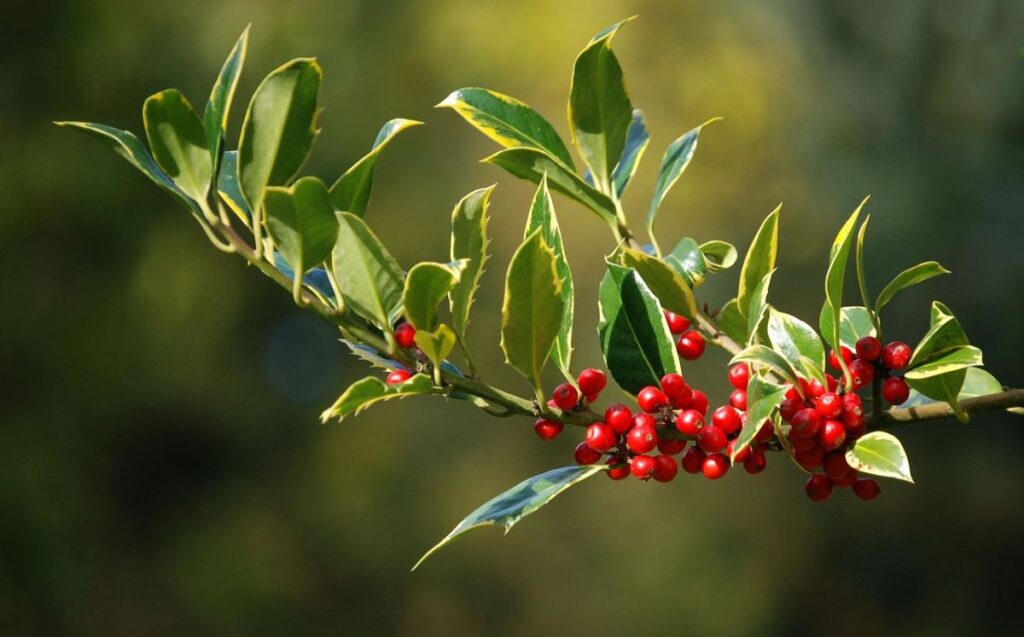

There are many types of plants in the plant kingdom.. Some have special characteristics, such as a plant with red balls. Indeed, if we ask you about them, it is possible that you associate them with a typical Christmas plant.
But did you know that there are many other plants with small red balls? We want to leave you with a selection of these below so that you have the choice. Shall we start?
The Best Red Ball Plants for Your Garden

Plant red balls there. We can’t tell you that there are many, but you will find a variety to choose the ones you like the most.
In fact, we’re going to talk about some of the best you’ll find here. Will you fall in love with one or more of them?
Gaultheria mucronata
More commonly known as chaura, it is a perennial shrub that produces red (or red to pink) balls. Native to Chile and Argentina, it is very frost hardy and the leaves, which are dark green, will stay on all year round.
It produces red berries 6 to 9 mm in diameter. At first, these balls are white, but as they mature they turn reddish and from there to purple.
Streptopus streptopoids
This strange name is for a plant with red balls that will look a lot like the one you know typical for Christmas. These small balls measure between 5-6 mm in diameter, but be careful, because they are not fruits that you can eat.
domestic nandina
We continue with another plant with small red balls that will attract your attention, not only because of these red berries, but also because of the color of the leaves.
We are talking about the so-called “sacred bamboo”. It is an evergreen plant that is distinguished by the color tone of the leaves over the seasons. (it goes from green to red).
As for the berries, they measure between 6 and 9 mm in diameter, of a very bright red. You can enjoy it both in autumn and part of winter.
Ilex aquifolium
This plant with red balls certainly looks familiar to you. Especially if you’re told it’s the mistletoe. In winter, it develops some fruits, these red berries. Branches are cut from it and hung on doors or frames so that when a person walks by, they know to kiss someone else.
If you want to have it in a pot, know that it will not grow more than two meters high, always in the form of a bush.
Ardisia crenata

Do not be mistaken if you see a photo. It seems, This shrub, also evergreen, native to Japan, India and the Philippines, develops bouquets of white flowers in the fall. which give rise to dark red fruits.
These are kept both in autumn and winter, so you can see them at Christmas).
Pyracantha rogersiana ‘Flava’
In case you didn’t know, Pyracantha is a red-balled plant, but it’s normal for this one to be harder to find (the most common is the orange-balled one).
It has long but narrow leaves of bright green color. For its part, the balls are developed in the spring and can be maintained until the end of the summer with them.
Cotoneaster horizontalis
Another of the red ball plants which is also easy to find and not too expensive for your pocket is this one. It is characterized by being deciduous, dark green in color, although it turns orange before falling.
The flowers it throws are white or white and pink. And, after them, the fruits will arrive, of red color. You will usually see them in the fall.
Solanum lycopersicum
You will love this plant with small red balls, especially if you like tomatoes. And we’re talking specifically about the cherry tomato, or cherry tomato.
You will have a plant with large leaves with grooved edges, and a dark green color. Among them will grow these little red balls, the tomatoes, which can measure about two centimeters in diameter. When ripe, they will acquire a very characteristic reddish color.
Vaccinium occicocus
In this case, we are talking about cranberries. These come out of this shrub and grow in cold regions. The flowers it produces are dark pink, but the berries later turn dark red.
If you’ve never tried blueberries before, know that they fall somewhere between sweet and sour.but they are highly recommended for diet due to the benefits they present.
Aiphanes minima
We end up with a plant that can grow up to 20 meters, but it is not recommended for any garden, especially if you have pets or young children. And it is that the trunk and the fruit can be surrounded by thorns. Actually, the trunk can exceed a foot in diameter, which means quite a large area of thorns.
Its fruit is a red ball, very rounded and striking because it acquires a fairly intense red hue.
Care and Features of Red Ball Plants

You want to know what you need to care for these plants and what their characteristics are. So take note of these tips that we share with you:
- Red ball plants are characterized by their persistence (although some species have cauda or semi-deciduous leaves). This means you can enjoy the plant all year round, even when it’s not flowering or fruiting.
- Most of them keep fruits for a long time, fatten some, maintain others.
- In general, a plant with small red balls will bloom in the spring and summer months, and it will be from autumn that you can enjoy their show.
- It is important to give it a good location. Many need lighting for several hours, although you don’t have to leave them in direct sunlight.
- Regarding irrigation, it will largely depend on the type of plant you have in hand to know whether to water less or more. We recommend that it is always better to water little, but sometimes, than to spend too much.
- Subscriber is needed in these factories, especially in spring and summer, since you will give it the necessary nutrients and energy to carry out the flowering and, with it, also the so appreciated red fruits.
Do you know a red ball plant that you would like to recommend? Leave us in comments.