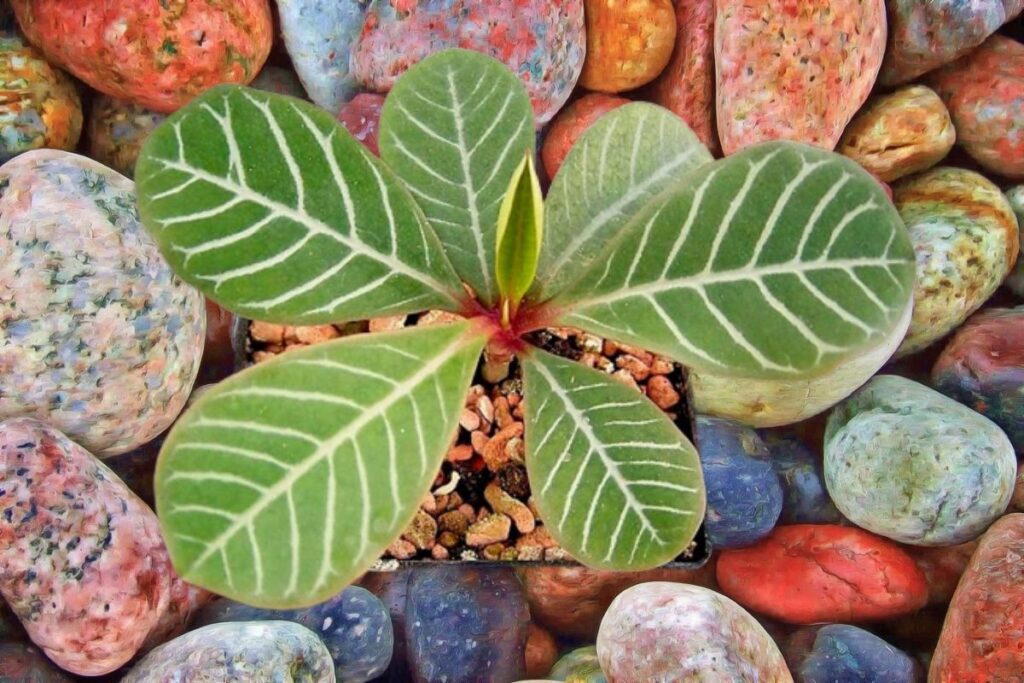

Have you ever seen a succulent with leaves and this one with white veins? Well, that’s what Euphorbia leuconeura is. Do you know her? It is an endangered plant because it is losing its habitat in Madagascar. What if you had it in your collection?
Below we will talk about it, its characteristics and the care you should give it if you are going to take care of it.
How is Euphorbia leuconeura
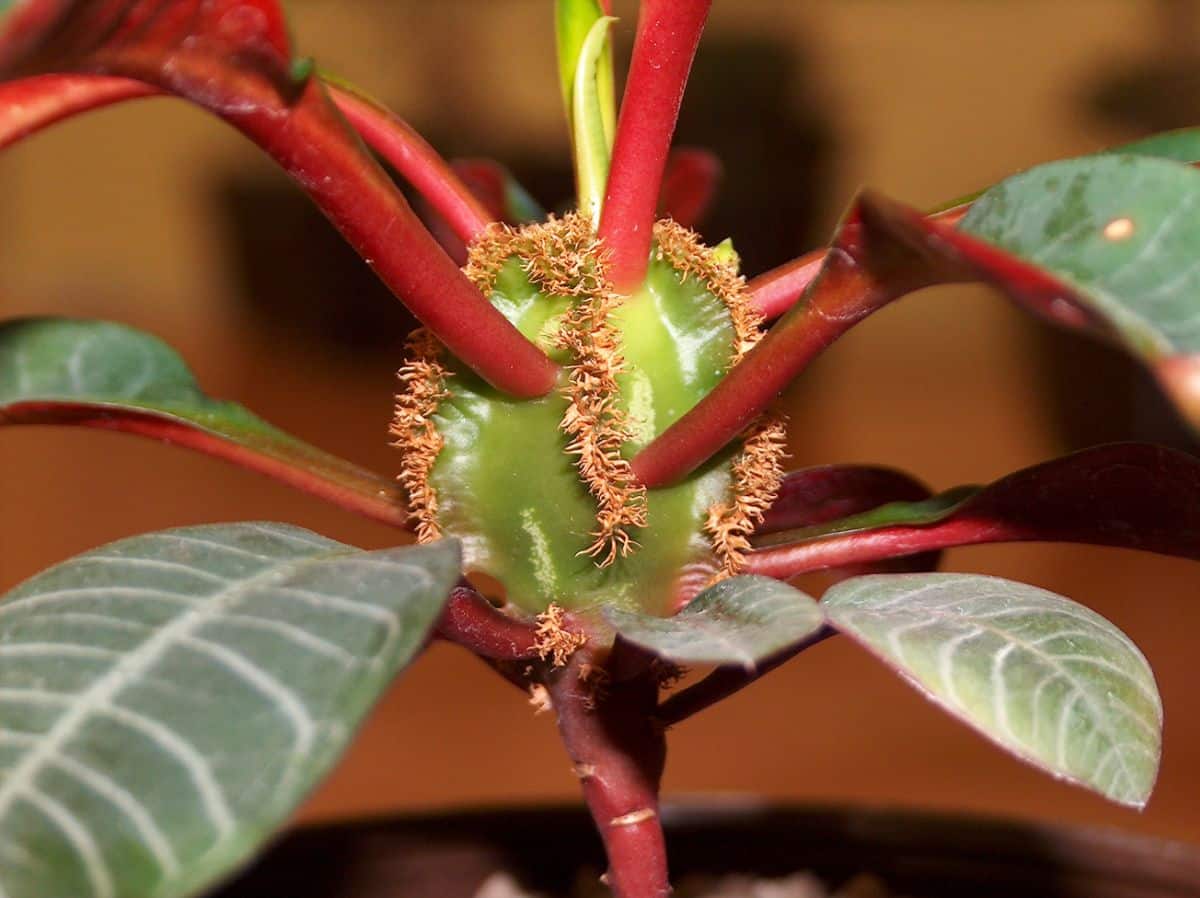
Euphorbia leuconeura is best known as the jewel of Madagascar and, as we have already told you, it is a plant that is in danger of extinction because it is losing its habitat (rocky areas, where it grows among forest undergrowth). It is native to Madagascar (hence its name) and is usually kept there as a houseplant.
It grows up to almost two meters, as if it were a branched tree. The leaves are dark green, however, they attract much attention as these, when young, are full of white veins. This means that when they are adults or older, this characteristic will disappear.
Another important curiosity to take into account is that she is told that she is a “spitter”. It’s not like I’m gonna spit poison on you or anything. But it shoots the seeds, sometimes several centimeters from the plant. Therefore, it is so called because it is able to extend for several meters around itself. And it is that its bulbous growth has it in the center, where it flowers and sheds its seeds.
The plant is a perennial, although it sometimes loses its leaves in winter to regrow in spring (especially if the temperature drops below 10 degrees).
You have to be careful because, if something comes off the plant, the white liquid that comes out is toxic, irritating on contact with the skin, and may even promote tumors. That is why it is recommended to wear gloves and even goggles to prevent the liquid from coming into contact with the person.
Euphorbia leuconeura care

Now that you know Euphorbia leuconeura, would you like to have it in your collection? It is not a “usual” plant but it does not stop looking pretty. In fact, it is, and you would just have to be careful about this problem with your liquid (so as not to put your health at risk).
It is not easy to find care, so we give you a summary of everything you need to take into account so that he does not die.
location and temperature
The first thing you need to know is that Euphorbia leuconeura is an indoor succulent. It doesn’t need to be outside, but it grows much better inside the house. Accept both semi-shaded and shaded pitches, although we recommend the former over the latter.
You need to make sure that there are no drafts because it does not tolerate them well at all. Even so, you could have it both in a pot and planted in the garden (for example next to a terrace or on a balcony where you have a large planter).
As for the temperature, euphorbias in general tolerate temperatures very well, both high and low. However, in the case of Euphorbia leuconeura, we found data which warns us that, if the temperature drops below 10°C, there may be no more leaves, but they will come back in the spring.
In general, your ideal would be between 25 and 32°C. But it can tolerate a few degrees more heat.
Substrate
Euphorbia leuconeura is a plant that does not pose too many problems for the soil you use because it tolerates slightly acidic, neutral and slightly alkaline (not the extremes).
What you need to keep in mind is that it requires good drainage. Our suggestion is therefore a mixture with a universal substrate, a little peat and a lot of drainage (perlite, bark, etc.) which helps to oxygenate well.
You must bear in mind that in a pot you need one that is deep to be able to develop and grow the necessary meters (that is, at least 24 to 30 centimeters).
Irrigation
Euphorbia leuconeura is a plant that tolerates excess water much better. This means that if you go too far, nothing will happen to it (if it’s sporadic, of course, because if it happens often, you can rot its roots).
Thus, watering it once a week is more than enough. This, yes, you need to make sure the substrate is dry to do this.
In the case of autumn and winter, it may be necessary to space out the waterings even further. In fact, they even stop as it helps him enter the resting period and he’ll be more likely to succeed if the soil is dry (don’t worry as he can handle long periods without water).
Another point to consider is humidity. It must have between 30 and 60% if it is indoors.
Subscriber

Once a month, in spring and summer, you should add a little fertilizer to give it more nutrients. This, yes, if you just planted or transplanted it, then better wait a few months to do so because it already has the nutrients it needs (it is better to leave it for the following year).
Size
In general, Euphorbia leuconeura is not pruned. But you may end up with damaged rods. If this happens, take gloves and goggles before handling it to avoid irritating your skin or causing health problems. You need to cut them from the base.
Other than that, you don’t need to touch the plant at all.
Multiplication
Euphorbia leuconeura reproduces by seed. These are “spit out” by the plant itself a few centimeters from it. And those are the ones that are planted and in 3-4 weeks they should sprout and grow from there pretty quickly.
We are not going to tell you that it is easy to find an Euphorbia leuconeura, because since it is endangered, it is complicated. But the truth is that it’s not expensive if you find it (usually outside of Spain). Would you dare to have it?