

Having and maintaining a bonsai is a challenge and at the same time something incredible. And it’s that they are delicate, we’re not going to deny it, but when you see that year after year it’s getting better, it gives joy. So until you get a big bonsai.
However, Do you know how to take care of it? How do they differ from other types of bonsai that are more easily found in stores? Next we are going to give you all the keys so that you are clear and know what type of bonsai we are referring to.
Types of bonsai according to size

If you are a bonsai lover, you may know that there is a classification of these miniature trees according to their size. If not, we tell you now.
And that’s it, the usual size you know and see in stores is just one of many there may be. More specifically, these:
Hachi Uye
This name is the one that encompasses the large bonsai trees. Really, the biggest size that exists.
They are characterized by have a height of more than 130 centimeters, yes, almost like the size of a person. Now they are very rare to see, as well as very expensive. And his care is enough to keep him in the best condition.
Only collectors and the rich are able to have such a bonsai.
omono
These are big bonsai, but not as big as the previous ones. These They reach a size between 60 and 120 centimeters. They attract a lot of attention and, although they are delicate and something to be aware of, they do not require as much care as others.
chimono
In this case, the height of the bonsai measures between 30 and 60 centimeters. Like the previous ones, they are not easy to find but you can see them especially in specialty bonsai stores.
These are less expensive and more basic treatments (although they have their particularities).
Komonō
They go from one height from 15 to 30 centimeters. These are easy to find and also easy to maintain. In specialized stores, it is the specimens that look the most expensive, but also the best cared for.
shohin
This is the name given to bonsai sold in stores, supermarkets… Also in places specializing in bonsai. Their height is between 15 and 25 centimeters and they are very easy to maintain. compared to the first.
suck me
They are mini bonsai, because They don’t even measure 15 centimeters. Unlike others, they are more difficult to maintain (although they are smaller) and require good technique and knowledge to stay healthy.
shit
These are very hard to find (as is the case with hachi-uye) because They don’t even measure 5 centimeters. They are also complicated to maintain and are not valid for anyone.
How to maintain a large bonsai

On this occasion, we will focus on the maintenance of large bonsai, hachi-uye and omono.
In Japan, these trees, especially the first ones, they are considered bonsai type trees, while in the West they are called garden trees.
location and lighting
These types of tall bonsai should not be kept indoors, but rather its ideal location is outdoors. Also keep in mind that due to their size they are very difficult to move, sometimes even requiring a crane to do so.
They need sun Normally, and depending on the species, directly. They are even grateful if you place them in an area where there is a bit of wind.
Irrigation
Watering a large bonsai is not as complicated as with others. These are able to withstand a week without watering, everything will depend on the climate in which they are found.
In general, they are usually watered every 5 days, but it is not difficult to water them because they do not need much. This is due to the advantage they have due to their height, as they are more like the needs of a “normal” tree than those of a bonsai.
Transplant
The transplant is not usual. This needs to be done every few years, of course, to be able to renew the earth and also change the pot if the one you have has become too small. But due to its size, it is quite complicated.
In fact, on the Internet you can see videos in which a hachi-uye transplant is performed and how laborious it is.
Wiring
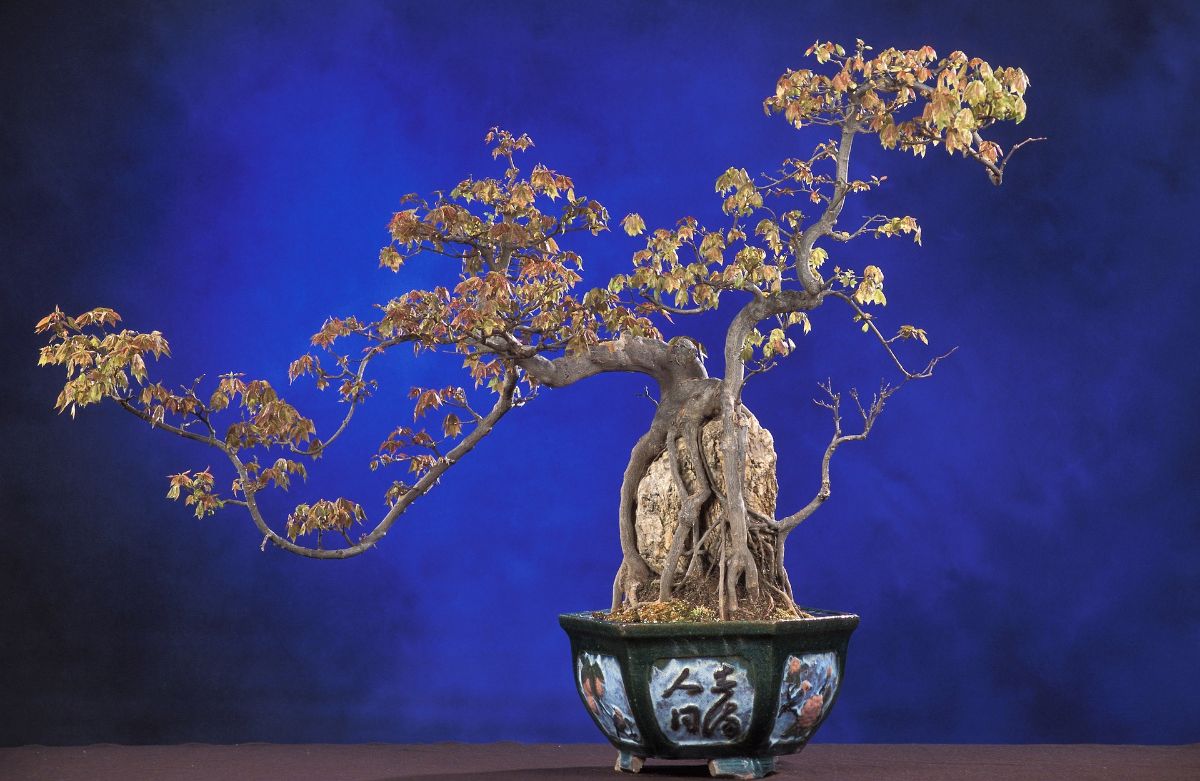
The wiring of a bonsai consists of orienting the branches of this tree so that they create a beautiful whole. However, in the case of hachi-uye, this is quite problematic, especially since the branches themselves offer a lot of resistance and wiring them can be complicated for one person.
Cut
To the previous difficulty we must add that it has a dense arborwith which you must be very aware that the plant can breathe on all sides, clarifying the center so that the sun reaches all parts of the plant.
In general, these are trees that tolerate severe pruning well, but you have to be above to prevent it from getting out of control or being affected by diseases or pests.
Subscriber
Yes, necessary, especially in the months of activation of this bonsai. In fact, over time you may need more to make up for the nutrients you no longer have in the soil.
The subscriber can be through soil or liquid in irrigation water.
Plagues and diseases
As far as pests are concerned, it must be said that they are much more resistant than other types of bonsai, and they are so because they are larger and have a more tree-like habit than what can be considered “bonsai”.
Even so, you have to be careful with them, because They can end the health of these living beings or cause permanent damage.
As for diseases, here there are more problems. Being potted and dependent on its keeper, it is more subject to problems due to excess or lack of water, light, subscriber… It must therefore be watched almost constantly.
As you can see, large bonsai trees look spectacular. But having to be very aware can make things difficult. And to this we must add that they are not cheap at all. Would you dare to have one like this in your home?