
If you purchase an item through links on this page, we may earn a commission. Our editorial content is not influenced by commissions. Read full disclosure.
Lucky bamboos are a popular choice because their beautiful appearance adds personality to your home. Bamboo plants are a popular feng shui symbol and are admired in Asian cultures for their simplicity, beauty, and powerful presence.
Bamboo plants are native to Africa but are found all over the world in homes and offices. The stems are often braided and twisted into beautiful shapes.
If you are looking for a “lucky” addition to your home, you should grow lucky bamboo. Here’s how:
What is a lucky bamboo plant?

Dracaena sanderiana is unrelated to the type of bamboo we grow outdoors, which are grasses of the Bambusoideae subfamily. It is part of the Dracaena genus, which also includes plants like dragon trees, snakes and the common dracaena.
“White Stripe Victory”, as you might have guessed from its name, has white stripes. ‘White Stripe Gold’, on the other hand, has yellow stripes.
D. braunii, a closely related species, is often also sold as lucky bamboo. They look alike and can be bred the same way. Look for ‘Lotus’ and ‘Ceres’ cultivars.

The right conditions for Lucky Bamboo
If you live in USDA growing zones 10-11, you can plant lucky bamboo outdoors. This plant is native to warm regions, you will not be able to grow it outdoors all year round if you live in a cold place.
It’s a good thing that this plant is perfectly happy in the same conditions we have at home! This way we can enjoy them wherever we live by growing them indoors as houseplants.
As for the temperature, you should give the lucky bamboo plants at least 65℉. although they can survive up to 90℉. Do not leave them in an area that drops below 50°F.
As for placing a lucky bamboo plant, do not place it near drafty windows or in front of an air conditioner. These places will be too extreme for your houseplant.
Lucky bamboo plants only need medium humidity, so you don’t have to worry too much about the humidity levels in the room your plant will be in. Besides temperature and soil, you will also need to provide the right lighting conditions.
Light levels
Light levels are important for growing lucky bamboo – and all plants, really. Provide bright but indirect light for best growth. As these plants originally grew under canopies in the rainforest, they will need moderate light exposure but no direct sun.
For example, you can place your lucky bamboo near a window with a sheer curtain. Or place your plant near a north-facing window.
If your indoor plant is exposed to the heat and intensity of direct sunlight, the leaves will be damaged.
When in doubt, it is always better to give this plant a little less light than too much. If you’re concerned that the lack of light is affecting your plant, watch for any signs of pale or elongated growth.
You can easily solve these problems by giving the plant more light, so it is not a serious problem.
Soil selection
The best type of soil to grow a lucky bamboo plant in is rich, well-drained soil. This will give your plant plenty of nutrients without drowning the roots. Any soil that holds water and drains well will do.
You can also place the plant in a vase or glass filled with water with pebbles at the bottom. This is a common and traditional way of growing lucky bamboo and a plant can live for up to a year in water.
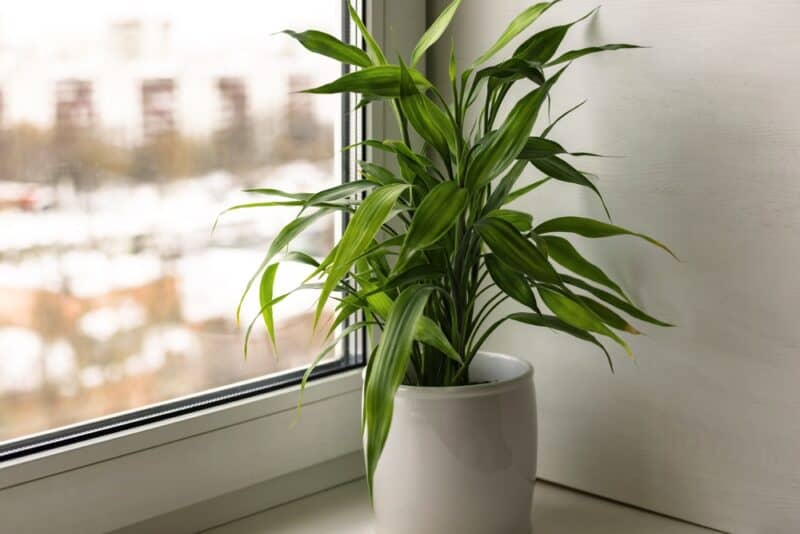
Remember to leave at least an inch of standing water covering the stems at all times and change the water regularly.
Once you’ve covered light, temperature, humidity, and soil, you can move on to caring for your new houseplant.
Caring for your lucky bamboo
Did you know that lucky bamboos are sensitive to chlorine? This means that tap water is not ideal for watering your plant if your water is chlorinated. Use distilled water or leave the water out for a day to allow the chlorine to evaporate.
To grow in a water vase, you should also make sure to change the water regularly. Ideally, every week is good for your plant to develop no disease.
You will know if your roots are healthy by their color. Your lucky bamboo should have red roots.
In addition to watering your houseplant, you can also feed your lucky bamboo fertilizer once a month during warm seasons. This is especially important if you are growing the plant in water as it will need liquid fertilizer every month.
There are also a few other things that can help you develop the best shape and size for the plant. Here are some gardening tips for growing lucky bamboo:
- You can shape the plant by rotating it towards the light
- Cut offshoots within 1 to 2 inches of the main stem
- Braid or wrap the stems together to create a fun look
Overall, the main maintenance tips to remember when keeping this plant at home are to change the water in the vase regularly, avoid direct sunlight, and fertilize monthly. As you can see the maintenance is quite low for this type of plant so anyone can give it a try.
A few notes on sizing

Similar to bonsai trees, pruning a lucky bamboo involves the same things: plant wire and frequent cut. To keep your houseplant healthy, it’s essential to prune it as soon as it develops larger stems.
Normally, this plant can get too heavy over time, which can ruin its overall appearance if you’re not careful. It is important to cut the stems, but you should avoid cutting the main stem completely as it is the base of the whole plant.
Instead of cutting the main stem, you should focus on cutting offshoots. All you need for this is a clean pair of scissors. Once you cut them back to 1-2 inches, you’ll start to see new shoots appear soon after.
If you want to achieve the distinctive look of traditional lucky bamboo plants with spiraling stems, you should focus on rotating the plant every few weeks. This is the key to getting a twirling design on your plant.
You also need to use wire to train the plant in the right direction.
Now that you have the basics of growing and caring for this plant, you should know more about the potential problems that can arise.
Common Problems With Lucky Bamboo Plants
Even if you follow every step in this guide, you might still run into unexpected problems when growing a lucky bamboo plant. Most of the time, these problems can be easily solved by increasing watering or moving around.
Also remember that these are not the plants that live the longest. You’ll probably get five years out of them if they’re in the ground and one year if they’re in water.
For example, browned leaf tips are common with this houseplant. Most of the time, your browning leaves are a sign that the water is full of chlorine. As already mentioned, you should use distilled water all the time.

Yellow leaves may indicate that the plant is getting too much sun. Keep it out of direct sunlight and cut off any badly damaged leaves.
Next on the list of lucky bamboo problems is black roots. If your plant’s roots are not red, there may be something wrong. You should immediately cut off the black roots and change the water in the pot or vase.
Add a few drops of bleach to the water to kill any pathogens. Keep checking and see if there are any improvements and keep pruning any dead roots that form.
Potted plants in the ground can also suffer from root rot. If this happens, the plant as a whole will look sad and withered. Treat the soil with a copper fungicide.
pests
In addition to care errors, some pests can also infect lucky bamboo. The main insects are scale insects, aphids and mites.
Was this article helpful?
Yes No ×
We appreciate your helpful feedback!
Your response will be used to improve our content. The more feedback you give us, the better our pages will be.
Facebook pinterest