

The red poppy It is one of the plants that can reach almost half a meter in height and has long stems. It usually grows in fields although many people use it to grow in their gardens. Not only does the red poppy attract attention, but almost all types of poppies attract worldwide attention.
Therefore, we are going to tell you how to grow the red poppy, its characteristics and the uses given to it.
main Features

It is a beautiful and strong plant with long stems, up to half a meter in height, ending in an erect bud or an incredibly large and beautiful flower, usually red, although there are also varieties of other colors. But no matter what color it is, it will attract everyone’s attention. They come from Asia and Eurasia, where they grow wild.
Her English name is Poppy and her scientist is Papaver Rhoes. Like almost all words beginning with A, the name poppy comes from the Arabic “Habbapaura”, which comes from the Latin scientific names Seed, Habb and Papaver.
They come from warm and temperate climates, although they can be grown in the vast majority of climates. With cultivation being so widespread around the world, there is already a wide variety of every type of climate or hardy plant.
The poppy is a herbaceous plant that does not exceed 90 or 100 cm in height and about 60 cm in diameter, which, like all angiosperms, has all the characteristic parts (root, stem, leaves, flowers, fruits and seeds). The root of the red poppy is thin, its stem is straight, green and covered with hairs. Its leaves have many alternating lobes, serrated edges and pointed ends, and are green in color.
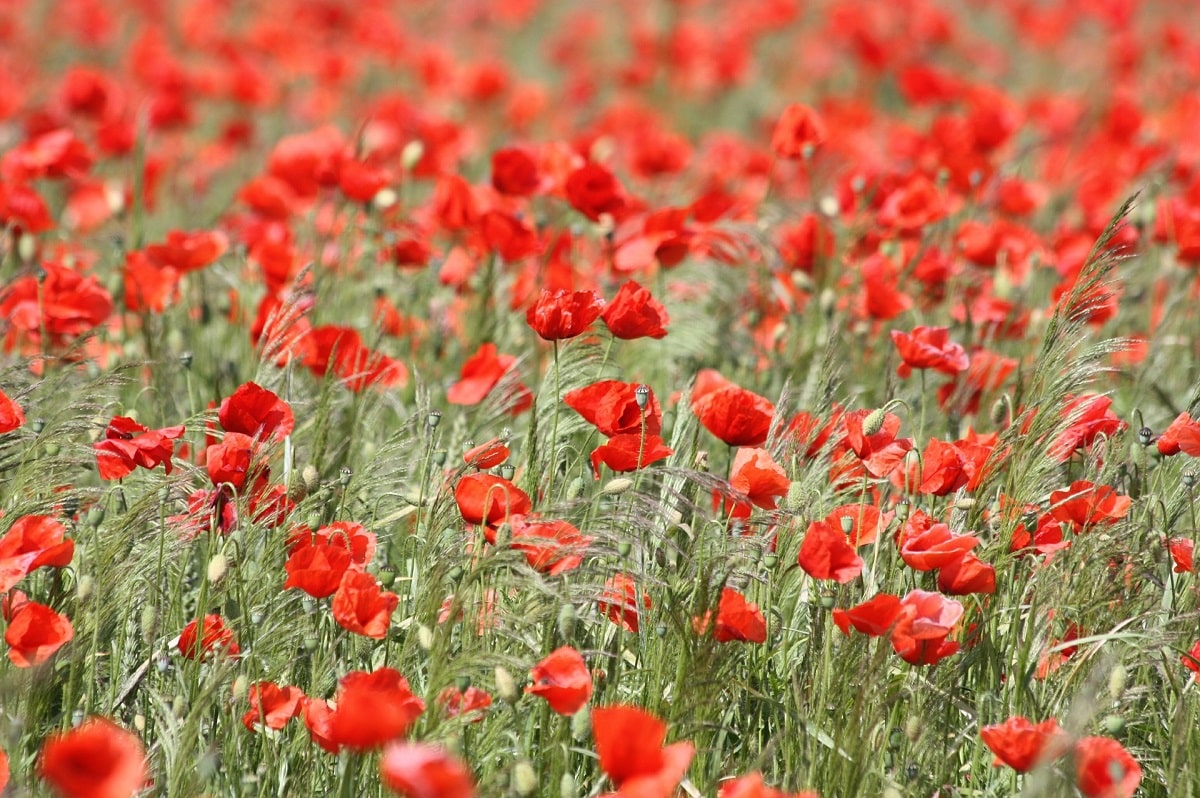
red poppy flowers They are solitary, radially symmetrical, with four petals, which, as the common name suggests, are red in color and also have a black spot at the base of the petals. The calyx is composed of two sepals. Sepals and petals may fall off the flower. It has numerous stamens, with blue and/or brown anthers around discoid stigmas, its ovaries are superior. Its flowers are hermaphroditic.
red poppy
The fruit of the red poppy is a dry fruit, capsule-shaped, oval, porous, dehiscent, rich in seeds, which are released through open pores in the upper part. The capsule measures approximately 1.46 x 0.96 cm. The number of capsules in the red poppy varies, so this variety has between 16 and 125 capsules per plant. However, some researchers claim that the number of flowers and capsules per plant can be as high as 400, depending on the fertility of the soil and the type of vegetation associated with it. The fruit is used for decoration. Its seeds are oily.
Like other members of the poppy family, the poppy plant produces latex throughout the body when the tissue is ruptured. The anatomy of this poppy is typical of dicotyledonous plants.
the reproduction
The pollination of the red poppy is carried out thanks to the work of insects, in this task mainly intervene bees and bumblebees; after pollination, after about 3-4 weeks, the flowers turn into fruits that contain a large number of seeds that will sprout when released from the stomata they possess. Seed propagation and germination can develop new red poppy plants. The plants take about three months to germinate and fruit. Red poppy seeds need intense heat to germinate and can remain dormant for some time.
It is an annual plant that flowers from June to October and sets seed in July.
Properties of red poppy
Poppy seeds are widely known for their pharmacological effects, thanks to their active principles such as: anthocyanins, alkaloids, mucilages and flavonoids. Its petals, capsules and seeds are commonly used in infusions, syrups, extracts or tinctures. Its properties include its sedative and antispasmodic properties, which make it ideal for treating coughs of all ages, including asthma attacks and bronchitis.
Another of the properties of its compounds is its antiseptic and healing properties, so it can be used to cleanse and heal wounds. It has also been reported to be beneficial in patients with conjunctivitis. Thanks to its sedative effect, it helps calm and relax the body and achieve restful sleep in times of emotional stress.
Recent studies have shown that poppy extract can be used in the in vitro maturation of sheep oocytes in experimental tests.
Side effects of red poppy
There is some debate about the localization of side effects and/or the degree of toxicity of red poppy, with some claiming that the plant is not poisonous.while others believe it to be mildly toxic to mammals such as cattle. In humans, there have been cases of poppy seed poisoning, particularly in Turkey, adverse or toxic effects include nausea, vomiting, seizures and some central nervous system changes, which are reversible after application of the treatment. . Recommended medicinal plants, do not increase the recommended dose.
How to grow red poppy

Poppy plantations have been associated with agriculture since ancient times, as their life cycle has always been suitable for most cereal crops.
However, poppies require care to thrive. What you need to know is:
- They are the best plants in dry, poor soil and they will get plenty of sun.l (although they also survive partial shade).
- They don’t need a lot of water, so they do not tolerate waterlogging. As for poppies, it is better to water less than too much. A few times a week is enough (it all depends on the weather and the season).
- Nutritionally, they prefer dry and poor substrates.
- They do not tolerate transplants well.so if you want to cultivate this species, do it in its permanent location.
- They reproduce by seed.
I hope that with this information you can learn more about the cultivation of red poppy and its characteristics.