
Today we will talk about the only one – Monstera variegata. If you are a fan of unique and beautiful plants, you know how this one steals the show with its gorgeous white leaves.
But here’s the point: these white areas sometimes turn brown, which can break a plant’s parent’s heart! Don’t worry, I’ve been there and have some tips to share with you to make those white areas shine like diamonds.
Let’s see why the white areas turn brown, shall we? It’s a mystery, but it’s said to be caused by a lack of nutrients, improper watering, or even exposure to direct sunlight. But don’t worry too much; I have this!
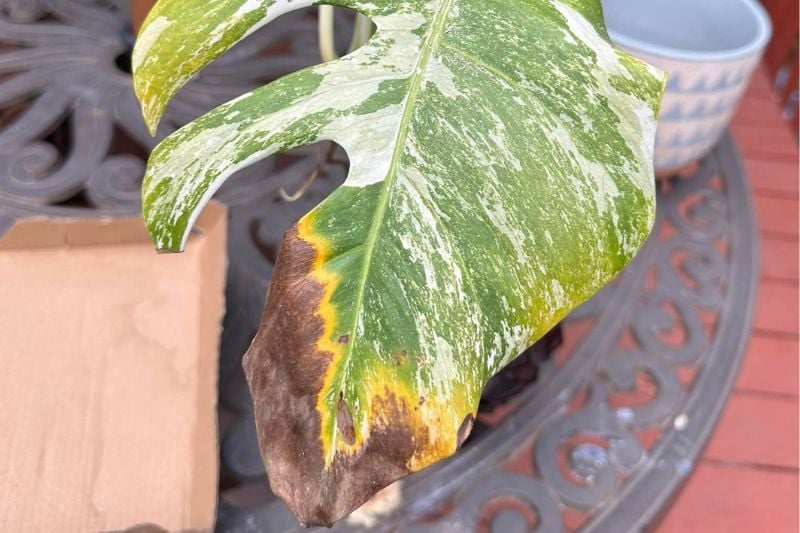
Why Monstera Variegata White Leaves Turn Brown
So, you may have noticed that your Monstera variegata eventually loses its white leaves, which turn brown and wilt, leaving only the green part. Well, I have the inside scoop on why this is happening.
You see, the white parts of the leaves have no chlorophyll. And what is chlorophyll, you ask? Well, the magic ingredient allows plants to photosynthesise and generate energy!
So, without chlorophyll, your plant cannot produce energy and will rely on the green parts to make up for it. And because of that, the whole plant grows a little slower.
Think of it this way: the white mutation is like a lazy roommate who doesn’t contribute rent. Green parties are like responsible roommates who have to take over.
So it makes sense that the plant would want to remove the white parts, right? And by the way, this also happens with mutations of different colors.
The larger the white area on a leaf, the more likely it is to be disturbed by the plant. Unfortunately, there’s no way of knowing exactly when this will happen or how soon it will happen.
But don’t worry; it’s all part of the plant’s natural process. For example, older leaves lose their white parts sooner, so the plant can concentrate on producing new leaves.
If you’re lucky enough to have a leaf with only a few white dots evenly distributed across the leaf, you’re in luck! The white parts are more likely to stick.
Avoid Brown Spots on Monstera Variegata
Here’s the truth: there’s no guaranteed way to keep Monstera variegata leaves from turning brown. It’s part of the natural process. But if you want to take it easy, I have some tips for you!
Buy a plant lamp first. It’s true, you heard me! A plant lamp can ensure that your Monstera variegata receives enough light so that the green parts can do their best to offset the white parts.
Then make sure your plant stays nice and moist. The Monstera variegata needs a lot of humidity, and the variegated variety is even more sensitive. This will prevent the white parts from drying out too quickly.
Finally, give your plant a tropical climate. Monstera grows naturally in the tropics and is therefore happiest at temperatures between 16°C and 24°C. If the temperature drops too low, growth slows.
Follow these three tips and your Monstera variegata will bring out its best, as if it were in a luxurious greenhouse!
But before you get too excited, I want to add an important note. Even if you follow all of these tips and give your Monstera variegata the best possible care, there’s always a chance of it happening. eventually brown spots will appear. It’s just part of the natural process, folks. So don’t be too hard on yourself when this happens!
What is variety in plants?
This great word, like many technical terms, comes directly from the Latin with “variegare”, which means “to make more varied” or “to add color”.
And if you think that’s fancy, wait until you hear the French connection – “panacher” which means “to mix”.
But enough history, let’s get to the juicy part. Simply put, variety means that a plant’s leaves aren’t just a dull color. Instead, they have multiple colors!
Sometimes it’s just two colors, but sometimes it’s even three or four! So, can you imagine how cool your garden would look with rainbow leaves?
And get this, in some plants this colorful display is natural and even forms patterns. But in other cases, it’s the result of a lucky little mutation. Variation is therefore the natural way to spice things up!
1-genetic variety
Nature is good at creating striking patterns; Same for plants!
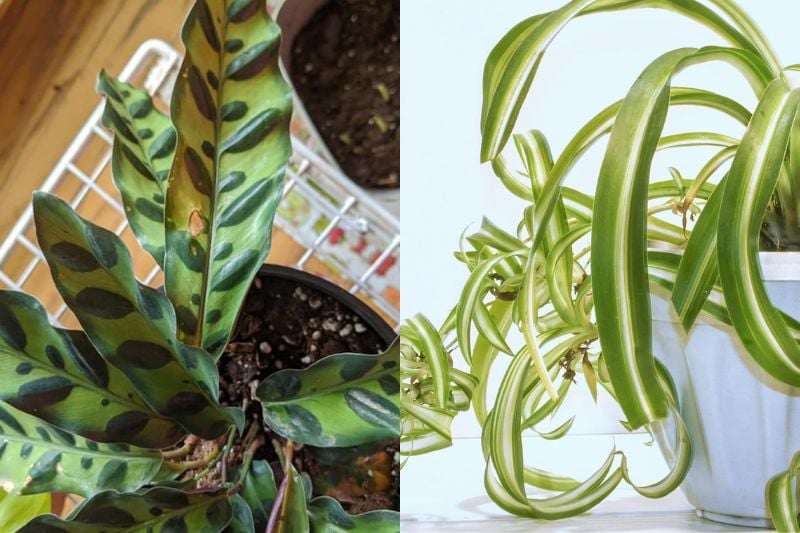 Rattlesnake Plant and Spider Plant
The DNA of these plants dictates the leaf patterns, giving each leaf the same design. Examples of such plants are the rattlesnake plant and the spider plant.
2 reflective screens
Have you ever seen a plant glow in the sun? Air pockets cause this natural variety in the leaves, creating silver spots on the plant.
Speckled, silvery ivy leaves are known for this effect, but the leaf veins of Alocasia Frydek also show it off beautifully.
3- Your chimera
And now, drum roll please, the shadow you’ve been waiting for so long: the chimera shadow!
This tint is caused by a genetic mutation that causes the lack or absence of chlorophyll in certain cells. Chlorophyll is responsible for giving the green color to the leaf.
So if those cells don’t have chlorophyll, they won’t turn green and you’ll end up with spots of different colors on the plant.
Monstera variegata is a good example of a variegated chimera plant, with white spots on the leaves.
Other plants, such as Monstera aurea, may have yellow spots, and Philodendron Pink Princess may have pink spots. These spots can appear on any part of the plant that was originally green.
However, the Chimera variation is extremely rare, making these plants sought after as rarities. Unfortunately, they are often more delicate than their “normal” relatives.
The most popular and well-known plant of the chimera variety is Monstera deliciosa variegata.
The variety of Monstera leaves can vary widely and some leaves are completely white.
Unfortunately, a white leaf cannot produce a cutting because it lacks chlorophyll and cannot photosynthesize. Other leaves may have half green and half white or white spots or blotches.
And just when you think you’ve figured it out, the plant may turn green, shrinking the white part of the leaves until the leaves are completely green. Talk about staying alert!
Special case: Monstera deliciosa ‘Thai Constellation’
Ready to dive into the world of Monstera deliciosa ‘Thai Constellation’? This plant is a rarity that is sure to excite you!
Unlike the Variegata, the Thai Constellation is a special case in that it was bred that way and will never turn green.
This is done by a complex process called meristem propagation or in vitro propagation which takes a long time so the supply in the market is low.
But wait, there’s more! The cream to yellow areas of Thai Constellation may also deteriorate and turn brown. Bullets, right?
To be clear, the Thai Constellation is always a Monstera deliciosa, while the Variegata is a Monstera deliciosa var. borsigiana.
They are two different forms of growth; You can learn more about the differences in my blog post.
Sharing is caring!