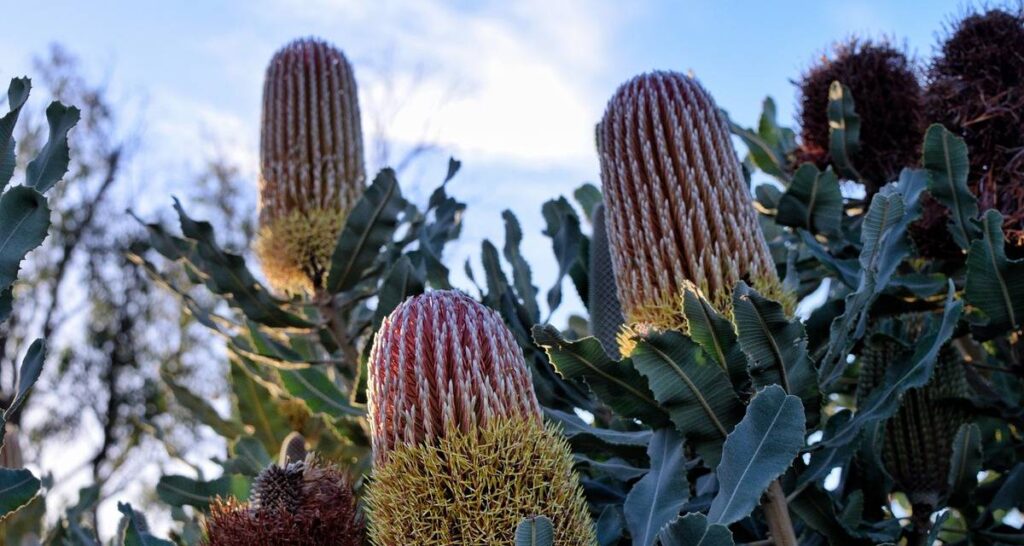
He plant genus Banksia It is a real treasure for gardening enthusiasts. These plants, commonly called Banksias, belong to the Proteaceae family and are native to australia. They are prized for their distinctive, showy cone-shaped inflorescence, which adds a unique and exotic touch to any garden. In addition to their ornamental beauty, Banksias have various applications, such as producing honey and attracting birds and other pollinators. Let’s take a closer look at these wonderful plants.
Key Features of Banksia
Genre banksia is formed by evergreen shrubs or trees that can reach a height of 25 meters in their natural habitat. Its flowers, which are actually a combination of many individual flowers, are arranged in cylindrical or conical inflorescences that vary in size and shape depending on the species. Its leaves are usually lanceolate and glossy dark green.
Regarding taxonomy, the genus Banksia has about 170 different species.
| Order | Proteales |
| Family | proteaceae |
| subfamily | Grevilleoideae |
| Tribe | bankieae |
| Gender | banksia |
Plants of the genus Banksia are endemic to Australia and are found throughout the country, from coastal areas to mountainous regions. Some species are also found in parts of South Africa. These plants have adapted to a variety of climatic conditions, from mild coastal climates to drier and more arid regions.
Continue reading: fast-growing evergreen shrubs.
Banksia and her response to fire
One of the most fascinating characteristics of the Banksia plant genus is its amazing adaptation to fire. These plants have evolved a curious response to fire that allows them to survive and, in some cases, even thrive in areas affected by wildfires.
When a fire devastates an area where Banksias grow, most species of this genus face complete destruction of their aerial structure. Yet despite the apparent devastation, they have a unique ability to survive and regenerate after a fire.
The response of Banksias to fire is possible thanks to their physiological and morphological adaptations. Many species in this genus have underground structures such as rhizomes and tubers that allow them to store nutrients and energy. These underground structures act as reservoirs that plants can use to quickly regenerate after a fire.
After the fire passed, the Banksias emerge from the ashes with fresh and vigorous shoots. These sprouts are able to grow rapidly, taking advantage of the nutrients stored in underground structures. In a short time, they bloom again and produce their characteristic, showy inflorescences, bringing life and color to fire-affected areas.
This response to fire is not only amazing from a plant survival perspective, but also has a major ecological impact. After a fire, the Banksias are one of the first plants to colonize the burnt area. Its rapid regeneration provides habitat and food for various species of wildlife, including birds and mammals, which find refuge and feed on its nectar and seeds.
The fire also stimulates the germination of Banksia seeds that are in the ground, because the high temperatures stimulate the opening of the follicles of the old cones that surround the seed.
In conclusion, the fire response of the plant genus Banksia is a remarkable example of the adaptation of plants to extreme environmental conditions. Their ability to survive and regenerate after a fire is a wonder of nature. Apart from their ornamental beauty, these plants play a crucial role in the restoration of fire-affected ecosystems.
Banksias are true survivors and testify to the resilience and strength of life in the wild.
read more: 10 plants in danger of extinction.
Banksia Care Guide
Banksias are hardy plants, but they require specific care to thrive. Here is a complete care guide for those who want to grow these beautiful plants in their garden:
- Climate: most species of this genus thrive best in warm Mediterranean climates. They are drought tolerant and can adapt to drier conditions, but they also need some moisture for optimal growth.
- Light: Banksia needs sun exposure to flower properly. Be sure to place them in a sunny spot in your garden to ensure their proper development.
- Floor: these plants prefer well-drained, slightly acidic soils. The ideal substrate for this genus is a mixture of sand and garden soil. Make sure the soil is well-drained to avoid waterlogging, which can be detrimental to the plant.
- Irrigation: for the first few months after planting, they require regular watering to help establish roots. Once established, they are drought tolerant plants and do not need frequent watering. However, in times of prolonged drought, it is important to provide them with additional water.
- Fertilization: Banksias do not require much fertilization, as they are plants adapted to nutrient-poor soils. However, you can apply a slow-release fertilizer specifically for native plants once a year in the spring to ensure they have the necessary nutrients.
- Multiplication: they can be propagated from seed or by stem cuttings. Propagation from seed is a slower process, but it can also be rewarding. If you choose to propagate them by cuttings, be sure to take semi-hardwood cuttings and provide them with the right moisture and temperature conditions.
- Size: generally does not require regular pruning. However, you can prune them lightly after flowering to maintain their shape and promote more compact growth. Avoid over pruning, as this may affect flowering.
Latest Findings
Banksias are truly fascinating and beautiful plants that can add an exotic and unique touch to your garden. With their distinctive inflorescences and weather resistance, these plants are an excellent choice for gardeners looking for something different and special. With proper care, you can enjoy the beauty and elegance of this genus of Australian plants for many years.
Feel free to include these wonderful plants in your garden and let them captivate everyone with their Australian charm!