
Among the many varieties of tulips in the plant kingdom, there is no doubt that the Estella Rijnveld tulip is one of the most beautiful you can find for the color of its petals. But have you ever seen it?
Below we show you all the characteristics that define this tulip as well as the care you need to provide to have it in your garden. Shall we start?
How is the Estella Rijnveld tulip

Source: Slovenske Trvalky
The Estella Rijnveld tulip is a real beauty for the garden, although it has the disadvantage that it does not bloom until the end of the summer season and you cannot enjoy it until the following season. However, those who have it know that it is worth taking care of it to see it flourish.
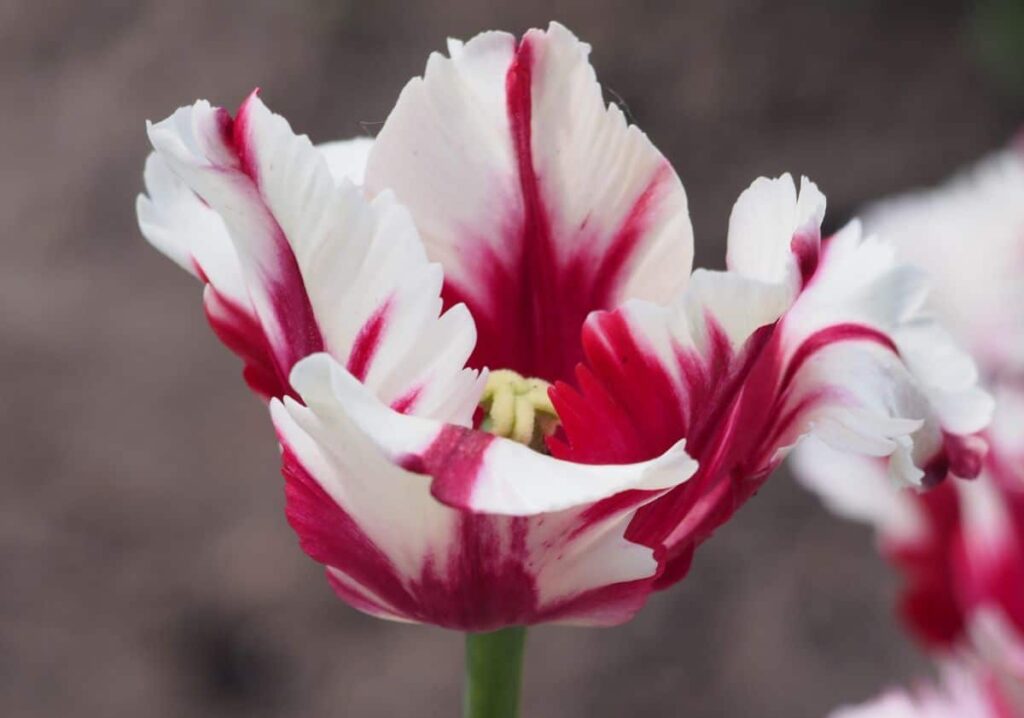
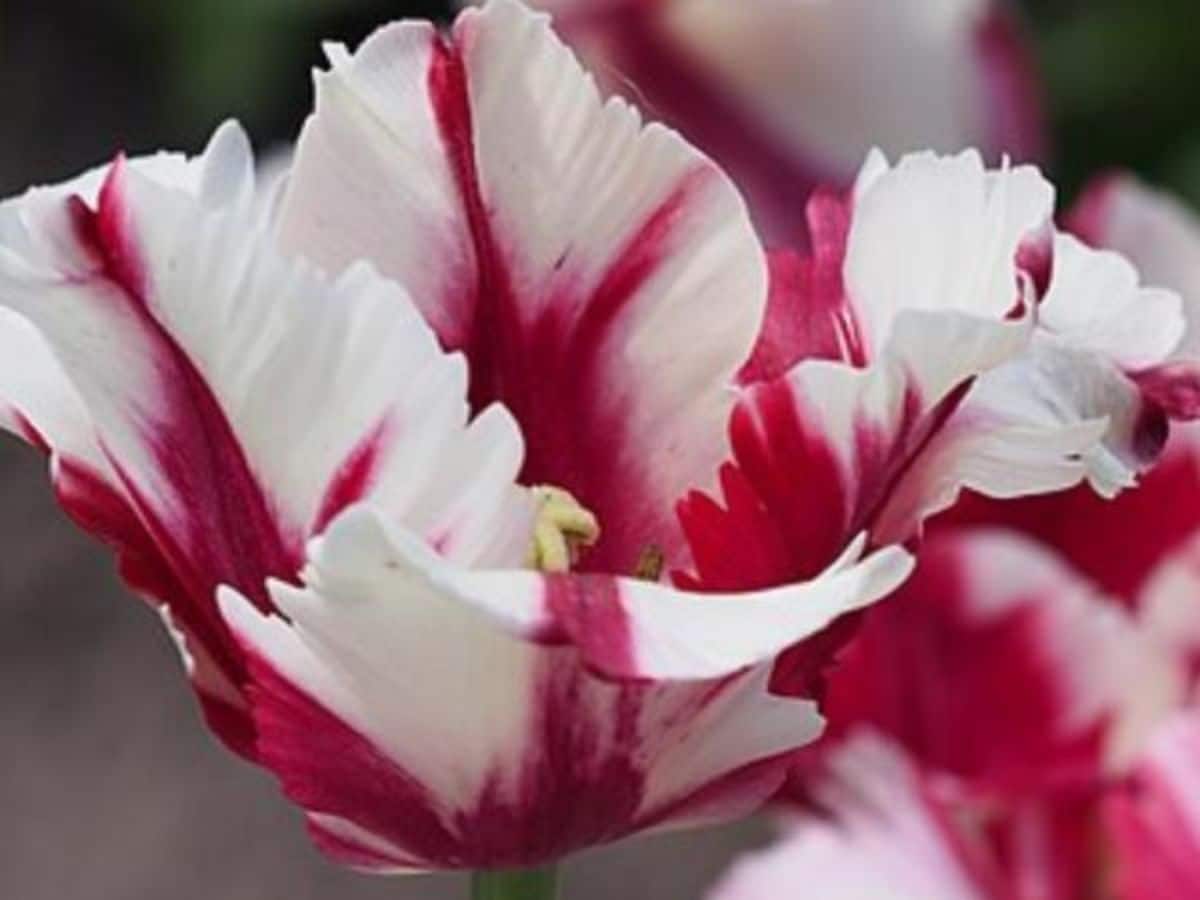
In case you don’t know, the Estella Rijnveld tulip is one of the Papagayos tulips. It is a flower whose main feature is the petals it has, which look more like feathers because the upper part looks like fringe. If we add to this the fact that its color is white and red (or pink) it makes it very colorful when we see it. Even more so when combined with the dark green of the tulip stem and leaves. By the way, it usually grows about 40-60 centimeters.
Another fact that you may not know is the fact that, of the Estella Rijnveld tulip, there are just over 3000 registered variants (many others still not registered). And what do they depend on? Basically the size of the flower and the flowering time it has.
When the plant begins to flower, you will notice that the buds are green. In fact, it is common to think at this time that you do not have an Estella Rijnveld tulip, but they were confused and bought something else. But as it develops and opens, the petals change color. And if you’re wondering, no, it’s not something that has been achieved by man, but nature itself has achieved it by evolving.
Tulip Care Estella Rijnveld
Source: Green Ecology
Now that you know the Estella Rijnveld tulip better, What if we gave you the keys to take care of it and you received one? For starters, you should know that it is neither too expensive nor difficult to find (especially if you know how to navigate the Internet). Plus, there’s not much mystery about his care; it is quite easy to grow and you can have it both in pots and in the garden.
But what is there to learn from him? Well, pay attention to the following:
location and temperature
As we told you, the Estella Rijnveld tulip can be planted in the garden or in a pot. Of course, when planting it, it is recommended to do it in autumn and protect it during the winter. And it’s just that I can’t stand the cold, therefore, you must cover it with a thermal blanket or similar so that the bulb is not damaged. In the event that the weather does not accompany it, it will be better to plant it in the spring.
Now well, Shade, partial shade or sun? Well, downright sunshine. It needs it to grow and thrive, so try to get as much light as possible. This implies that it will be hot, yes, but the plant will be used to it and will tolerate high temperatures better than low ones.
Substrate
Proper soil for tulips is one that keeps them moist. Which means you will need worm humus, or similar, to maintain the humidity when watering. But be careful, because if it is too waterlogged, it can rot. Therefore, it is better to add some drainage to avoid this and the roots get oxygen to be healthy. Otherwise the soil can compact and not let the plant breathe).
Irrigation
If we have ever told you that tulips need moist soil, you will know that watering is one of the important parts. But beware, this does not mean that you have to water constantly. In reality They can handle a little drought, but not too much.. Therefore, you need to water it 1-2 times in spring and 3-4 times in summer. But at the end of flowering (even a week before) you have to start to stop watering it so that everything dries up and the bulb is in hibernation for the following season.
We recommend that you be very careful when watering so as not to wet the flowers, especially since, having a feathery appearance, when wet, they lose their beauty and can burn with the sun’s rays.
Size

The pruning of the Estella Rijnveld tulip is practically nil, other than removing the fading flowers (to try to get more out of them) and cutting the plant at the end of the season.
In this way, you will disinfect it at the same time as You will see that there are no pests or diseases that can affect it.
Plagues and diseases
Like many other plants, tulips are susceptible to pests and diseases. In the first case, worms, aphids, snails and slugs are the most common and those who will have to be careful not to do their own thing in the leaves especially. Another that commonly affects is Lampetia equestris, better known as the daffodil fly.
When it comes to diseases, brotyte and Augusta disease are the ones that can jeopardize the health of this plant.
Multiplication
Propagation of the Estella Rijnveld tulip can be done easily via the bulb. And it is that it develops an offspring that, When they reach a suitable size, they can be separated from the mother plant and planted in a separate pot or in the garden.
This, yes, Before that, it is advisable to leave the large bulb and the suction cups in the air. so that the cut you make heals before you plant them. Mostly because you avoid problems that endanger the bulb (one or the other) when it comes into contact with soil and water.
The Estella Rijnveld tulip is a real delight in the garden. With the white and red tones, it stands out wherever you plant it. For that, What if you took a plant from it and put it in your garden?