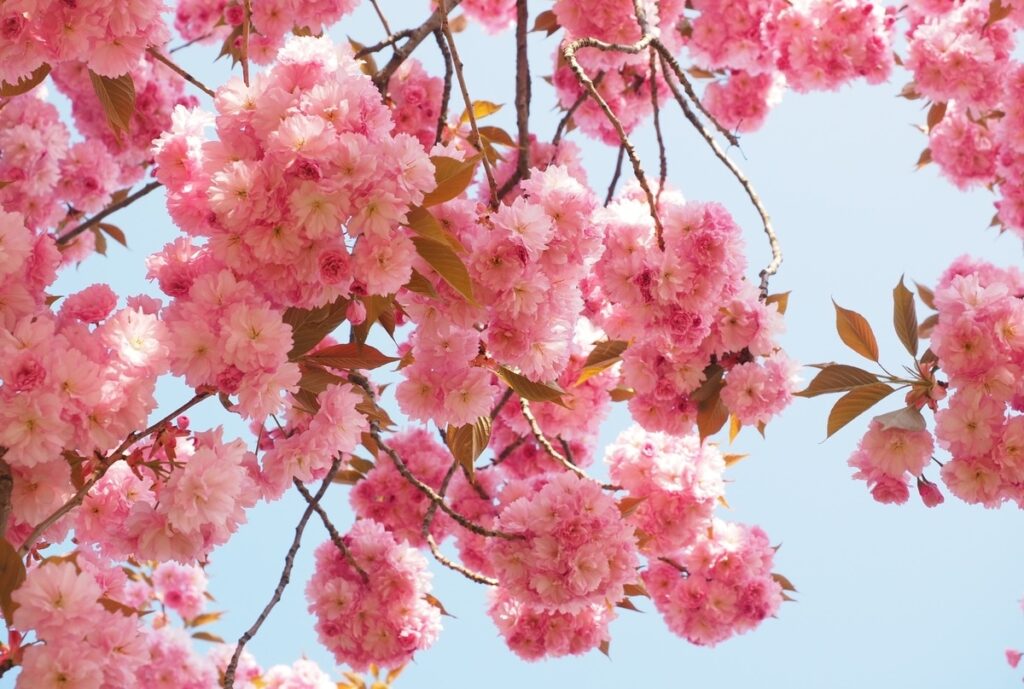

In East Asia there are trees that amaze more than one of us. One of the most popular is the one known as the Japanese rose tree. But, although searching the Internet reveals one in particular, I would like to tell you about others that could also be given this name.
And it is that of course the flowers can be pink, but there are also certain cultivars that have leaves of a certain pinkish hue, or a soft red that is worth knowing. For him, Here are the ones that, for me, are the most beautiful Japanese trees with pink leaves and/or flowers..
What are pink Japanese trees called?
As you will see, few trees are native to Japan and have pink flowers or leaves. But the ones that do exist have an ornamental value that we believe cannot be ignored. And without lingering any longer, here they are:
Katsura Tree (Cercidiphyllum japonicum)

Image – Wikimedia/Jean-Pol GRANDMONT
The Katsura tree is a deciduous plant native to Japan and China that grows between 10 and 40 meters tall. Its growth rate is very slow, but its ornamental value is very high even when it is a young specimen: its leaves are round and green except when new, when they are then pink.
The flowers, both male and female, are also pink, although this is a darker shade than the leaves. These grow in the spring, a little before the foliage, and they are small.
japanese cherry (Prunus serrulata)

Image – Wikimedia/Myrabella
The Japanese cherry tree is the quintessential pink Japanese tree, the first one that pops up when you search for Google images of this plant. He is originally from Japan, but also from China and Korea. It reaches an approximate height of 6 meters, and develops a very wide crown, up to 5 meters in diameter.and dense, so it casts a nice cool shadow.
Its flowers are certainly roses. They grow in clusters in the spring, along with the leaves. They measure about 2-3 centimeters, and are composed of five petals.
Prunus x yedoensis

Image – Wikimedia/松岡明芳
The Prunus x yedoensis is a hybrid between prunus speciosa Yes Prunus pendula f. ascend who is from Japan. It is a deciduous tree that reaches a height of 5 to 15 meters., and develops a very dense crown with a diameter of up to 4 meters. The leaves are green, about 14 centimeters long by 7 centimeters wide, and fall in winter.
The flowers appear in clusters in spring, before the leaves. They do this by grouping together in clusters, and they are about 3 centimeters in diameter each. In addition, they are fragrant and can be white or pink.
How do you take care of the Japanese rosebush?
Now that we know their names, we can talk about their care. And it is that this article would not be complete if we did not tell you what you must do to keep them healthy, right? Well, here are some general tips that we hope will help you get the most out of your plants:
Location
The three trees we named you These are plants that should be grown outdoors., because not only do they resist cold and frost, but also because they need to feel the change of seasons: air, rain, heat, cold, etc., are very important to them. Therefore, they should not be kept indoors.
But yes it changes the exact location: while the Prunus needs to be exposed to direct sunlight, the Cercidiphyllum prefers a sheltered place.
Ground

Image – Wikimedia/掬茶
The three They grow in soils rich in organic matter and well drained.. Likewise, it is important that the soil is acidic or slightly acidic, because in alkaline or calcareous soils they will have ferric chlorosis, or what amounts to the same thing: yellowish leaves due to the lack of iron.
Another option is to plant them in pots, but if this is done, they must be given specific substrates for acid plants; or even if you live in the Mediterranean region, rather than a classic substrate, we advise you to mix akadama (on sale here) with 30% kanuma, or to put coconut fiber in it, because it will help to better adapt to the climate.
Subscriber
The pink Japanese tree will appreciate being paid during the growing season; that is, from the moment the flowers and/or leaves bloom in spring, until the end of summer. To do this, you can add acid plant fertilizers (on sale here), or fertilizers suitable for organic farming, which are all those that are natural, such as mulch or guano, for example.
Cut
We do not recommend the size, unless they have a dry or broken branch, in which case it can be removed the same day. But if you deem it necessary, you can do it in late winter if it is a young tree, or after flowering.
hardiness
the three trees They easily withstand frost and snow. (as long as they are not late). But they don’t like extreme heat. In the Mediterranean, for example, they struggle if kept in places at low altitudes above sea level. On the contrary, in a temperate, mild and mountainous climate, they can be beautiful.
Did you know the pink Japanese tree?