

One of the crops that presents the most doubts at harvest time is corn. There are many people who wonder when to harvest corn and what aspects should be taken into account to know if it is already mature enough and in good condition.
For this reason, we are going to dedicate this article to telling you when to harvest corn, what characteristics it must have and what care is needed to be able to have a good harvest.
Corn Harvest Aspects

The maturity cycle of maize is determined by the sum of the accumulated temperatures (thermal integral), from sowing to harvest (if it is ensiled), or until the physiological maturity of the grain. The thermal integral is constant: in warm years, the sum of the temperatures required by the plants is reached earlier than in colder years, and flowering and ripening are also earlier.
Since the FAO cycle is based on the conditions of the American corn belt, the local variables of the region such as climate, altitude and planting date must be taken into account when selecting seeds. . Under normal conditions, Maize is sown between mid-April and mid-May. In addition, it must be taken into account that when sowing is delayed, the FAO seed cycle must be shorter,
Regarding the harvest, taking into account the variables, three general periods can be identified:
- tender grains: three weeks after flowering. Around August or September.
- Forage corn: October, when the grain is close to maturity.
- dry cereals: From November, but in dry years, it can be harvested in October.
When to Harvest Corn

About 4 months after sowing maize, the time to harvest the ear approaches. You should know that this is not an exact science, and that weather conditions, planting time and crop development can delay or delay harvesting by several weeks.
That’s why it doesn’t make much sense to give precise dates, and it’s better to learn how to visually inspect the cobs to make sure they’re in perfect condition for harvest. In this article we will also give approximate dates, but most helpfully we will show how to determine the best time to harvest based on the use of the corn grain.
Planting period, climatic conditions of the growing area, crop management and genetic characteristics of each maize variety may result in earlier or later harvest dates. This is clear and it happens with almost all crops, but in the case of corn you also have to consider where the grain is going.
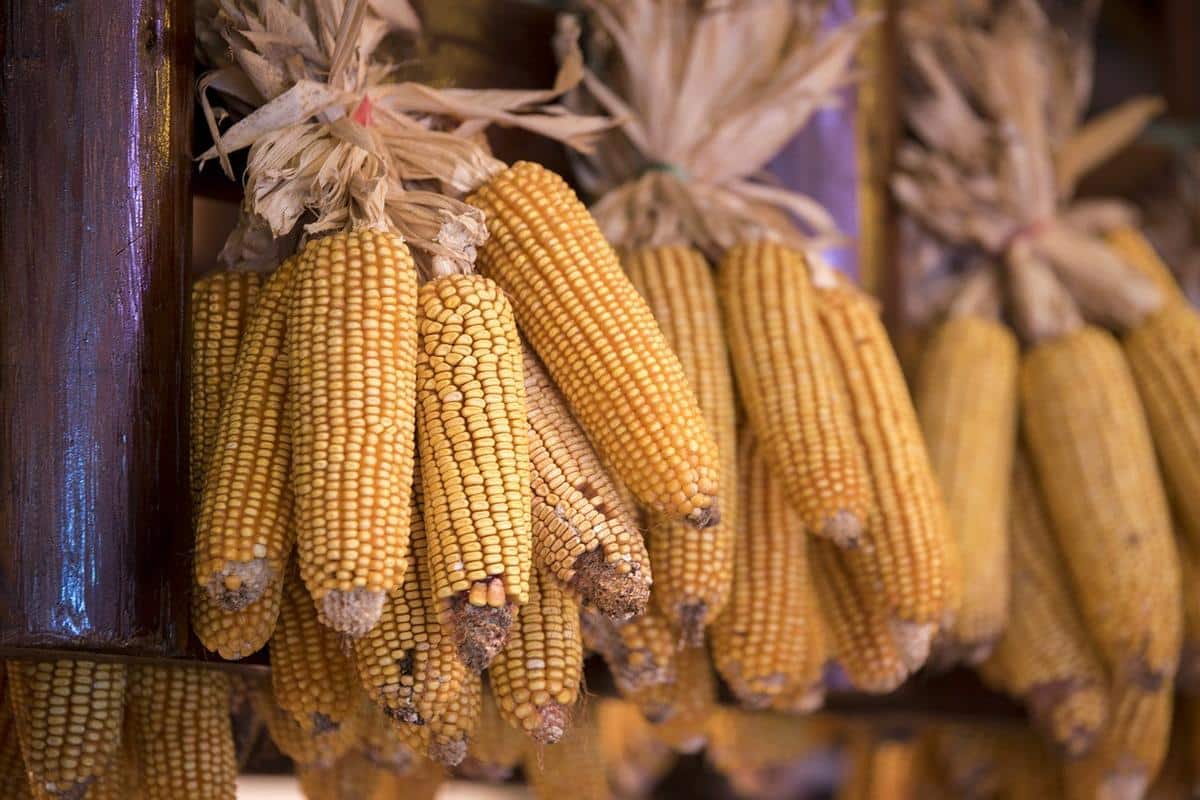
Corn ripe for storage
If you want to keep it at room temperature, it is very important to pick it perfectly ripe and dry, that is to say that it has not been exposed to humidity for a few days before harvesting. This is the only way to keep the moisture content of the grain as low as possible.which is ideal for good preservation after air drying.
The dried grain is often used to grind flour or shell corn to feed livestock or farm animals.
Determination of the state of physiological maturity
Here are some of the things to consider when determining the physiological maturity of maize:
- Corn plants show signs of rot: the leaves dry up and lose their green color.
- When we squeeze the cobs of corn with our fingers, the corn cobs do not yield, and the corn kernels are clearly felt.
- The skin on the ear is dark, brittle or peeling.
- The casings become thinner, lighter in color and dry in appearance.
- Some or all of the ears have returned and are now pointing downward, as if dropped.
- When the husks are removed from the cob, all the kernels were well formed and dark enough not to run when pressed with a fingernail.
- If a grain is depilated, black dots are observed in the area where it is inserted into the ear.
Immature corn for canning or eating
When corn is to be eaten roasted or boiled, or if the grain is to be conditioned as sweet corn in the coming months, it should be harvested before the grain reaches physiological maturity and becomes too tough.
Determining when to harvest baby corn is a more difficult task than detecting maturity. If the time is not enough, the grains will be too soft or even shapeless. If the time is too long, the grains will harden. Sweet corn is harvested about 20 days after the whiskers have grown on the cobs.
But in this case, symptoms can also be detected indicating that the sweet corn is at its optimum harvest time. These are:
- The husk of corn cobs is dark in color and not moist to the touch.
- When squeezing the ears in their middle part, they do not give way.
- The beans are pale in color (if they are dark yellow or orange, they are overripe)
- Press with your fingernails, the particles will peel off and discharge a milky liquid. If the liquid spraying the grain is colorless, it will take longer to harvest the cobs. On the contrary, if it seems soft, the ideal harvest period is coming to an end, so you will have to hurry before all the cobs are useless for this purpose.
Tips for when to harvest sweet corn
- Harvest early in the morning or in the evening, try to keep the temperature as cool as possible and the ears not warm.
- Harvest layered ears and keep them that way until ready to serve.
- Immediately move the ears to a cool place out of direct sunlight.
- Eat or preserve as soon as possible.
I hope with this information you can learn more about when to harvest corn.