Most herbs are grown by planting seeds. Surprisingly though, most can be propagated very easily by taking cuttings (stems) from healthy plants. Learn how to propagate herbs by cuttings and discover 12 of the easiest to propagate.
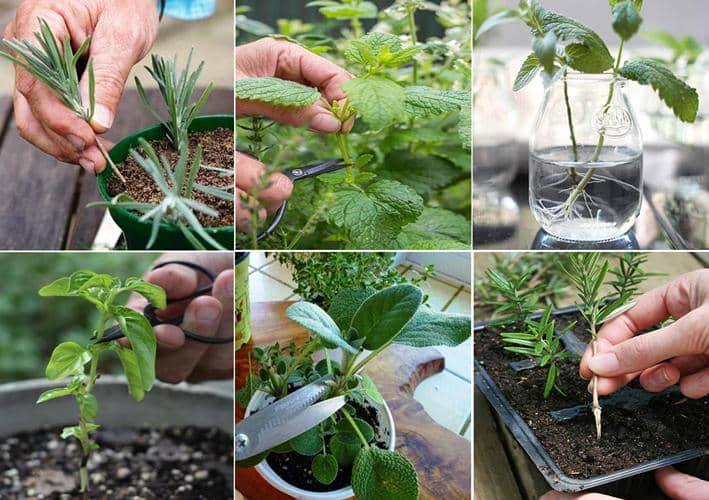
Just be sure to take a cutting from a basil plant that hasn’t flowered or gone to seed.

Basil cuttings should be at least 7 to 10 cm long. Cut the basil stems at a 45 degree angle with clean, sanitized, sharp scissors. The 45 degree angle will ensure that there is enough surface area at the lower end of the cut for the roots to form.
Remove most of the basil leaves from the cutting, leaving only a few on top. Cut the remaining leaves to a third of their size if they are particularly large.
Choose a location with good air circulation and ventilation, but avoid exposing the cuttings to frequent cold drafts and strong winds.
Instead of garden soil, use a starter mix or simply combine equal parts sand and compost.
Leave the pot where it does not receive direct sunlight and keep the soil constantly moist. In about two to three weeks, your basil cuttings should develop new roots.
Once the new roots have developed, the stems are ready to be potted up or transplanted outdoors.
2. Mint – Mint

The best time to start planting mint cuttings is in late spring or early summer.
Mint is as easy to grow as basil from cuttings. Mint cuttings usually root in just a week or two.
All you have to do is take a few 10-15cm sprigs of mint from a healthy plant and plant them in the ground.
Discard the lower leaves and plant in any type of soil. It will be a good idea to grow several cuttings together to have a bushy plant.
One thing about mint plants, although they don’t require any special treatment to root their cuttings, it’s important to note that mint plants can be very invasive.
When you decide to transplant your cuttings after the roots have developed, it may be a good idea to move your mint to a container, where the plant cannot spread where it wants.
If you decide to plant mint in the ground, be sure to plant it in a spot with deep edges to prevent it from spreading where it is not wanted.

Oregano is a little trickier than basil and mint to propagate from cuttings, but it’s not impossible.
Cut the 2 to 4 inch long stems from a young oregano plant with sterilized scissors. Make the cuts at a 45 degree angle and remove all leaves except the first three or four sets of each cut.
Oregano roots grow much slower than basil or mint, so using a natural rooting hormone is a good idea.
Keep the cuttings in a bright place, but out of direct sunlight. Allow at least four weeks for oregano cuttings to develop new roots and be ready to transplant into pots.
4. Thyme – Thymus

Be sure to take your cutting of thyme from a node where the leaves are growing, as the plant’s roots are most receptive in these areas.
You can do it any time of the year in warm weather and between spring and fall in cool or moderate weather.
After removing the lower leaves from the cutting, plant your thyme cuttings in moist soil and keep them out of direct sunlight. It will form roots in 2-4 weeks and you will soon have a new plant.

Stevia plants are often used to add sweetness to a teapot, and it’s easy to root stevia from a cutting.
You can root a stevia cutting in water if you wish, but the easiest way is probably to place the cutting directly in a moist seedbed or in perlite.
Keep the cuttings moist and exposed to light (natural or fluorescent), and your stevia cuttings will start to root in two to three weeks.
Once rooted, move the cuttings to a sunny window or wherever you plan to grow them more permanently.

Lavender cuttings should be taken during the summer, as lavender is known to root more easily during this time.
Take cuttings of new growth 5 to 15 cm long using a sharp knife.
Cut the stem just below the bump that indicates a leaf node. Remove the leaves from the lower half of the stem and carefully remove the skin from the bottom of the stem on only one side of the stem.
Plant it in a container of growing medium and dip the cutting in rooting hormone if you prefer. Rooting hormone will encourage strong root development and help prevent the tip of the cutting from rotting, but lavender cuttings have been known to root quite well without the hormone.
Plant the lavender cuttings about 3 inches deep in the ground. To create a greenhouse environment for your lavender cuttings, cover them with plastic.
Keep the soil moist until the roots have developed. The cuttings will root in two to four weeks, but it may take a little longer. Check to see if roots have formed by lightly tugging the plant. If the plant resists, it has already formed them.

Germinating marjoram seeds is a slow process, taking up to two weeks to germinate. But it can be propagated much more easily by cuttings and you can have new marjoram plants in no time.
Take cuttings from the end of the stem and choose a stem at least 5cm tall. Leave the top four or six leaves attached, but remove the rest of the foliage from the cutting.
For best results, plant marjoram cuttings in late summer or early spring in cool climates and in winter in particularly warm climates.

You can root lemon balm sections that are stem cuttings 5-10cm long to produce new plants.
Remove the lower leaves so that only the tip of the cutting has new growth. Next, place the lemon balm cutting in a container of water, refreshing and replacing the water as needed while you wait for new roots to appear.
This will take a few weeks, as lemon balm is not the fastest to root. Once your cuttings have had a few weeks to develop roots, move them to the container or spot in the garden that will be their permanent home.

The best time to take rosemary cuttings is when the rosemary is producing new growth, as the hot weather intensifies during the summer.
Take cuttings from a few centimeter sections of your plant’s latest growth.
Take more cuttings than you want to grow, as not all rosemary cuttings will root. Take sections 10 to 15 cm long and remove the leaves from the bottom two centimeters of the cutting.
Place the cuttings in a container filled with cool water so they can root. It is important to keep the water in the container cool and full throughout this process.
After a few weeks in water, the rosemary cuttings will have taken root and be ready for planting. However, keep in mind that cuttings may take longer to root in cold weather.

Salvia cuttings can be rooted in water or soil. To root your cuttings in water, simply add them to a vase or glass with a few inches of water, then store them in a sunny window and watch for a few weeks until roots develop.
If you want to root salvia in soil rather than water, it is best to treat the cut end of the cutting sections with rooting hormone.
Next, plant your cuttings in a mix of 70% perlite/vermiculite and 30% potting soil.
Roots should appear in about two weeks when the plants are rooted in the ground.

Take cuttings to propagate tarragon in the morning, choosing 10-15cm of growth that appears just below a node and removing the bottom third of its leaves.
Treat the cut end of the section with rooting hormone and place the cuttings in a container filled with moist potting soil.
Water the cuttings regularly to keep them consistently moist as they grow. Once all danger of spring frost has passed, you can move your tarragon cuttings to the outdoor garden.

You can propagate watercress using stem cuttings, rooting them in water or moist soil.
If you prefer to use just water, be sure to change it once or twice a week and keep the watercress roots below the surface of the water.
If you want to do it directly in the ground, the best medium for growing watercress cuttings is peat moss mixed with perlite, vermiculite, or another mixture.
Share it on the networks: