
If you purchase an item through links on this page, we may earn a commission. Our editorial content is not influenced by commissions. Read full disclosure.
If you’ve been gardening for a while, you’ve probably noticed that plants thrive best in environments similar to those in which they evolved. This is why it is easier to grow tomatillos in Southern California than in Colorado.
If you are interested in growing corn, your best option for success is to grow a variety that has been developed in your region (or an area that matches it).
Below are 18 native corn cultivars to consider. These are all heirloom and heirloom varieties that would make great additions to your garden or property.
1. Turquoise Hopi
Very few edible plants are naturally bright blue, but ‘Hopi Turquoise’ corn is one of them. It was originally cultivated by the Hopi people of Arizona and therefore thrives in dry, hot locations similar to the American Southwest.
That said, it is a reasonably hardy plant that can handle fluctuations in temperature and humidity well. Each stalk reaches about five feet and the single ears mature in 90 to 95 days. Seed Kingdom sells seeds in a wide variety of quantities.
2. Pima White
The Akimel O’odham and Tohono O’odham peoples of the Sonoran Desert have grown this magnificent corn for centuries. It’s beautiful, but can be hard to find outside of the southwest. This fast-maturing corn is ready to harvest in 60 days and can thrive with little water.
Like other species of flint corn, it is ideal ground into flour for cakes and flatbreads. Plus, it’s sweeter than many other flints and makes absolutely delicious cornmeal porridge.
3. Bolita Belatove
Speaking of Southwestern varieties, this native Mexican corn cultivar thrives in the Southwest, as well as throughout Mexico and Central America. It is a stunning pink color and creates a pink-purple flour when ground. As you can imagine, this allows people to make beautiful dishes such as pink tortillas and arepas, perfect for parties!
Note that many sources will not ship these seeds outside of the United States.
4. Abenaki Rose
While we normally eat soft corn on the cob, indigenous peoples usually process dried corn into flour. This cultivar was grown around the St. Lawrence Seaway in areas that now include Newfoundland, Quebec, the Maritime Provinces and the New England states.
This variety is quite beautiful, with cream-colored beans with a pink tip. The grains are excellent made into hominy or ground into flour for porridge, bread and cakes.
5. Glass Gem
Some plants are almost too beautiful to eat, and “Glass Gem” corn certainly falls into that category. It is said to have been bred from Osage, Pawnee and Cherokee varieties, and the grains look like vibrant gemstones.
The modern variety was bred by Carl Barnes, who wanted to honor his Cherokee heritage by preserving this age-old food.
Although this corn is almost too stunning to eat, you can grind it into flour or use it to make popcorn. Get seeds from Harley Seeds on Amazon.
Personal note: I grew this corn in southern Quebec and northern California, and it did a lot better in the latter area. If you are in a temperate or cooler zone below 7b, skip this strain. It needs the warmth and full sun of the Southwest to flourish properly.
6. The Mandan Bride
The Mandan peoples of North Dakota grew this corn, which is one of the finest varieties on this list. If you like all the hues of an autumnal sunset, then you have to grow this cultivar.
Not only does it look gorgeous, but it creates a delicious meal that can be used to make some of the best grains you’ve ever eaten.
Display the cobs as part of your fall celebrations, then grind the kernels into flour and enjoy! Buy seeds on Amazon.
7. Flint corn from Gaspé
If you’re short on space and your growing zone is between 3 and 6, consider this heirloom Canadian cultivar. It was first cultivated by the Mi’kmaq people of the Maritime provinces of Canada and parts of Massachusetts and Maine.
This corn only grows to about 2.5 feet tall, making it ideal for small gardens. Although you can’t eat it fresh, it’s great for grinding it into flour. Additionally, the grains can be softened by boiling and are delicious in fall soups and winter stews.
8. Cherokee Gourdseed
While many of the other native corn cultivars on this list are native to the Southwest, Cherokee Gourdseed corn comes from Appalachia.
It is one of the few Eastern Woodland varieties still grown in this region and is a beautiful nutty cultivar ideal for groats, stuffings and breads. Huge ears take around 125-130 days to mature but are worth the wait.
We’ll cover planting companions later, but consider growing this corn alongside other seeds from the Cherokee Nation when creating a permaculture guild.
This native corn variety may not be as vibrant as ‘Hopi Turquoise’, but it is beautiful nonetheless. Originally grown by the Navajo people of Arizona and New Mexico, it creates a soft, sweet flour when ground: ideal for tortillas and other flatbreads.
Plants mature in about 100 days and are drought tolerant.
10. Chippewa of Bear Island
Give this one a try if you’re looking for a great cultivar for colder climates. It is an Ojibwe variety that originated in Minnesota, but has also spread to Manitoba and Ontario. It resembles other species from the Dakotas or Montana, but its grains are more bronze-red than multicolored.
Like the other heirloom varieties here, it’s an ideal flint corn for cakes and sweet cornbreads.
11. Cudu
‘Cudu’ is another old Montana cultivar that is both beautiful and delicious. Its white ears are flecked with dark blue, and the grains create a nutty cream-colored flour when ground. This variety has a mild, delicate flavor ideal for cornbread, cakes, dumplings and cookies.
Try mixing it 50/50 with amaranth or wheat flour to make bannock!
The plants take about 85 days to mature and are fairly cold tolerant.
12. Assiniboine Flint
This flint/mill cultivar has been grown in southern Manitoba and North Dakota for hundreds of years. As a result, these plants grow well in cool weather and are both frost and drought resistant.
Like most other native corn varieties, these cobs cannot be eaten fresh. Instead, flint grains must be dried and ground into cornmeal before use.
13. Maiz Morado
If you are growing a gothic garden, this black corn variety is perfect. The original variety ‘Kulli’ is a maize native to Peru, but ‘Maiz Morado’ has been adapted to suit more northern climates. It will even grow as far north as Montana or Saskatchewan!
It is high in anthocyanins and can be ground into a purple-black flour that is wonderful in tortillas and soups. Buy seeds on Amazon.
14. Blue Po’suwaegeh
Although it is called a “blue” corn, this one is so dark that it is almost as dark as the cultivar mentioned above. It has been cultivated by the “Pueblo Pojoaque” people of New Mexico for countless generations and is traditionally used to make blue atole.
This nourishing drink is brewed from blue corn, cinnamon and piloncillo (cane sugar) and is delicious for breakfast or after working hard on the farm for hours.
15. Seneca White Nose
Seeds for this native corn cultivar are incredibly difficult to find. If you manage to find any, however, you’ll be treated to one of the most delicious and delicately flavored varieties of Flint. You may be able to get some through the Iroquois White Corn Project or by trading with friends in native communities.
16. Bofo
If you live in Colorado or USDA growing zones 5a and 7a, consider growing speckled Bofo corn. It has been cultivated by the Cora and Huichol people for generations and is as beautiful as it is delicious. The grains are cream-colored, speckled with purple, indigo or burgundy, as if splashed with watercolor paint.
It is a sweeter variety that is ideal for cookies, cakes, puddings and breads.
17. Maize Puhwem
Consider this cultivar if you’re looking for one that thrives in midwestern to south-central states. It was first cultivated by the Lenape and Delaware peoples of Oklahoma, but was commercialized throughout Algonquin territories.
This cultivar has a moderately sweet, slightly nutty flavor that is ideal for cornbread, dumplings, and Johnny cakes.
18. Burro Mountain Popcorn
Most of the native corn cultivars on this list are flint varieties. This means that they must be ground into meals to be eaten, whether cooked into porridge, cakes, tortillas or soups. In contrast, this ancient variety of popcorn is the ancestor of nearly every popcorn cultivar we enjoy today.
Its seeds were discovered in a millennial pot in New Mexico in the late 1970s. Additionally, this variety is believed to have evolved from the Aztec variety “Palomero Tolequero”.
Tips for Planting “Three Sisters” Companions
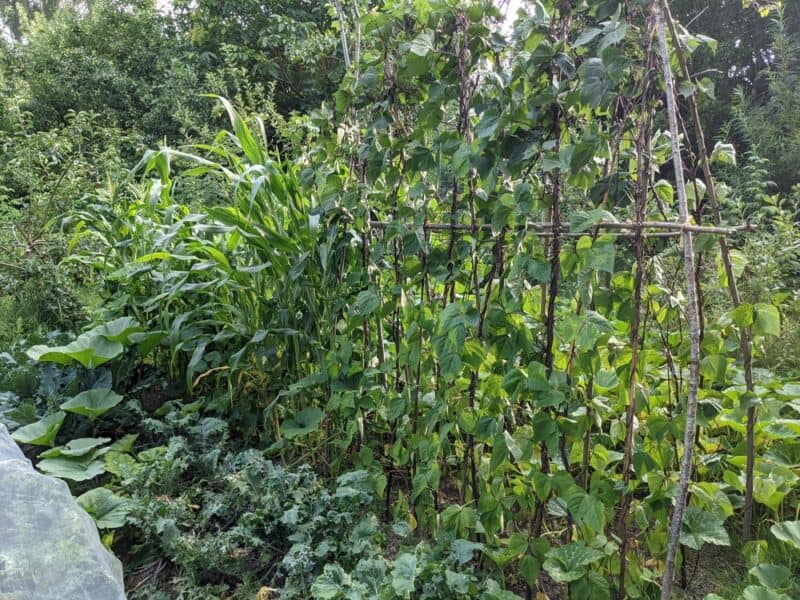
If you’re planting a “three sisters” guild garden (or four sisters, if you add sunflowers), aim for companion plants native to your area. These have evolved under the same conditions as your native corn species and will therefore thrive alongside it.
For example, here in Quebec, we grow Abenaki and Bear Island cultivars, which are well adapted to our cold and slightly humid environment. We accompany the plant with Algonquin pumpkins, Mohawk beans and the sunflower’s cousin, Jerusalem artichokes (aka “sunchokes”). These all thrive in our climate as they have evolved over thousands of years.
On the other hand, although we grow ‘Glass Gem’ maize, we have never had a really good harvest. The spikes of the plant are dwarfed, so the kernels are half the size they should be.
Also, remember that corn should be planted in blocks! The wind fertilizes these plants, so that their silk styles will only catch pollen from acorns if they are very close.
Additional note for native readers:
Many companies, including Truelove Seeds and Native Seeds, offer free heirloom seeds to indigenous people in North and South America.
If you are interested in growing native corn or other species grown by your ancestors, you may consider contacting them. If they don’t have the seeds you’re interested in, they may be able to suggest alternative resources.
If you grow these species successfully, please save the seeds for future generations too!
Was this article helpful?
Yes No ×
We appreciate your helpful feedback!
Your response will be used to improve our content. The more feedback you give us, the better our pages will be.
Facebook pinterest