
If you purchase an item through links on this page, we may earn a commission. Our editorial content is not influenced by commissions. Read full disclosure.
Who doesn’t love grabbing strawberries, raspberries, blueberries and blueberries fresh from the bush? Do you know who loves berries as much as people? Birds. They can’t resist a ripe, juicy berry, and who can blame them?
There are several techniques you can use to protect berries from birds.
There is a lot of misinformation about which methods work. This guide will dig into the details to help you figure out how to keep these berries to yourself.
What birds eat berries?
When you look at birds, it’s hard to imagine that these little creatures need to eat so much food. They can eat up to 80% of their body weight each day. This means that if you don’t protect the berries from birds, they could strip your plant of its fruit in no time.
Each species of bird has its food preference.
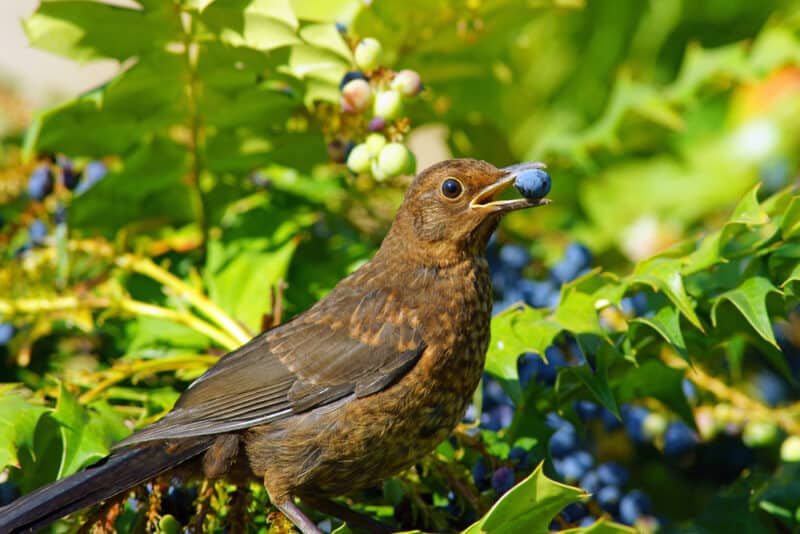
Depending on the species, birds eat leaves, nectar, grass, fruit, insects, fish, small mammals or seeds. Some birds seek out berries because these fruits are nutritious. Berries are an important food source for birds as they have antioxidant properties.
Birds identify the quality and nutritional value of a berry by its color. For example, one study shows that the Eurasian blackcap (Sylvia atricapille) identifies variation in anthocyanin levels in fruits using color and selects the most nutritious berries over others.
Scientific studies like this show that birds focus on finding berries that give them the best nutritional value. Birds will target your crops if you have a healthy garden with abundant berries.
Here is a list of some of the most common birds that eat berries:
- purple finch (Hemorrhagic purpurus)
- Dark-eyed Junco (Junco hyemalis)
- Golden-crowned Sparrow (Zonotrichia atricapilla)
- Spotted towhi (Pipilo maculatus)
- Fox Sparrow (Iliac gateway)
- Band-tailed pigeon (Patagioena fasciata)
- Red-eyed Vireo (Vireo olivaceus)
- American Robin (Turdus migratorius)
- Black-capped Chickadee (Poecile atricapillus)
- cedar waxwing (Bombycilla cedar)
- house finch (hemorrhagic mexicanus)
- Western tanager (Piranga ludoviciana)
Any edible fruit is fair game, but blueberries (Vaccine spp.), cherries (prunus spp.), grapes (Vitis spp.), raspberries (Rubus spp.), serviceberries (Saskatoon spp.), blackberries (Rubus spp.) and strawberries (Fragaria × ananassa) are favorites.
How to protect berries from birds
The best way to ensure you can enjoy your berries before the birds do is to take a multi-pronged approach. Exclusion methods like nets or cages are the only methods that work well on their own.
1. Anti-bird netting
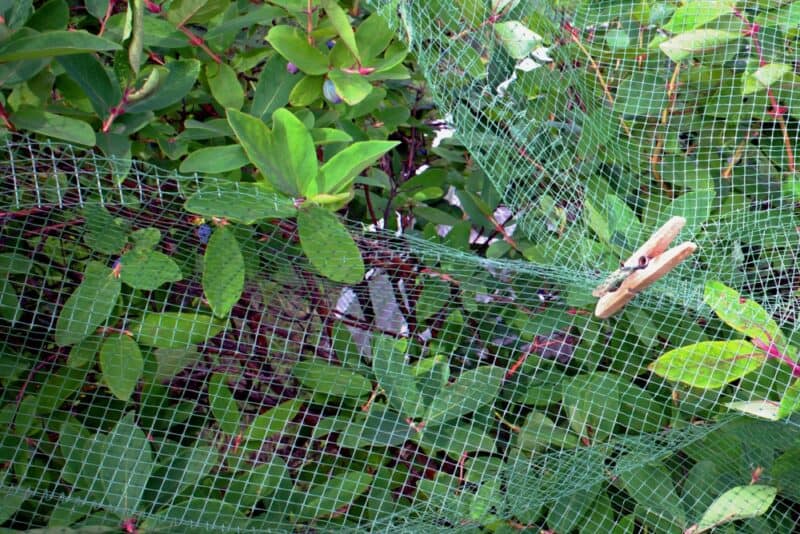
A bird netting is a simple and very effective method of protecting berries from birds. The nets can be used in larger spaces but are also suitable for a small cultivation of berry plants. Setting up bird netting to protect berries from birds is easy, as you only need a few materials.
You need bird-friendly posts, ropes, pegs, and nets for a basic bird net. Choose a netting material that will not entangle the birds when they land on the surface. These are usually labeled as “bird safe”.
Many manufacturers make netting specifically to protect plants from birds, like this black netting from Poyee on Amazon. Some kits include all the necessary stakes, ropes or posts.
Measure the length and width of the garden to get the correct measurements for the bird netting. You can use multiple nets, but make sure they overlap when installing them to prevent birds from sneaking through the divider.
You can lay netting directly over plants, but it’s best to support them with poles or some other type of framework. Tie the net to the posts using twine, rope or zip ties, then secure the net to the ground using rocks or stakes.
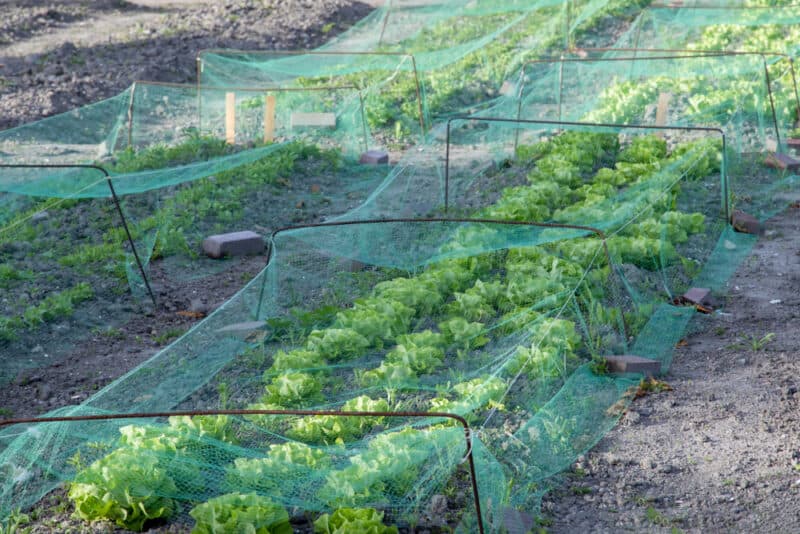
A teepee shape is an easy way to place the bird netting above plants. A rectangular configuration is more effective for a raised bed or a large area of berry plants.
Remember that birds can become entangled and die in the nets. Taut, securely attached nets are less likely to tangle our flying friends.
2. Bells
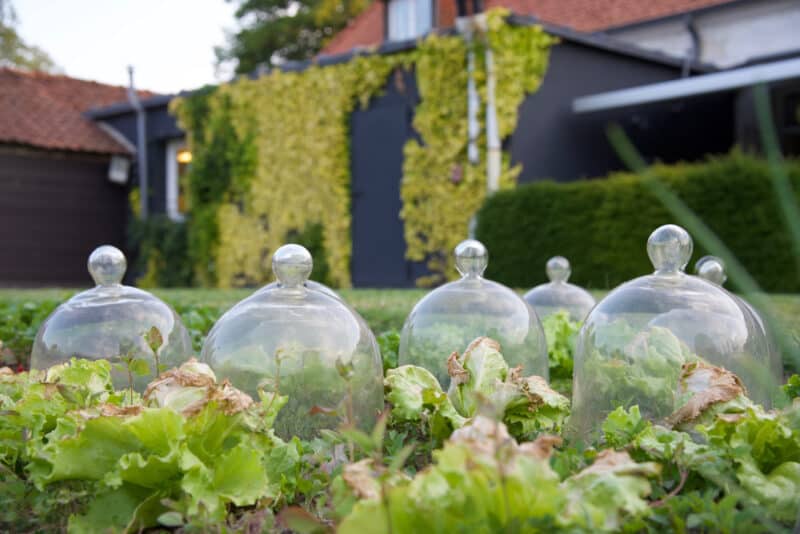
Cloches can be placed on individual plants, making them an easy bird-proof berry solution for smaller plants like strawberries. You don’t have to cover the whole plant; the bell can protect the bays in a small section.
There are affordable options like chicken wire bells available online. It is possible to build your own plastic bells.
Glass and plastic domes increase indoor heat and humidity, so be careful if you opt for one of these. Otherwise, mesh cloches allow air to circulate and do not raise the temperature. They also allow pollinators access to plants.
Remember to hand pollinate during the blooming season if using sturdy glass or plastic cloches. Otherwise, the flowers will not be pollinated and the quality of the fruit will decline, or the fruit will not form at all.
3. Culture cages

Grow cages are more difficult to set up than netting, but they’re much easier to use and don’t have the potential to become a tangled mess. You can buy ready-made cages or create a DIY option at home to protect berries from birds.
Nets can also come loose or creatures can sneak under, allowing birds access to the plant. Replacing the net every time it tears or tangles can be frustrating.
Grow cages are generally more secure and can be made of metal so there is no tearing to worry about.
The downside is that they cost more and you need to have room to store them over the winter.
4. Provide other foods

Food is the main attraction for wildlife in your garden, so you can solve the berry picking problem with a simple solution: provide other food. Using bird feeders to distract these animals will keep them from foraging among your berries.
Plus, you don’t have to worry about them hurting themselves on nets or cages.
Bird feeders can approach berry plants to land on them. This will limit temptation and give them enough food to keep them busy for a few minutes. After a full stomach, they will hopefully move on to another location.
Check the feeder daily to keep it full at all times and watch the birds nibble on seeds as your strawberries bloom. Keeping a record of the different species of birds that visit your garden is a great hobby for spring and summer.
Start a nature journal and make friends with these wild animals this year!
You can also just plant an extra bush or two if you have room and let the birds take care of that. That way, there’s enough for everyone!
5. Plant berries that birds won’t eat
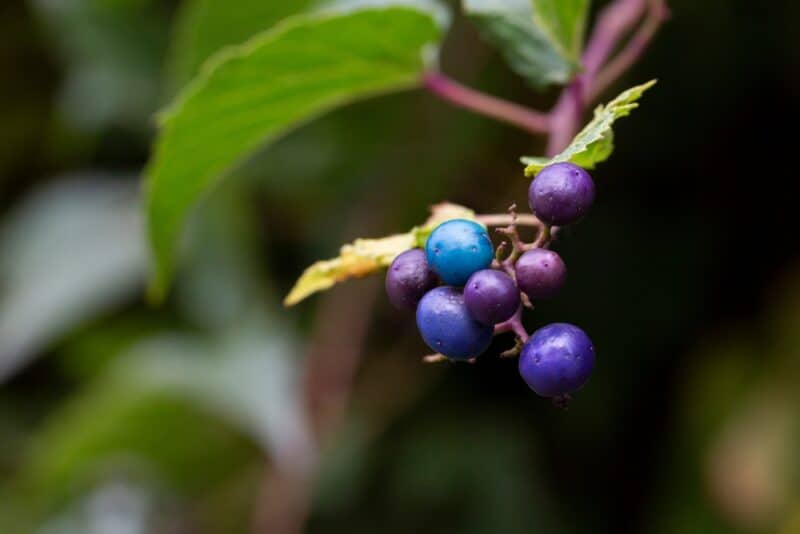
If you want berry plants primarily for appearance and not for harvest, you can protect the berries from birds by planting species they won’t eat.
Red is one of the most important colors in the visual spectrum of passerines. Another option, therefore, is to plant berries of different colors, such as blue or purple.
Porcelain Berries (Ampelopsis brevipedunculata) are unique plants with pink stems and large berries. The color of the berries starts out as a dark blue and fades to white or pale purple. Although edible, they do not taste good.
The other species of berries not very popular with birds are:
- Viburnum opulus ‘Xanthocarpum’ is a cultivar with orange-yellow berries that birds will eventually eat, but only as a last resort. You can eat the fruits, but they are acidic.
- Harlequin glorybower (Clerodendrum trichotomum var. Fargesii) has inedible pink berries.
- Barberry ‘Pirate King’ (Berberis x carmine ‘Pirate King’) has bright pink edible berries.
- ‘Profusion’ Beautyberry (Callicarpa bodinieri var. giraldii ‘Profusion’) has dark purple berries that are edible, but don’t eat too many at once.
6. Decoys and Scare Tactics
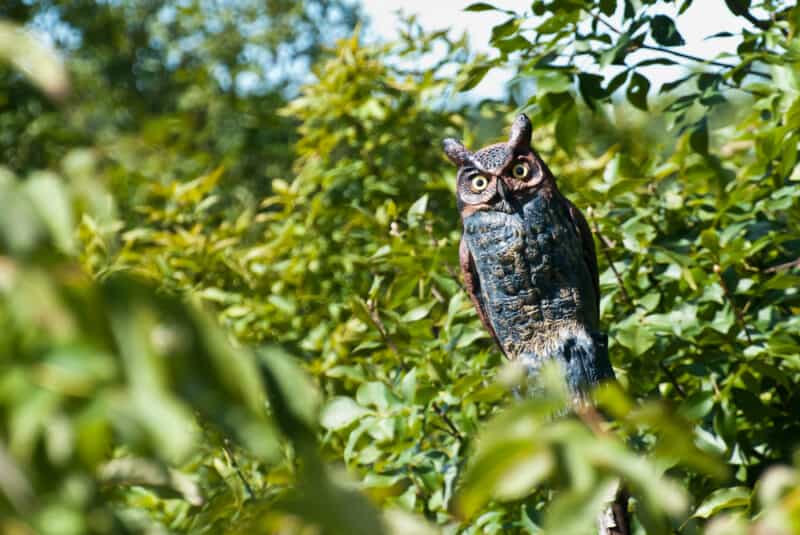
Everyone has seen these decoys as owls or scarecrows, and many of us have tried scary tactics like snagging CDs, but do they work to protect berries from birds? Scarecrows have long been associated with keeping birds away from crops, so they must have some value, right?
We know a decoy works best if it looks like a predator. A study in Oregon found that a fake owl was more effective than a benign object like a box. The type of lure is therefore essential.
But even when you use a predator-shaped decoy, the birds acclimate to it in just a few days. Studies have even shown that even decoys that have moving parts are not enough to scare birds away in the long term.
You can try other methods to imitate nature, such as placing lengths of black pipe in the garden to look like snakes.
What about mirrors and other reflective surfaces like aluminum foil? These were also not shown to be effective long-term in a study from the University of Nebraska. Something like a shiny pinwheel near your berry plant may deter some birds because it jiggles and puts on a shiny sheen.
Changing the location of the lures will help. Every few days, move the lures or reflective items.
Audio tools like wind chimes can also help temporarily, but like decoys, birds tend to acclimate to them. Wind chimes can be placed around your garden as both an audible and a visual deterrent.
There are plenty of memes on social media claiming that rocks painted to look like berries can confuse and keep birds away. The theory is that the birds will try to peck at the rock and learn that it is hard and unpleasant.
Apparently, after this experience, they won’t want to return to your garden. As with decoys, this does not work long term. Birds quickly learn that some berries are edible, although some are not.
So have fun painting berries if you like it, but don’t expect it to protect your plants.
Was this article helpful?
Yes No ×
We appreciate your helpful feedback!
Your response will be used to improve our content. The more feedback you give us, the better our pages will be.
Facebook pinterest