

Have you ever heard of Pachypodium geayi? Do you know what kind of plant it is? If you’re not very good with them, or need a plant that tolerates heat well, this may be a good choice.
But how are you? What features does it have? does it bloom? Does he grow a lot? What care do you need? We’ll give you an answer to all of that below. Go for it!
How is the Pachypodium geayi
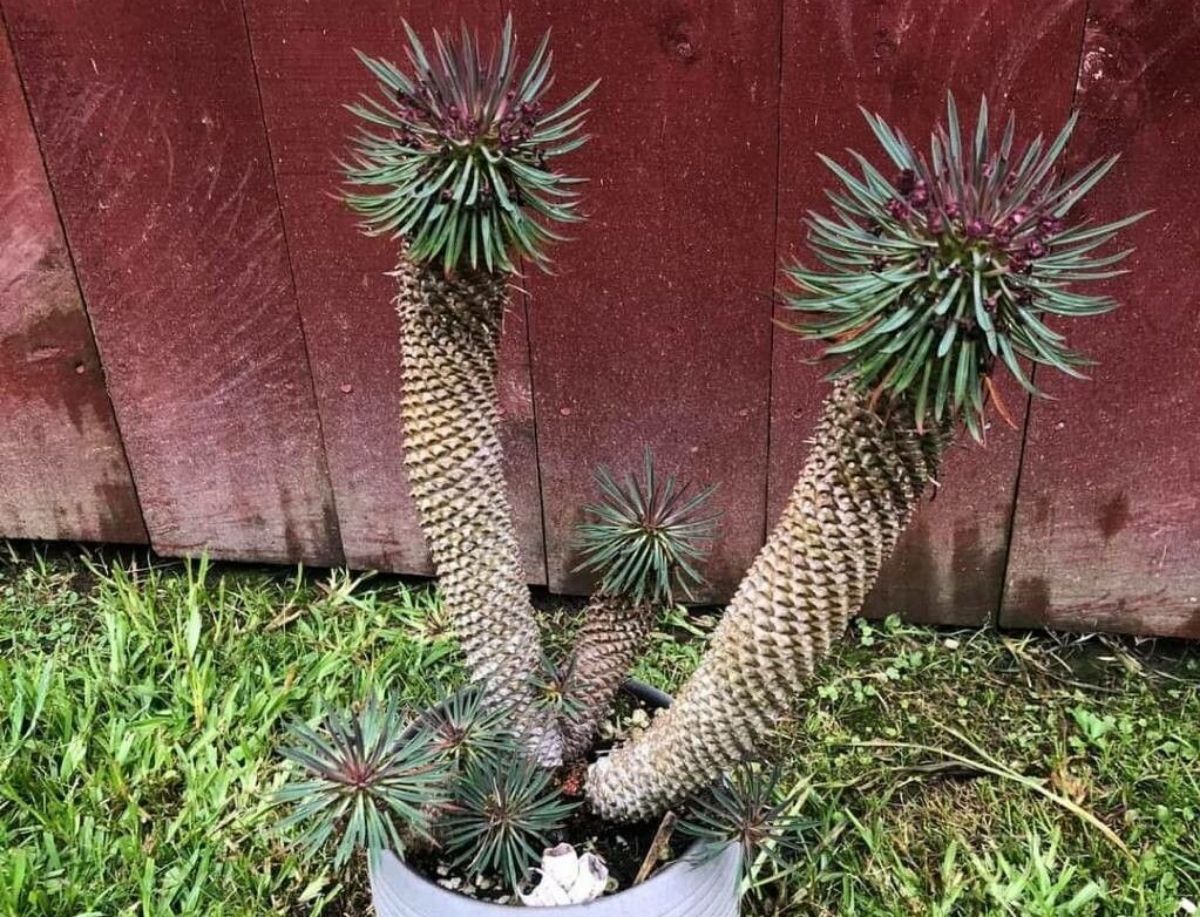
Source: Pl@nNet
The first thing you need to know is that Pachypodium geayi is actually a succulent.. It was discovered by Martin François Geay in 1904, hence its name.
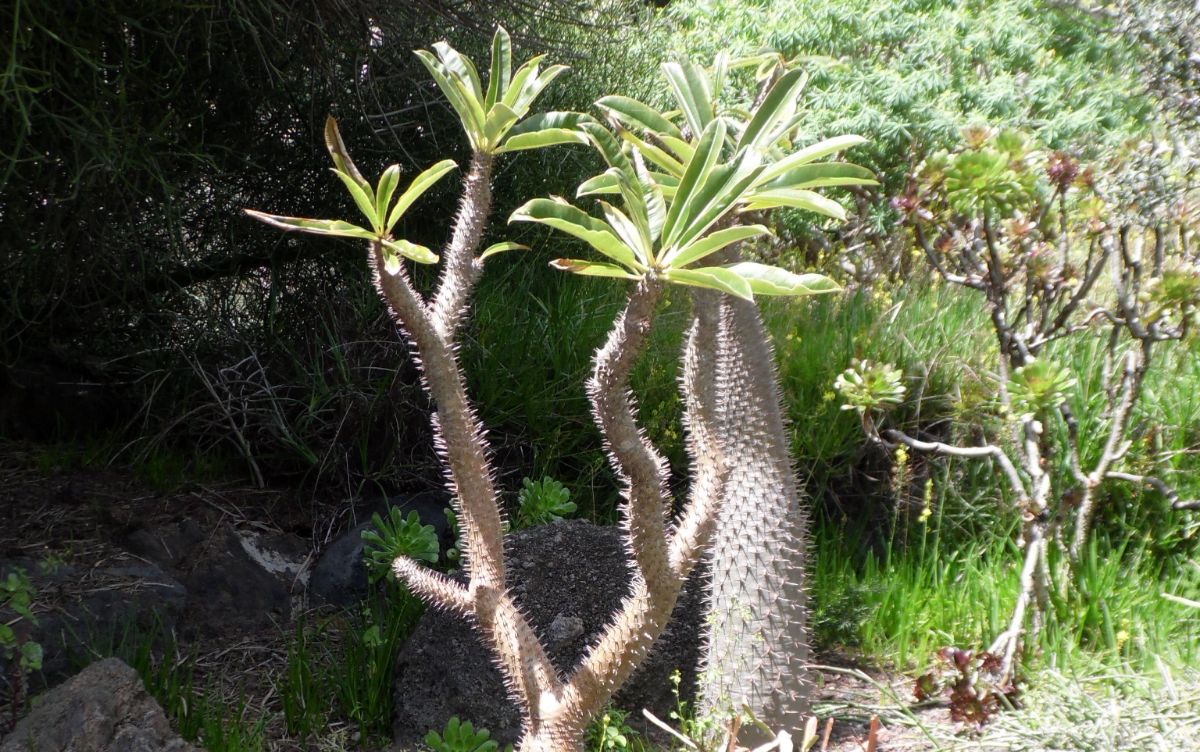
This plant looks like a palm tree, with a rather thick and high stem, with thorns, and from which quite dense foliage grows. The leaves are one of its characteristics because they acquire a grayish-green color and, in addition, they are long and thin. Actually, They can measure more than 40 centimeters, while in width they cannot exceed 2 centimeters.
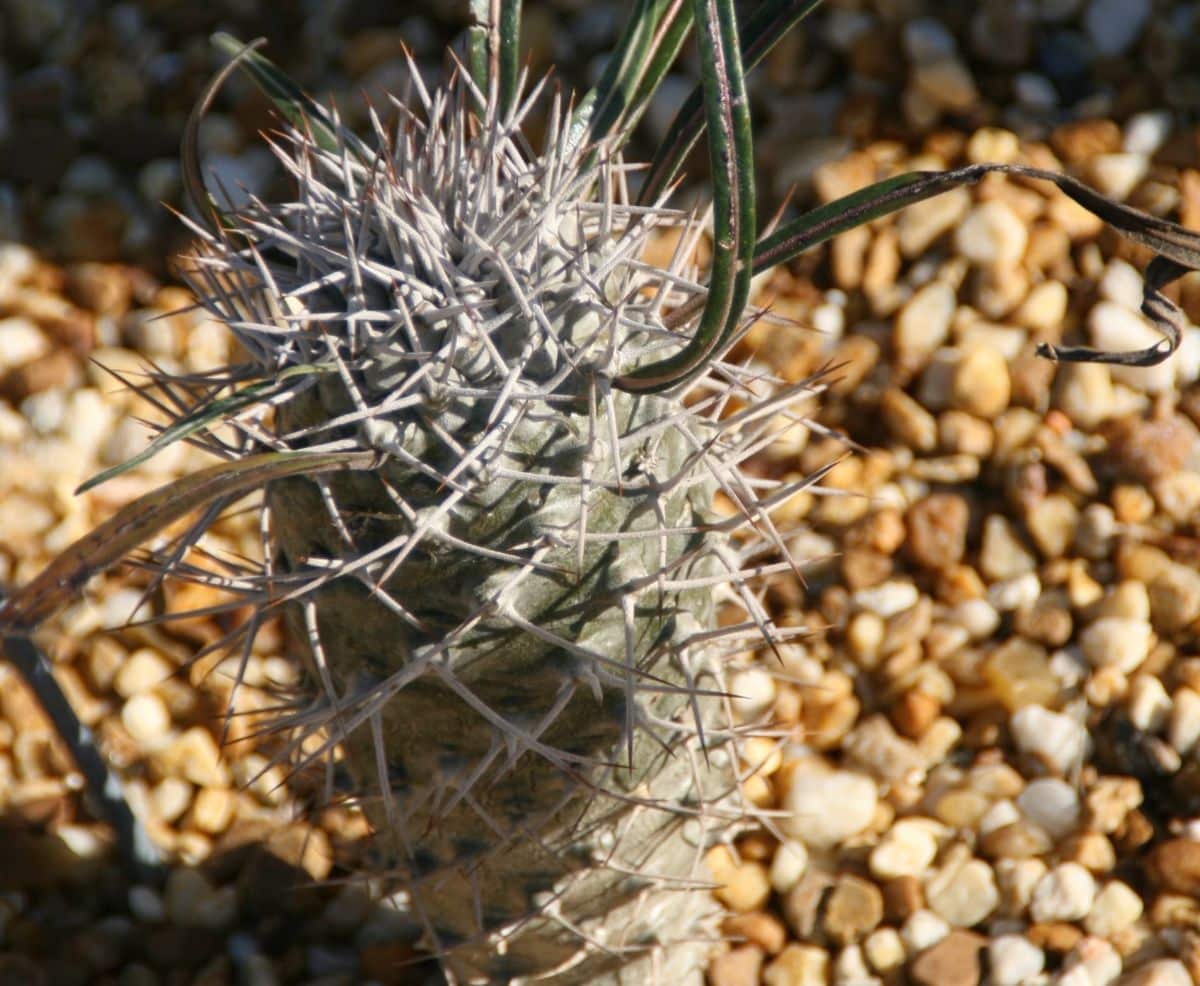
As for the thorns, they come out of the stem, and they are quite long. Of course, they have an aspect that does not make them look like thorns (because they are covered and it may even tempt you to put your hand near them). Of course, don’t even think about doing that, because they click a lot. In fact, as they grow and develop, they are able to cover the entire trunk, serving as protection so that it does not get damaged.
Pachypodium geayi can easily reach 8 meters in height. Obviously, this does not happen overnight, but can take 30 years or more. However, when kept in a pot, its growth is very limited.
Does Pachypodium geayi have flowers?
Well yes, although it looks like a palm tree, it actually flowers. These are usually very small and white with a bit of yellow in the center. They are flowers with five large petals, practically equal to each other, and curved. Of course, don’t expect him to blossom quickly; it takes about 10 years to do it.
After the flower, and around the age of 13, comes the fruit, where the seeds are found. They are like pods and once opened the seeds will be protected.
Pachypodium geayi care
Now that you know more about Pachypodium geayi, how about leaving it to yourself in case you want to have this plant in your garden or in a pot? If you don’t want to lose her in an instant, We advise you to observe these precautions.
location and temperature
If you want Pachypodium geayi to feel good, If it is healthy and has the light it needs to carry out photosynthesis, it is best to place it outside in a warm spot in partial shade. If where you live the sun is not so intense, you can put it in full sun.
Now you have to make sure that the temperature is, during the day, between 20 and 30 ºC, while at night it must be kept at 5-10 ºC. The first year, or even the second, are the most complicated because the plant must adapt to the temperatures (especially if these degrees are exceeded), but if it is reached, it will be able to survive without problems at higher temperatures.
In the case of lower degrees, it is advisable to protect it with a net or similar (at least the part of the earth so that the roots do not suffer).
Substrate
The ideal soil for Pachypodium geayi is that of cacti and succulentsbut we recommend mixing in some worm humus and also drainage (perlite, orchid bark, etc.) as this will help it be looser and not clogged from watering.
Irrigation
Irrigation is one of the most important cares for Pachypodium geayi. As a succulent it is, it won’t need very heavy or constant watering. So in general it will be, in spring and summer, with high temperatures, every other day; while in autumn and winter you will only have to water three times a week.
Of course, everything will depend on the substrate. If it gets wet, even if it needs watering, don’t. It is best to wait for it to dry out before watering again.
Subscriber
Unlike other succulents, this plant accepts fertilizers, in fact it appreciates them, especially if you have it in a pot and not in garden soil.
Bet on a liquid fertilizer that you can include in the irrigation water and add it once a month. We recommend that it be high in nitrogen.
Plagues and diseases
This is perhaps one of the worries you most want to avoid, because it means the plant is not healthy and you have seen pests or signs that let you know that there is has a problem.
In the case of pests, the most common is the cochineal, which is generally located on the leaves (upper side and lower side) as well as, occasionally, on the trunk. There it is more difficult to remove because of the thorns, but you will have to help yourself with a tool and a cloth to clean the whole plant.. Then you can apply a fungicide to treat it and also to prevent more problems from appearing.
However, in terms of diseases, many of them are related to excess or lack of irrigation and lighting. You can easily see it on the leaves. If they begin to lose color and turn yellow, it may be due to lack of light or overwatering.. On the other hand, if they look dry or curled, it could be due to a lack of water or too much light.
What you should keep in mind is that Pachypodium geayi is a deciduous plant, that is, in autumn and winter it can lose its leaves. So if you see that at this point they start to turn yellow, maybe it’s their natural process.
Multiplication
The propagation of this plant is by seed. However, as we told you before, it will take about 13 years to produce them after flowering.
Do you now know more clearly what you need to know about Pachypodium geayi?