

One of the typical Spanish plants is the Allium moly. Wait, you don’t know which one we’re talking about? Also known as golden garlic, molybdenum garlic, chive or Spanish garlic, it is a perennial plant.
If you want to know more about it, below we give you the characteristics of this species of garlic and the care you should give it to enjoy it in your garden (and eat it incidentally). Shall we start?
How is Allium moly
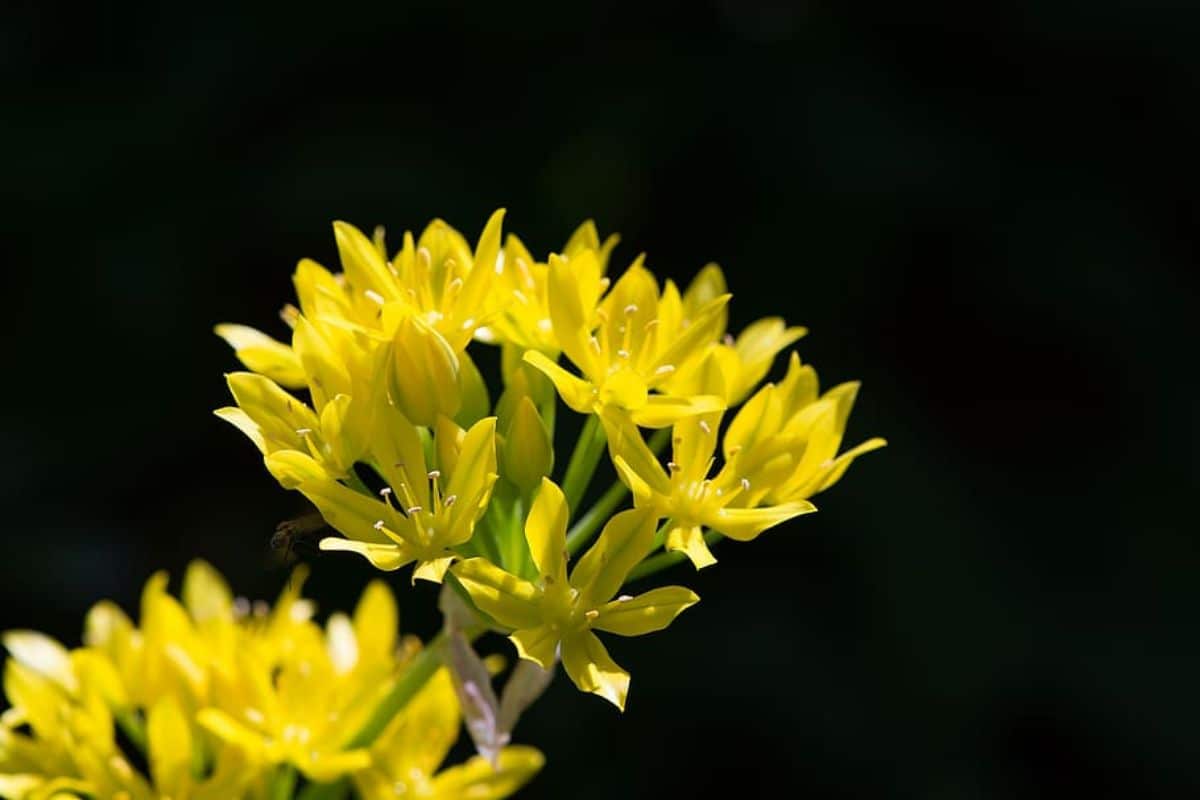
As we told you, Allium moly is typical of Spain, where it is usually grown, although in fact the origin is European. In France, for example, it is protected due to the rarity of the plant, but not in Spain, where it can often be found in its natural habitat (in rocky areas) or, if you obtain the plant or the seeds, grow it in your garden.
And it is that, although it can be edible, this garlic plant is usually kept at an ornamental level.
It is a bulbous plant, not exceeding 40 centimeters, consisting of a round bulb covered with a white layer. Its diameter usually does not exceed two centimeters. Its life cycle extends from around September to June, leaving the warmer months at rest. For this reason, in winter it is common for it to begin to develop a stem with several leaves (often 2-3), large and flat, and bluish-green in color. These can measure between 15 and 30 cm and about 3 cm wide.
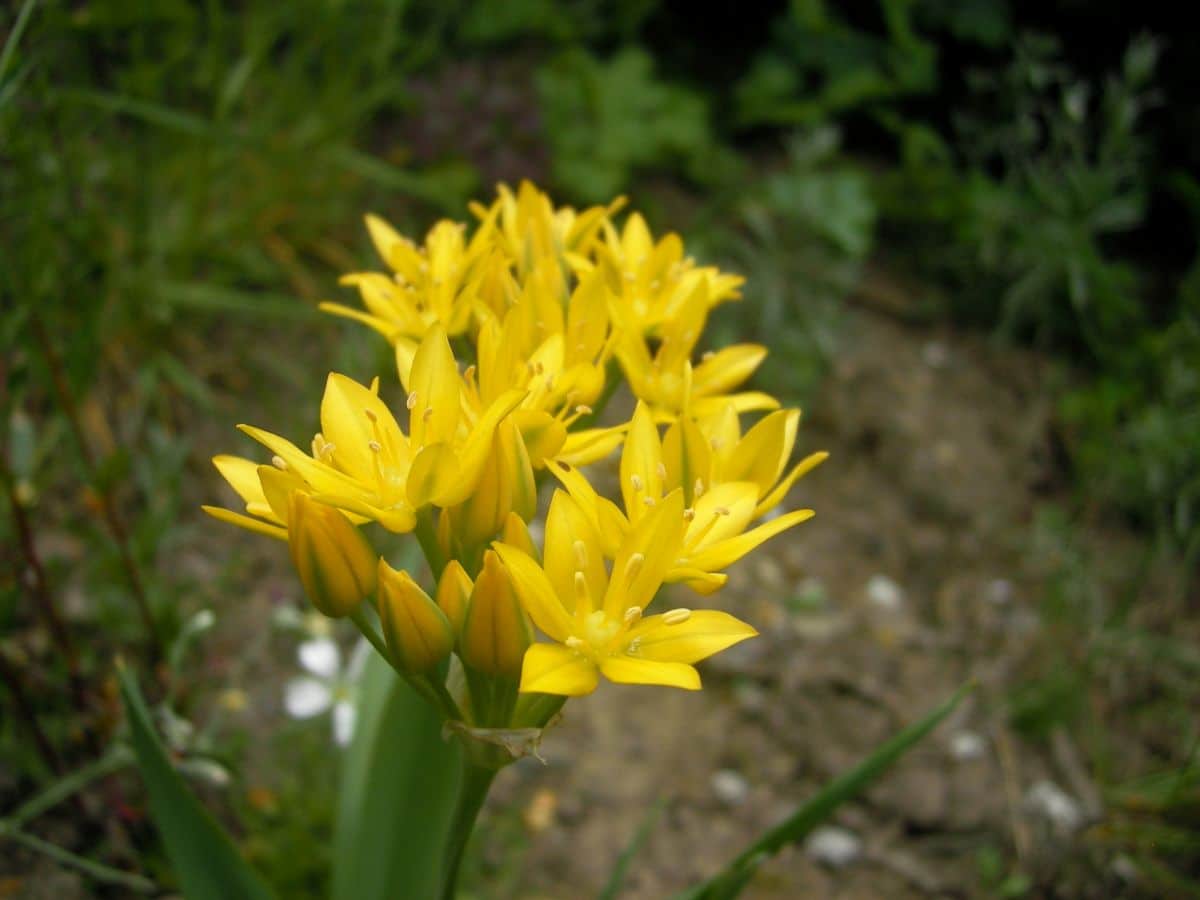
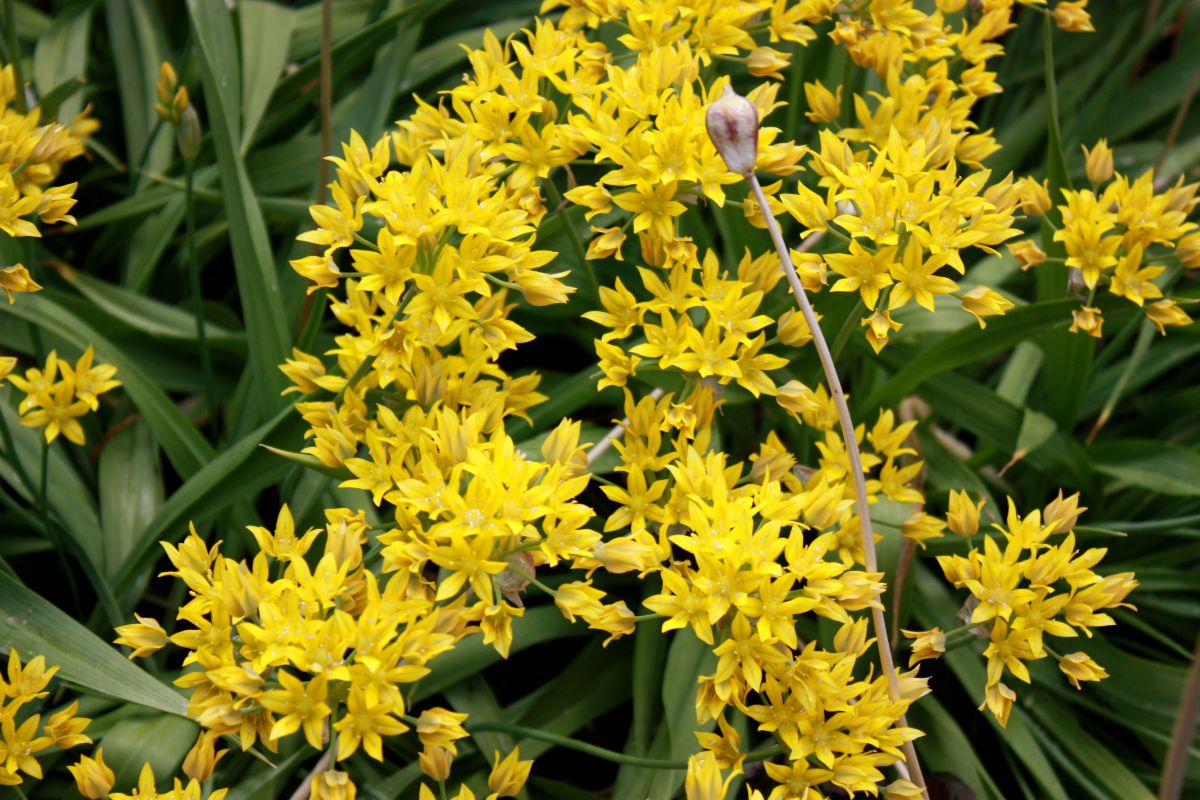
In addition to this stalk, from March to June it usually produces one or more flower stalks, 15 to 30 cm long, which cause the flowers to be taller than the plant itself. Thus, you will have about ten flowers, yellow and in the shape of a star, with 6 tepals of one centimeter.
These flowers are very attractive to insects, which pollinate them and this causes them to create ovoid capsules. When these are opened, seeds which are very small and black can be obtained.
Allium molybdenum treatment
Now that you know more about Allium moly, What if we help you so that you can grow it and take care of it in your garden? We have investigated and here we leave you the keys so that it succeeds.
location and temperature
As we told you, Allium moly is grown through bulbs which are usually planted in fall and winter. These should be placed at least ten centimeters deep and, unlike others, they will go in groups. Now where?
You can plant it both in pots and directly in the garden. As for light, partial shade is best, especially if you usually have a temperate climate where you live. But it adapts without problem to full sun if the temperatures are not too high.
To give you an idea, in France it is planted in full sun, but in the case of Spain It is recommended to plant it in partial shade because of the hours of sunshine and its incidence.
As for the temperature, although it must be taken into account that extreme heat slows down the growth of the plant (and for this reason it is left to rest during the summer months, to prevent it from deteriorating ), it is not the same with the cold. In fact, It is able to withstand temperatures of -29ºC.
Substrate
Although Allium moly can be placed in any type of soil, if we had to recommend a specific one, it would be one with an acidic or alkaline (even neutral) pH. For example, clay or sandy soil. Of course use one or the other, it is important to mix it with drainage because the soil needs to be very light and loose.
Irrigation
The irrigation of Allium moly depends on many factors, among which the location, the temperature, the time of the year… In general, all Allium moly need a slightly moist substratewith which you will have to water it according to the season.
Of course, in summer it should not be watered because the bulbs will be at rest. In fact, it’s common for the plant to start shedding its leaves and stems when the heat hits. So at that moment you have to stop watering so that the earthand the bulb, dries up and can therefore come to rest.
From September you will need to water it at least once a week. However, in winter you may not have to water it much if there is humidity in the environment. From spring, watering should be increased at the beginning, and reduced in the middle of the season.
Subscriber
When we talk about a bulb, it is normal that when it finishes its cycle and rests it has come out of the jar. For thatwhen it comes to replanting it, it will be done in a new pot with new soil. This implies that it is not necessary to fertilize it because it will have nutrients as long as it is planted.
However, if it is not removed from the pot, we recommend that you give it a fertilizer with the irrigation water following the manufacturer’s instructions.
Multiplication
Finally, we want to tell you about the propagation of Allium moly. In this case, you have two options, both equally good.
The first has to do with the bulb itself that you have. Over time, it is common for bulbs to produce suckers. At first these will be very small and might not work for you. But when you see it’s big enough, you can separate it and plant them separately (yes, wait a few days for it to heal).
The best time to do this is when the bulbs are dormant, which is June through August. At this time, you should remove them from the pot, clean them as best you can, and store them in a dark, cool place until the high temperatures pass.
The other option you have for propagating Allium moly is through seeds. Although it means waiting longer for it to grow, they can give good results.
To do this, you need to collect them from the stalk and store them in the refrigerator until September arrives. That’s when you can plant them, and hopefully some of them will sprout in the spring (it’s true, it can take several months to see if some will thrive).
As you can see, Allium moly can be a good choice to grow in the garden or in a container. Not only for its usefulness (it is edible and both the bulb and the leaves can be eaten), but also for its beauty. How about trying?