A friend of mine is a certified plant killer – they can’t seem to keep a plant alive for more than four weeks at a time.
So when they admitted they were toying with the idea of getting (killing) another plant, I had to think quickly.
Often people take care of their plants because they enjoy looking at them (aesthetic value). But this is not always enough. Sometimes you need that extra push.
So I decided to give them a plant that would also take care of them, creating a mutually beneficial relationship. And that plant was none other than the Philodendron, one of the best houseplants to have in your home.
A philodendron has countless benefits; is a well-known air purifier, it is easy to maintain, have great adaptability, can be grown permanently in water, and increase humidity.
Along with philodendrons, they have the added benefit of helping you sleep, reducing stress, increasing productivity, and are easy to propagate.
These are just some of the motivations behind my endorsement of Philodendron.
If you too are considering buying this herb, keep reading to see how beneficial this step would be for you:
What are the benefits of owning a philodendron?
I have always known that plants take care of us. Even without getting technical about it, we do know that they release oxygen into the air, which fuels the lifeline that keeps humanity alive.
So I knew that any plant would work for my friend in terms of indoor air quality. But wanting something more attractive, I chose a philodendron for the following benefits:
1) Air purifying properties
 Have you ever walked into a room full of plants and automatically felt like the air was cooler? That’s what an air-purifying plant does in a room.
And if you spend many hours indoors, you quickly feel that the air is not clean enough, even if an air conditioner is running at full speed.
This is why air purification plants have become so popular, with shutdowns, high pollution levels looming and WFH crops growing.
And the Philodendron is an excellent choice. The philodendron is JAR-thumbs up, and you can be sure your gardener won’t mince words that this plant will do wonders.
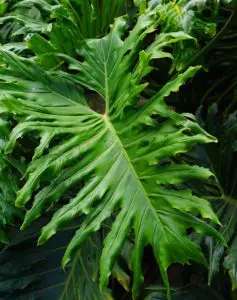
It features large leaves that cover a wide area and allow the plant to remove nearby formaldehyde. And the width of the leaves also works to block toxic EMF radio waves in the air!
Of course, some philodendrons have superior air-purifying properties than others. Here are the varieties of Philodendron:
These are just a few examples. You can always search for others whose aesthetic values interest you the most and choose between them.
PS: Did you know? Philodendron is simply a name for the genus Philodendron. Among them are hundreds of species with this name. And that gives you plenty of latitude to search for the perfect plant.
You might also like: Can the philodendron grow in the shade?
2) Permanent water growth
If you often forget to water your plants, be aware that some philodendrons can grow in water. Examples include the heart-leaved philodendron and the velvet-leaved vine philodendron. Can you imagine?
And I must also add that the technique of growing these plants in water is very simple, even a complete novice can hack it.
It is enough to provide the plant with its basic needs: light, nutrition, temperature, humidity, etc. And change the water once a week.
Since these plants tend to grow quite quickly, you may want to add some pruning to the routine to avoid having to repot the plant.
Advantages?
- Aesthetic value: You can use a water-grown philodendron as a centerpiece instead of using flowers. For even better aesthetics, make sure the container is clear so people can see the roots and stems. And for a better view, you can color the water!
- EASY MAINTENANCE: Now that you are no longer at risk of soggy soil, killing the plant will be much more difficult.
And because these plants hang down, the view becomes spectacular when you direct the growth around the house.
We have an article about it. How to propagate philodendrons in water.
3) Easy to maintain
Did I mention my friend kills almost every plant in the house? He feared the same fate would befall any plant he gave them.
So I opted for one of the easiest plants to maintain. Even if you are determined to kill this plant, it will fight.
And that’s what every herbicide needs: a plant that can handle those few days or weeks of neglect. What does a philodendron need to survive?
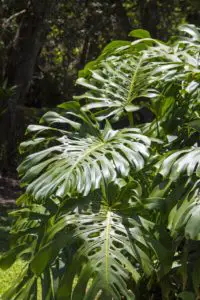 Bright, indirect light: does well in sun/partial shade and will burn in full sun,
- A good soil: it must drain well with an acid pH,
- Repot every few years,
- Water moderately only when the top four centimeters of soil are dry – the plant does not like soggy soil and prefers to be flooded rather than overwatered. In winter it doesn’t even need a lot of water, you can do it once a month!
- A wide temperature range, as long as they stay above 55 degrees Fahrenheit, and
- A little damp.
And as if that were not enough, it only needs to be fed once a month and does not need fertilizer in winter. When I read these instructions and how easy they were to follow, I knew I had found the perfect plant.
4) Adaptability
Not all plants like to be moved to a different environment. And sometimes the shock is so strong that it kills the plant. But fortunately, this is not the case with the Philodendron.
Did you know that Philodendron means “tree lover”? Essentially, these species thrive in the wild, where they survive by clinging to aboveground vegetation in search of light.
So even in their native habitat, these plants are feisty and get by with what they have.
To keep this plant alive, all you need to do is make sure it has access to bright, indirect light. You can do this by placing it near a window, away from direct sunlight.
If the plant is in shade or low light conditions for too long, it will start moving towards natural light. To do this, she uses her light-harvesting complex, which allows her to absorb more light.
So in the dark areas of the room the leaves will be much greener than the others.
If the plant gets enough light, it won’t need a lot of light-harvesting complex and the resulting leaves will be less green.
This ability allows you to slowly move the plant into shady areas of your home, knowing that it will soon recover. However, it is not a green light to prevent it from fully lighting up, it could kill the plant.
You might also like: Can you put a philodendron outside?
5) Increased humidity
Does the air in your home sometimes seem too dry? You can solve this problem by adding a Philodendron – this plant has a high evaporation rate.
And you know what that means: more humidity in the air. So, in addition to removing toxins in the air, it also makes it easier to enjoy fresh air in your home.
This can be useful in the summer when the heat can be a bit uncomfortable.
6) Philodendrons are easy to propagate
A philodendron is easy to propagate, the best time to propagate a philodendron is in the spring.
To propagate a philodendron, use sharp, sanitized shears or shears and cut about 4 inches from the end of the stem. Make sure the stem is not damaged or diseased.
Make the cutting just below the node and remove all the leaves from the lower half of the cutting before placing it in water or soil.
Once the roots have grown several inches, which will take a few weeks, they are ready to be transplanted.
7) Philodendrons can reduce stress
 Having a houseplant has several advantages. These include reducing anxiety and stress, reducing mild depression, lowering blood pressure and increasing productivity.
Introducing a philodendron to your home can provide you with all of the above benefits, as well as beautiful greenery in your home.
You might also like: How to Solve Your Philodendron Selloum Problems
8) Philodendron is an excellent sound absorber
Plants can reduce noise levels in the home and outside in three different ways, namely; deviation, absorption and refraction.
These three methods are all thanks to the leaves. Each plant is different in its sound deadening effect due to the size and shape of the leaves.
The philodendron is no different, and each species can have different soundproofing effects in your home.
Final thoughts: What are the benefits of owning a Philodendron?
And to top it off, I’d like to point out that philodendrons are beautiful houseplants, available in many different sizes, shades, and patterns.
It is therefore very easy to find the one that matches your interior. Happy gardening!
Before you go, here are some other related articles that I encourage you to read below to solve more of your gardening problems:
Anthurium versus Philodendron
How to Care for a Philodendron Tiger Tooth
Red Heart Philodendron
What is the rarest philodendron?
Philodendron Selloum versus Xanadu