
The soil pH It is a very interesting parameter to know what can we plantro, directly, if we can plant.
The acidity or alkalinity number This is extremely important because microbiology conditions soil and even nutrient solubility.
There are suitable plants calcareous environments and alkaline pH, and others that need slightly acidic areas to develop their full potential. However, a plant is better able to thrive in slightly acidic environments even when used in alkaline areas than vice versa.
To measure the pH of a soil no need for expensive instrumentse, unless we need a lot of reliability. Nail single pool pH strip which are extremely cheap and allow us to get rid of doubts.
In this article, we tell you how to know the pH of the soil without too much paraphernalia.
read more: how to know the texture of the soil in an artisanal and analytical way.
How to measure and know the pH of a soil
If you have a pH meter (pH reader), you’re in luck, since you’re going to get a very accurate range, even with decimals, of soil pH.
However, if you are new to farming, a simple pH strip kit is enough to get a range of 0-14 and get an idea of what is the situation of your land.
Since pH strips and pH meters only read liquid or partially liquid solutions, it is necessary to prepare the soil sample beforehand.
We tell you everything.
Instruments needed
In general, you have 2 options, the first more reliable and the 2nd more common, but interesting if necessary.
pH meter
Using a digital reader, it will tell us, with great precision, the pH value, with 1 or 2 decimals.
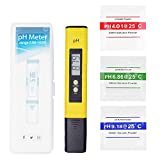
Portable Digital Display PH Tester, Water Quality Tester with 0-14 PH Measuring Range, High Accuracy Handheld Digital Meter for Aquariums, Swimming Pools, Auto Calibration
- ❤ Swimming Pool pH Meters Quick and Accurate Results: No need to work with color shirts and boring test strips. Resolution: 0.01 pH, Accuracy: ±0.01 pH Lightweight and compact pocket pH meter. Fits completely concealed in a purse or pocket for easy, casual carrying.
- ❤ Easy to use: Simply dip the pH meter electrode into the solution to be tested, readings are quickly displayed on a large LCD screen.
- ❤ Digital pH meter Working temperature: 0°C to 60°C. Size of the digital pH meter: 15.5 x 3 x 1.5 cm. 2 sets of free pH calibration powders, easy to calibrate with pH 4.01 and 6.86 calibration powders provided in PH make the strips more accurate. Very accurate for a measuring range of 0 to 14 pH, resolution of 0.01 pH.
- ❤ Self Calibrating pH Meter: Features built-in calibration with 3 buffer powders (included). Simply press a button to complete the calibration. This pH meter is factory calibrated. Users can use it directly.
- ❤ Swimming Pool Chlorine and pH Meter Wide Application: Ideal tool for any aquarium, fishing industry, swimming pools, spa, school labs, food and beverage, drinking water, etc.
Logically, the more we invest in the device, the more reliability and durability it will bring us. In online stores we find very cheap options.
As a tip, to check that the device is measuring correctly, take a first measurement with distilled water (pH 7) to check that everything is correct.
pH strips
By comparing the colors according to a chromatic scale, we will know the approximate and subjective value of the pH of the soil.
discounts
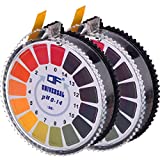
Universal pH Test Paper Strips Roll pH Test Strips, 0-14 pH Full Measuring Range, 2 Rolls, 16.4 Feet/Roll
- pH test paper roll: pH test strip has full pH range, measures pH values in the range of 0-14, pH color chart intervals: 0, 1, 2, 3, 4, 5, 6, 7, 8, 9, 10, 11, 12, 13, 14, easy to read
- Material: pH paper is made from quality litmus paper, get fast and accurate results in seconds with the good quality pH test paper.
- Multiple Applications: The universal pH paper is a good teaching source for schools, laboratories, it can also be applied to detect the pH of body urine, saliva, drinking water, swimming pools, aquariums, hydroponics, aquariums, food, etc.
- Easy to use and operate: pull out a small test strip, touch the liquid to be tested, a few seconds later, compare the test results with the standard color on the carton.
- Scroll Design: Lightweight and compact coil design for convenient use and carry; Length of each roll approx. 16.4 feet/ 5 m, 2 rolls, totally 32.8 feet
read more: how to properly fertilize a vegetable garden.
Step-by-step measurement of soil pH
Step 1: Representative Soil Sample
In any type of soil, there are areas with noticeable changes in the pH range. For this reason, several random samples of the earth’s surface that we want to measure are usually collected. Thus, we will have a faithful representation.
It is not necessary to take a large sample, because 50-100 grams will be quite enough.
Step 2 – Moisturize the potting soil
Since we need to hydrate the soil so that it forms a paste that is easy to dose with the device, we will add distilled water to the mixture.
We will add 2.5 times more distilled water than the soil sample.
In this case, as we talked about a sample of 100 grams, we will add 250 ml of water.
It is very important that it is distilled water, at pH 7, because if we use tap water we will obtain an unreal result and the sample will be altered.
Shake the mixture well until it forms a paste, letting it sit for about 10 minutes.
Step 3: measure the pH of the supernatant liquid
As we have used a larger amount of water, there will be a supernatant liquid from the mixture with traces of soil, from which we can measure with our pH meter or with the famous pH strips mentioned above.
Once you know the pH of the soil, check the information we show you below to know the situation of your soil.

Classification of a soil by its pH
We are going to establish a complete classification of the soil according to the pH range it has.
- pH < 4.5: extremely acidic, few plant species thrive in this type of soil.
- pH 4.5-5: strongly acidic, with a risk of phytotoxicity due to the strong presence of metallic aluminium.
- pH 5.1 to 5.5: notably acidic with possible mineral deficiencies in Ca, K, Mg, N, P, Mo, etc. and excess Cu, Fe, Mn, Zn and Co.
- pH 5.6 to 6: moderately acidic, being a suitable soil for most crops.
- pH 6.1 to 6.6: slightly acidic, harboring the range of maximum nutrient availability.
- pH 6.6 to 7.3: considered neutral and habitable for all plants, with no risk of phytotoxicity.
- pH 7.4 to 7.8: moderately alkaline, with free presence of calcium carbonate in the soil.
- pH 7.9 to 8.4: as basic soil and alterations in the assimilation of minerals such as P and B, in addition to an increasing deficiency in Cu, Fe, Mn, Zn. Co, especially iron.
- pH 8.5 to 9: alkaline soil with serious iron chlorosis problems.
- pH 9.1 to 10: very alkaline and high presence of sodium carbonate which reduces crop productivity.
- pH > 10: Strongly alkaline with a high percentage of exchangeable sodium. Microbial activity is low and availability of micronutrients is low, with the exception of molybdenum.
If we had the option of choosing the best pH range, we would undoubtedly choose the slightly acidic one, with a pH between 5.5 and 6.5.
pH and nutrient solubility
A very important determinant of soil pH is nutrient availability. That is to say that the presence of an element, such as iron, does not mean that it is directly assimilated by plants.
In this case, the iron in a soil with an acid pH is in the valence state 2, Fe(II), directly assimilated by the plant, so it is very rare for iron chlorosis to occur in the crop.
However, at an alkaline pH above 7.5, the predominant form of iron is the valence 3, Fe(III) unavailable to plants.
It is true, but it cannot be assimilated. Thus, at this type of pH, chelate forms are used which keep the iron protected in the Fe(II) form until it is released.
To know the behavior of nutrients according to the pH range, what better than to consult this clear and concise image, where it explains how each element behaves. When the bar is the thickest, it means that the assimilation is maximum. On the other hand, when it decreases, its availability for the plant is reduced.

Depending on the pH of your soil and the nutrient or micronutrient interested in supplying it, assess whether it is necessary use complexes or chelates to reduce precipitation losses.
A soil with a pH of 8 is unlikely to assimilate iron which contains the ground. All intakes of this micronutrient must be protected in the form of a chelate, preferably with the EDDHA agent (wide range of stability at different pH).