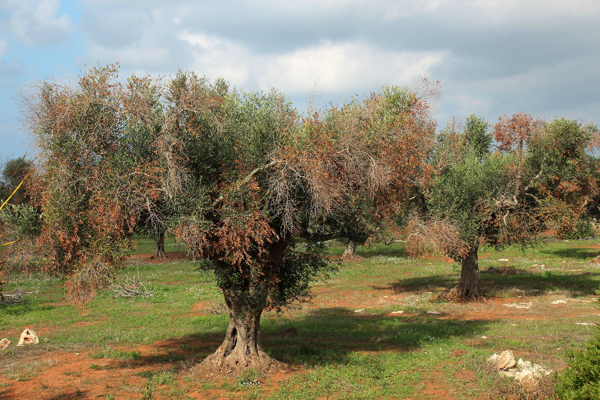
Many will have heard of the dire situation of many olive groves in Puglia, where Century-old trees were exterminated by drying out completely . This disastrous pathology which caused a stir in the media is called CODIRO or in its entirety” quick-drying olive complex and is one of the most dangerous diseases of the olive grove.
In recent years, scientific studies have established a link between CoDiRo and Upset Xylella , a gram-negative bacterium, which reproduces inside the xylem vessels of plants, causing their occlusion. The consequence of the bacterial attack is therefore the obstruction of the circulation of the lymph, made up of water and mineral salts, in the pots and therefore the desiccation of parts of the plant.
The Xylella bacterium is extremely polyphagous, in fact, in addition to the olive can attack other species of agricultural interest, such as citrus fruits, vines, plum trees and cherry trees, but also plants of ornamental interest, such as the oleander, as well as a large number of wild species.
Therefore, Xylella is not only the CoDiRo bacterium that affects the olive tree . The two major diseases caused by Xylella that have had the greatest economic impact on agriculture are” Pierce’s disease of the vine and the citrus variegated chlorosis (CVC), known for the devastating and destructive effects they have had since 1880 on vines in California and since 1987 on Brazilian citrus groves respectively.
The subspecies of the bacterium associated with the “olive drying complex” in Puglia is currently thought not to infect grapevines and citrus fruits, but has also been isolated from almond and oleander trees.
Contents [Ocultar]
-
CoDiRo Symptoms and Damage
-
The Xylella case in Puglia
-
Transmission of the bacteria
-
Fight against Xylella and CoDiRo
-
Use of resistant cultivars
-
Circulation of propagation material throughout the country
-
Insect vector control
-
cultivation practices
-
-
Shadows in the case of Xylella
CoDiRo Symptoms and Damage
The main symptom of CoDiRo is the call » steep blade “, It’s the drying of the marginal or apical part of the leaf .
This desiccation first occurs on the branches of secondary branches, but quickly spreads to the main branches, taking away in a short time to the drying up of all the olive trees , due to the reduction of the photosynthetic surface. In addition, it is possible to observe the internal blackening of the wood at different levels of the youngest branches, the branches and the stem.
The case of Xylella in Puglia
They must have heard of the case Xylella in Puglia , which has caused the loss of many centuries-old olive trees in Salento, a true heritage of the territory. During the summer of 2013, several cases of drying out of cultivated olive trees were reported in an area south of Gallipoli, in the province of Lecce, in some olive groves in Puglia, which showed the symptoms described above.
The Puglia Region, with the collaboration of the University of Bari and the CNR, has studied the triggering factors of the epidemic, identifying different phytosanitary agents, which together constitute CoDiRo (fast-drying complex of the olive tree). In particular, reference is made to the quarantine phytopathogenic bacterium Xylella molesta to yellow wood rodent (Lepidoptera Zeuzera Pyrina which attacks the olive tree in the Mediterranean environment) and certain lignicolous vascular fungi ( Phaeoacremonium parasiticum, P. rubrigenun, P. aleophilum, P. alvesii and Phaemoniella spp. ), which cause trees and vine plants to dry out.
Xylella annotidiosa is a bacterium included in the list of quarantine pests of the European Union (Annex I of Council Directive 2000/29/EC), which is found in Puglia for the first time in the territory of the Community. It is a very polyphagous bacterium that attacks cultivated and spontaneous plant and tree species, and has a high rate of spread, as has happened in recent years.
The policies implemented by the Puglia Region, in collaboration with the European Community, aimed to eradicate the outbreak by cutting down the olive trees showing the symptoms and the olive trees in the immediate vicinity of the infected plants, in order to contain the disease in a geographically limited area. territory. To date, the presence of the bacterium is limited to the Puglia region and attempts are underway to prevent the infection of olive groves in neighboring regions through prevention strategies.
transmission of bacteria
Xylella spreads nuisance mainly through insect vectors , belonging to the Cicadelidae family, which, thanks to their biting and sucking apparatus, feed on the xylome vessels of infected plants. In this way, they transmit the pathology of diseased plants to healthy olive trees, infecting them. It is a family of polyphagous insects that attack many species. Numerous studies have indicated that the skimmer (Philaenus spumarius) is the main insect vector of the bacterium, but to date the possible vectors that have determined the spread of bacteriosis in Puglia have not been precisely determined.
Fight against Xylella and CoDiRo
As in the case of many diseases of the olive grove and of cultivated plants in general, the best natural control strategy that can be applied against Xylella is prevention since the use of synthetic chemicals and antibiotics to fight bacteria is not allowed in organic farming.
Use of resistant cultivars
For the planting of new olive groves, especially in areas affected by epidemics, the use of healthy and certified propagation material is recommended. .
To date, no community directive prohibits the repentance of olive groves in epidemic areas. Resistant cultivars such as Fs-17 (Favolosa) and Leccino have been mentioned which could be used for new penetrating olive groves. However, we must consider the value of local cultivars, which are a heritage of the territory, and ask ourselves if it is really worth replacing them.
Circulate propagation material throughout the country
A very important factor that must be controlled is the trade in propagation material, which must be healthy and certified, in order to avoid the spread of the bacterium at a national level.
Insect vector control
Another prevention system is based on the control of insect vectors , through the introduction of antagonistic insects capable of hunting or parasitizing potentially harmful insects. In this way, it is possible to carry out a good control of the dynamics of the population of the vectors themselves, to limit the spread of bacteria as much as possible. Synthetic chemical insecticides are prohibited in organic farming.
cultivation practices
An aggravating factor for the manifestation of symptoms in plants infected with Xylella nuisance is plant stress , in particular that due to the scarcity of water. The Salento region has a Mediterranean climate, with particularly hot summers in which it is easy to find dry periods.
It is therefore good, in the case of non-irrigated olive groves, very common in Salento, to use all those cultivation techniques, including mulching, which favor the retention of rainwater in the soil. Cultivation practices in olive groves should aim to obtain well-cultivated trees which, in a healthy state, offer more resistance to the possible spread of diseases.
We recommend weed removal by mechanical methods, such as edge and channel cleaning, throughout the contaminated area. In addition, it is essential to control the areas close to the infected olive groves, the so-called buffer zones, in order to prevent the rapid spread of the bacteria and, consequently, of the disease.
In the contaminated areas, the institutions have prescribed eradication measures consisting of the eradication of all infected tree seedlings, the removal or devitalization of the root system and the intensive monitoring of wild plants adjacent to the infected olive tree. . In addition, any suspicious symptoms found on plants within a radius of 200 meters are sampled and analyzed.