
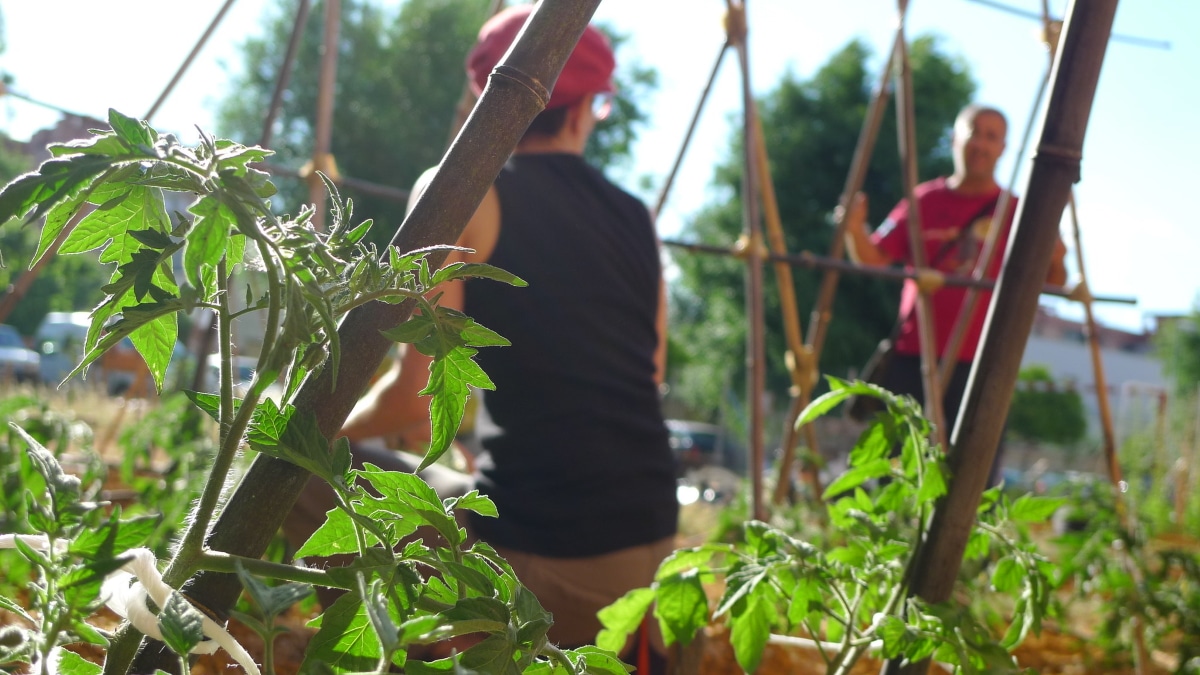
When you have an orchard, you rarely run out of tomatoes. They are the most sought-after vegetable par excellence. In turn, we will all know stories or tricks that we have seen or heard to get a good production. It is not difficult to grow tomatoes, if you know how. Even one of the most common questions that we usually ask ourselves when growing them is how far apart the tomatoes are planted.
Like the rest of the plants, the tomato grows best when its conditions are suitable for it, which do not necessarily have to be the same for another vegetable. From irrigation, to its diseases, to its nutrients, even from a distance. In this article we will explain how far apart tomatoes are plantedwhy should this be done, what distance should be left between the rows, between the plants, and above all… that It will depend on the variety of tomatoes. that we plant!
Different distances between tomato plants

There are average distances to plant your tomato plants, but if you want to do it well, the best is to adapt the distance to the type of variety of tomato you are going to plant. For example, the creeping tomato, the one that doesn’t require a cane, can be planted a little closer together. The cherry tomato, if it is not a truss variety, can be left a little more compact. For the rest of the cherry tomato on the vine, pear-type tomato, vine, barbatro, pink, normal salad, black… etc., the same distances can always be used.
The following distances can be taken as an average. Depending on the climate of the region where the tomato plants are planted, the distances may vary. It will depend on the wind, the humidity, whether it is in a greenhouse or outdoors, and the variety that is going to be planted.
For outdoor cultivation
They can be grown with a distance between plants from 35 to 55 centimeters. Depending on the width of the crown, the foliage and the vigor of the variety, it may be more beneficial to leave more or less space. Between the rows, the recommended distance is between 120 and 160 centimeters.
For outdoor cultivation, the number of planted tomato seedlings is not so much desired, but that they have a good space between them. Indeed, tomato plants are one of the vegetables that cause the most fungal disease problems. Let the wind circulate, otherwise it can generate a lot of humidity and make it a breeding ground for fungus or other pests.

Important. For cultivation in places with high humidity, increase the distance when planting. It is better to have few tomatoes, but to ensure the harvest. If under normal conditions the density is 1.5 plants per square meterin humid areas, it can be reduced to 1.2 plants per square meter with peace of mind.
For greenhouse cultivation
Planting can be done in single or double rows. In the case of singles, the rows can be spaced from 1 to 1.40 meters and the tomato plants can be planted with a distance between 30 and 50 cm between them.
When sowing in double rows, the plants can be 40 to 50 cm apart and the spacing between the two rows 50 to 60 cm. Finally, between each of the double rows, the space can be reduced a little to 80 or 100 cm. The average recommended density is approximately 2’25 to 2’50 plants per square meter.

Related article:
How to tie tomato plants?
Why is distance so important?
Tomato cultivation is one of those that usually presents the most complications, and they are almost always related to distance and irrigation. If the region and the season are good, there shouldn’t be any major complications, but why do they happen so often?
The distance between plants has more to do with a point of balance between development and production than in quantity It is always better to bet on quality than on quantity, as long as one does not go too far, that is to say waste space unnecessarily. The distance is always important for the good development of the plants, it allows the light to penetrate well and helps to ventilate the area well and prevents fungal diseases.

Some people warn that a greater distance facilitates the proliferation of weeds, which is also not recommended. This is like saying that it is not interesting that few people live in an area because there will be more to clean up. He has his logic, but that’s not a relevant factor. When in doubt, it is always better to leave space between plants, production will never be affected, which happens if the distance is too short. It is very important to remember this.
Distance-aware watering tips
Just like knowing how far tomatoes are planted, many people have problems with tomato irrigation, even professionals in the sector. If the distance between the tomatoes is less, it is possible that the soil tends to dry out more slowly, because there is less evaporation because the sun’s rays hit less. On the contrary, if the distance is greater, it will be possible to observe that it dries faster. Either way, it’s not relevant either.
The important thing here is the moisture that the soil retains, that is, where the root is located. The tomato is a plant that needs very little watering., and only requires a little moisture to be able to feed properly. In the case of tomatoes for dipping bread, these are varieties that still need less watering, I would almost dare to say that they should almost never be watered. Watering when the plant shows no signs of needing it, for example, withered leaves in the morning after sunrise, contributes to malnutrition. Because? Because the water helps the minerals down, preventing the tomato plant from getting adequate nutrition.
For these reasons, having the correct distance between tomato plants and correct watering means that the plants require practically little care. Almost all tomato problems are linked by these two factors. And I insist on this, I have seen many professionals ruin entire productions by ignoring these important practices. With the great economic and moral damage that entails.
Related article:
Tomato diseases due to excess moisture