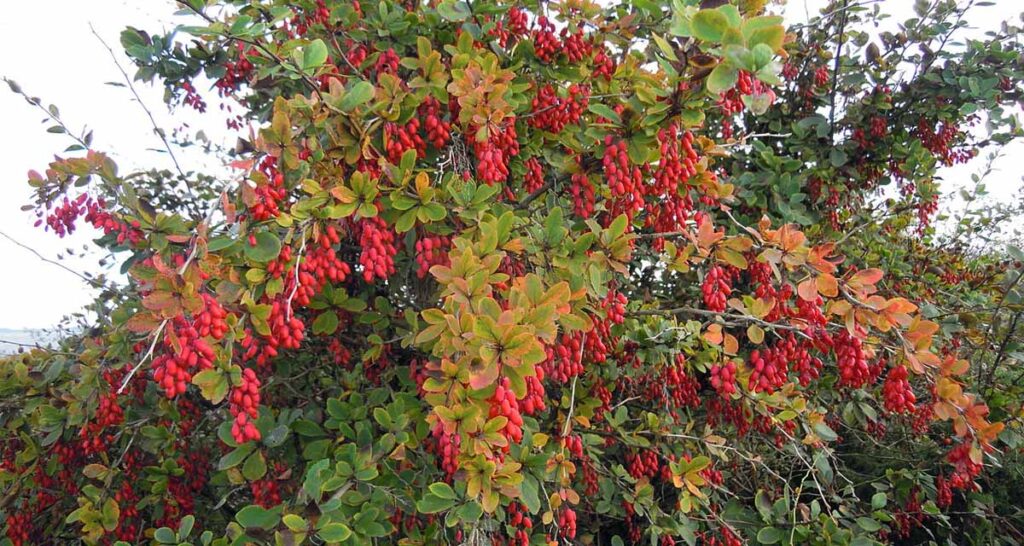
In nature, we find a large number of herbaceous plants and shrubs, which, seeing them directly, do not even attract our attention. One of these cases can be Berberis vulgaris (commonly called Berberis or barberry), but inside it retains many medicinal properties and a magnificent use for beekeeping, cabinetmaking, gardening or gastronomy.
Berries are a cold hardy plantthat is why it is also generally grown as ornamental species in central Europe, forming a bush with a rounded shape, dark green leaves and fruits in the form of red berries. In fact, nothing has anything to do with a Berberis vulgaris care, with regular watering, conditioned, fertile soil, than a Berberis growing wild in a meadow, rocky area, or mountain. They physically resemble 2 different plants.
Therefore, in this article, we want to let you know Berberis vulgaris both for its interesting properties (today studied in medicine) and for its method of cultivation, since it can be interesting to grow it in the garden as an isolated plant, reaching several meters in height and with an exquisite combination of dark green colors of its leaves and yellows and reds of its flowering and fruiting.
Characteristics of Berberis vulgaris (barberry)
Barberry, scientifically known as Berberis vulgarisit’s a fairly leafy bushwhich can reach up to 2 meters in height under the best growing conditions.
Some of its main features are:
- Stems: thorny and adapted to bad weather.
- Wood: light in appearance, darkening and acquiring grayish tones over the years.
- Sheets: oval in shape, they are formed just at the base of the spines, being small (up to 2 cm) and with serrated edges.
- Bloom: inflorescences in elongated clusters of 2.5-5 cm, grouped between 10 and 20 flowers. Yellow color and diameter of 0.5 cm on average.
- Fruit: berry of red color when ripe, oblong in shape and small in size, which houses 2 seeds inside. The flowering season is between spring and summer (May and July). Fruiting from July to October.
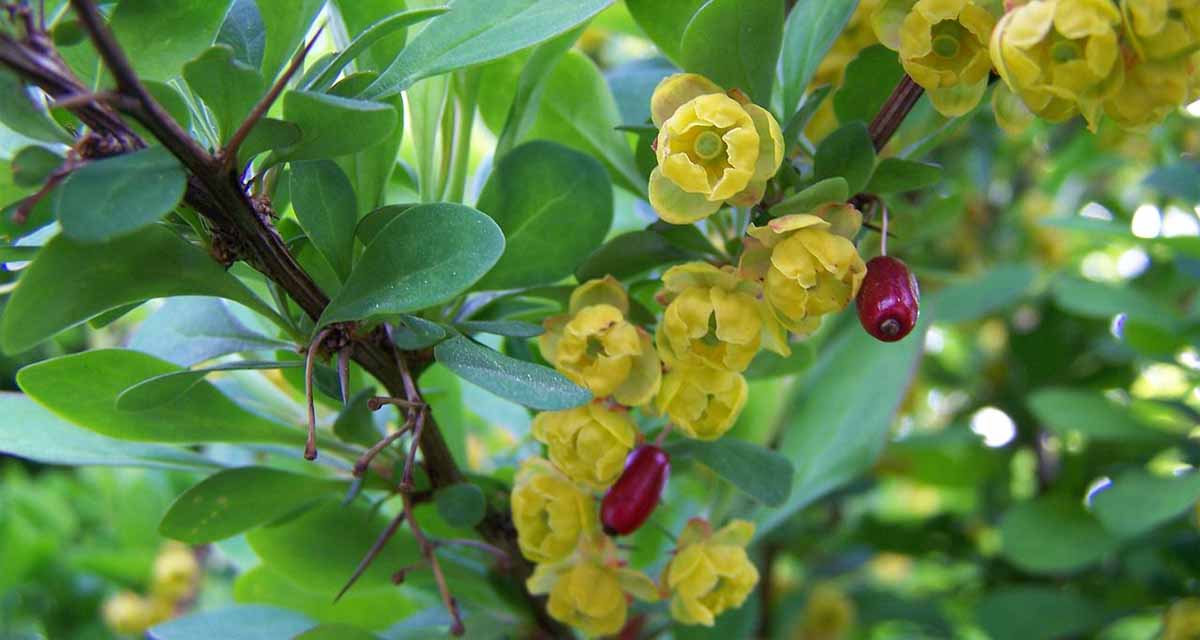 Photography: Boronian – personal work
taxonomy
| Order | Buttercups |
| Family | Berberidaceae |
| Genre | berberis |
| Species | Berberis vulgaris |
The genre berberisAlthough this may not be known to many, home to around 500 speciesmost shrubs between 1 and 5 meters high, preferably evergreen.
Common name: barberry, abrilla, acetín, agracillo, berberis.
Subspecies:
- Berberis vulgaris subsp. Australia (Drink.) Heywood. Located in the Betic Mountains and south of the Iberian system. Produces black fruits.
- Berberis vulgaris subsp. Seri O. Bolòs & Vigo. Located in the northeast of the Iberian Peninsula. Produces red or blue-black fruit.
- Berberis vulgaris subsp. vulgar: located in the north of the Iberian Peninsula. Produces red fruits.
Where is barberry found?
Although it can be grown as ornamental species in any gardenusually Berberis vulgaris It grows naturally in isolated areas, pastures with semi-arid climates and calcareous soils of central and southern Europe, North Africa and even Asia.
Booming populations have also been seen in the Americas, especially in the United States. And under these conditions, in certain extreme cases, it is also naturalized in Australia (Oceania).
As you can see, barberry adapts very well to all types of weatherwhere it develops favorably at an altitude between 200 and 900 meters, although in areas with higher thermal amplitude it can develop at higher altitudes (even up to 2000 m).
And in Spain?
The barberry It appears in low mountains covered with hedgerows or even in high mountains (from 1000 meters above sea level) in warmer regions such as those of the south and southeast of the Iberian Peninsula. In Andalusia you can see Berberis vulgaris in the Betic Mountains.
Natural Berberis Growing Conditions
Berberis is an ideal shrub for areas with low rainfall, drought-prone or low-maintenance gardens.
Climatology
Withstands a wide range of temperatures. Withstands cold very well, even below 0 ºC. It can be grown both in continental areas and in coastal areas, with higher humidity. It requires light conditions, although it can be grown in partial shade.
the type of soil
It grows in any type of soil, with a preference for limestone at basic pH. It does not have high nutritional requirements, so it grows even in infertile, rocky soils.
water needs
High drought resistance. Grown in the garden, it can be installed with 1 dripper per plant, watering once a week with an average of 30-60 minutes.
plant propagation
Once the seed has been extracted and cleaned from the fruit (between September and October), the germination rate Berberis vulgaris It’s good, sprouting without the need for further treatment. However, the germination percentage improves when a cold lamination.
To do this, the seeds are placed in a container with sand at a temperature between 2 and 4 ºC (usually in the refrigerator) for 20-30 days. After this procedure, it is sown in a pot with a universal substrate at an average temperature of 25 ºC (spring).
Once the seed has germinated, it should be kept in the pot for a few months, increasing its exposure to light and temperature changes. Subsequently, the bush can be transplanted into the garden or to the designated place.
Current uses of Berberis vulgaris
Really Berberis vulgaris It’s not a well-known plant, although it has been used throughout its history for just about everything. Currently the main use is as ornamental plantalthough it is not physically distinguishable from other bushes and the thorns its branches contain can cause problems when caring for the bush.
Some of the uses of barberry are as follows:
Use in gastronomy
Barberry berries, when at their optimum ripening point (from October in most regions), are an excellent fruit for making jams. In fact, Iran is a major consumer and also a producer of these berries, which it processes dry, as if they were raisins.
Use of wood
Bark, branches and roots are used. From these parts, a yellow extract is extracted to dye textiles, leather or other materials.
Beekeeping
During the flowering period, Berberis vulgaris attracts a large number of pollinating insects and, in particular, bees. Its many yellow flowers provide an attractive aroma and sweet taste.
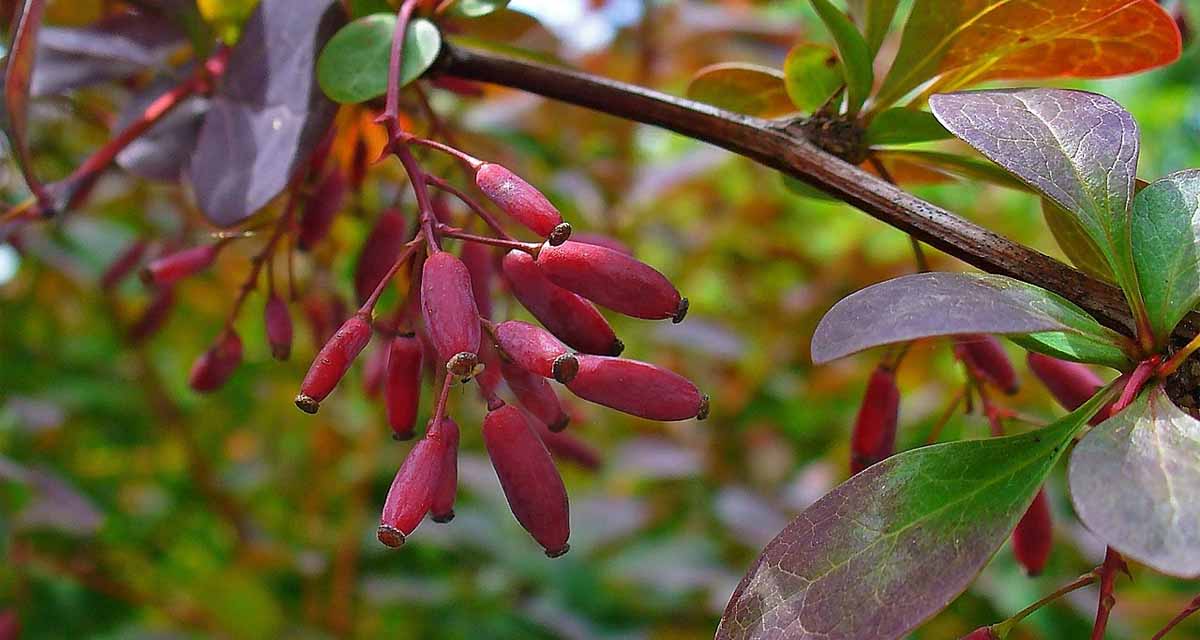 Berberis vulgaris ‘Atropurpurée’. Photography: H. Zell – Own work
Medicinal properties of barberry
We capitalize this heading in view of the future possibilities offered by barberry as a medicinal plant. Although today the tests carried out are positive, they are still insufficient to draw any type of conclusion.
believes that Berberis vulgaris offers interesting properties against type 2 diabetes, hypertension and hyperlipidemia, with far fewer side effects than current drugs.
Some previous studies in rats have concluded that barberry may have significant anti-diabetic effects, also reducing serum cholesterol and triglyceride levels.
Active ingredients of Berberis: Phytochemical analysis detected the presence of saponins, tannins, flavonoids, sterols, anthraquinones, emolols and alkaloids, mainly selecting the root bark.
Contraindications
Its consumption is not recommended.
Any part of the bush Berberis vulgaris can contain substances not approved for human health. Unripe fruits contain alkaloids such as isoquinoline, berberine, jatrorrhizine, palmatine and bisbenzyltetrahydroisoquinoline related alkaloids such as isotetrandrine, berbamine and oxyacanthine.
However, all these alkaloids disappear in ripe fruits, which is why some countries, such as Iran, use their fruits for the preparation of jams.
Cover photo: Arnstein Rønning – Own work