
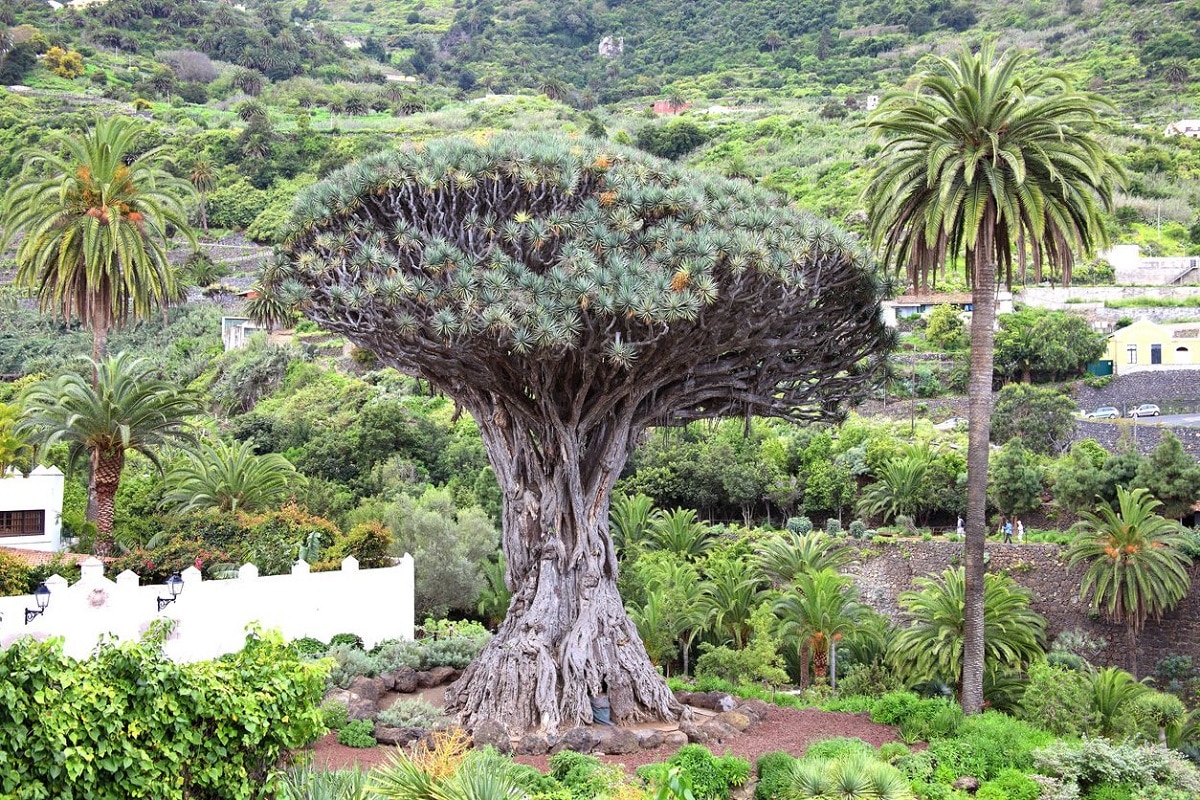
The Drago Icod de los Vinos It is located northwest of Tenerife in the Canary Islands and is one of the oldest living organisms in the world. This tree has unique characteristics and is worth stopping by on your trip to Tenerife.
In this article we are going to tell you what are the characteristics of Drago Icod de los Vinos, his origin, his legend and much more.
main Features

Its longevity is unknown. but it is estimated to be around 800 years old. Undoubtedly, it is the largest and oldest dracaena plant in the world, which is why it was declared a national monument in 1917.
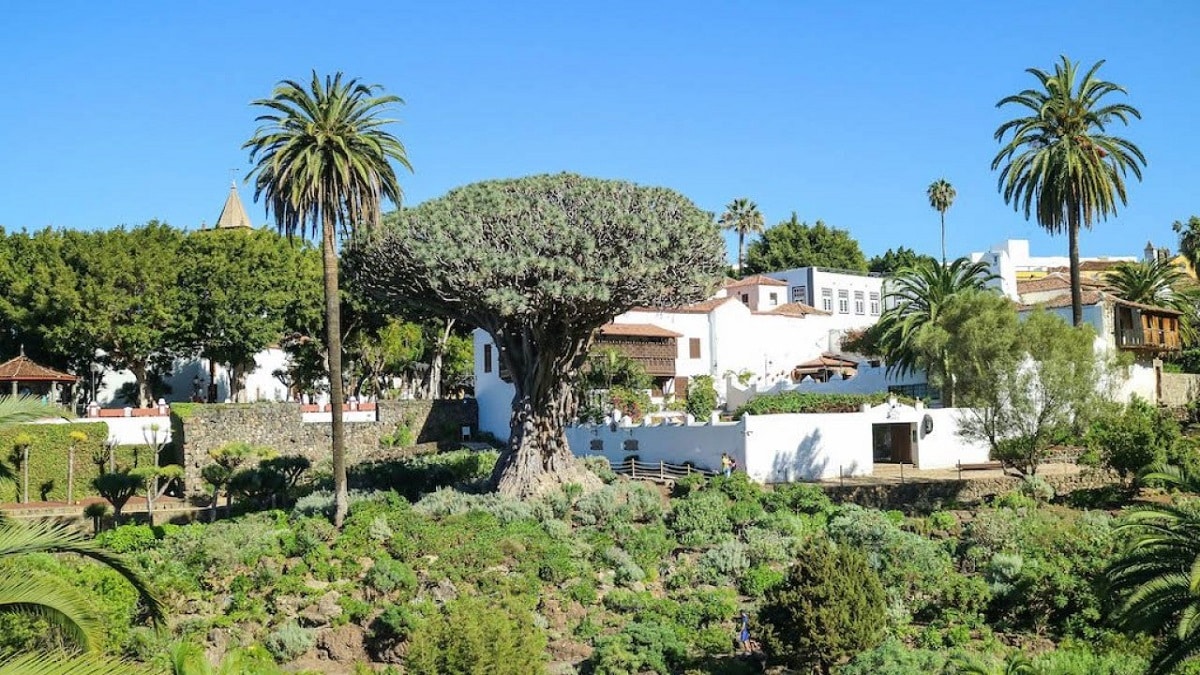
This impressive tree is located on 3 hectares in the Parque del Drago, where you can also observe other native plant species. It was created to protect the Millenary Drago from contamination and vandalism.
All the conservation work has been worth it because today the tree is in perfect condition and can continue to be a true symbol of Tenerife next to Teide.
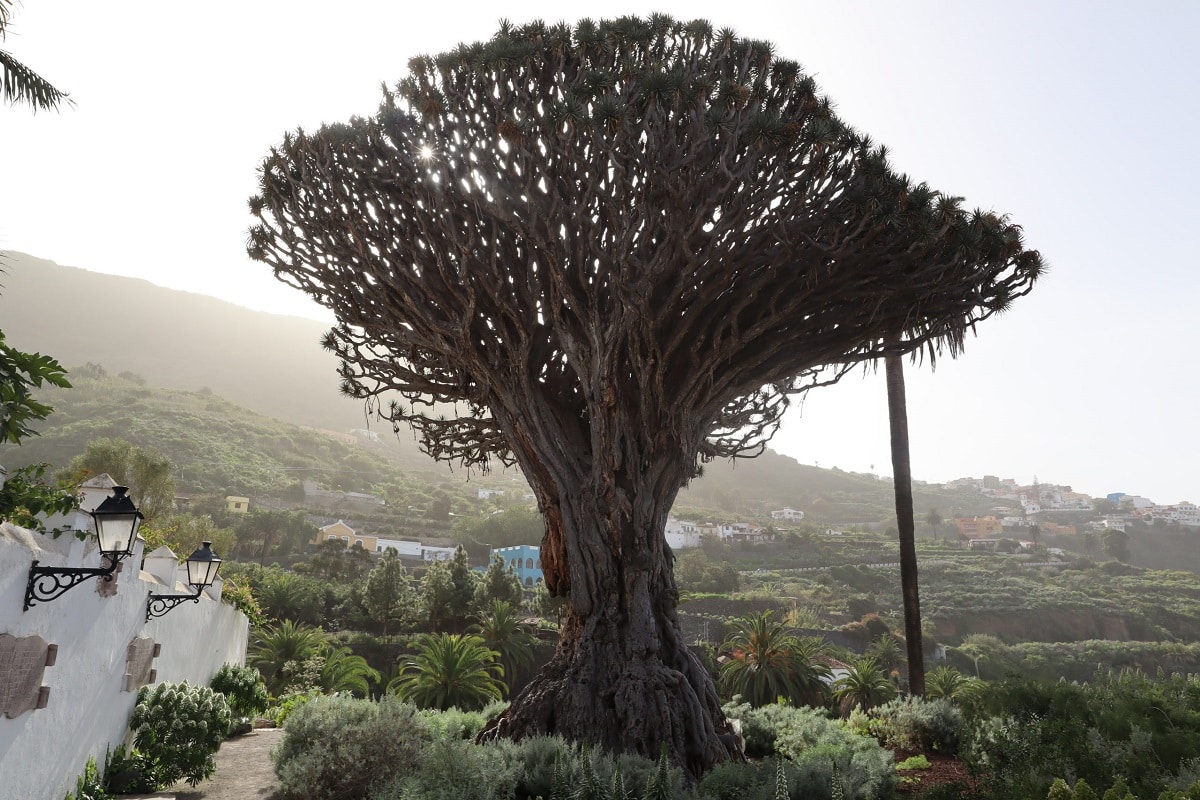
The dragon tree is a tree plant belonging to the monocotyledonous flora with an unusual secondary growth. It is therefore a woody herbaceous plant rather than a “tree” in the strict sense. It is currently the largest and oldest of its kind known in the world. It is about 18 meters high, with a crown diameter of about 20 meters, a circumference of the base of the trunk of 20 meters and more than 300 main branches. The flowers are small and numerous, with 6 petals and the same number of cream-green or very beige stamens, and they are grouped in showy inflorescences that protrude from the clusters of leaves.
It is estimated to produce up to 1,500 branches in a good flowering year. The trunk has a huge cavity up to 6 m. High, accessible by a door. It was thoroughly cleaned in 1985 and a fan was installed in the trunk to promote air circulation and prevent fungus growth. In 1993, the town hall of Icod de los Vinos, on the proposal of the winning architect of the 1984 design competition, diverted the road a few meters from the Nagar tree. Fortunately, today this plant is not not in danger.
how it was formed
The Dracaena Draco species is native to the subtropical climate of Macaronesia., although specimens have also been found off the coast of Morocco. Although it can grow in any of the five North Atlantic archipelagos, the exotic tree is most concentrated in the Canary Islands.
The dragon tree Icod de los Vinos is the oldest of the Islas de la Suerte. It is estimated to be between 800 and 1,000 years old, although some say it could be over 3,000 years old.
Curiosities of the dragon tree Icod de los Vinos
Until 1867 there was a dragon tree in La Orotava, larger and older than the millenary dragon tree of Icod de los Vinos, but it was knocked down by strong winds. Another peculiarity of this species is that its sap is red, being the only species in the world with this characteristic.
This is why the Guanches, the indigenous people who once inhabited Tenerife, say that the so-called “dragon’s blood” has healing and miraculous properties. The strange shape of the treetops and its dozens of dragon-like branches have added to its legend and mystery over the centuries.
The dragon tree’s strange shape and the sage that grows on the trunk have created countless legends for the dragon tree. One of them is linked to the 100 dragons in charge of protecting the golden apples of the garden of the Hesperides. He was killed by the Titan Atlas to help Hercules complete the Eleventh Labor ordered by Herodotus.
It is said that when the blood from the dragon’s wound fell on the garden, the tree we now know as the dragon tree grew. Another legend says that a merchant landed in search of “dragon’s blood” on Icod Beach, where he found Kansai youths bathing. He started chasing them and managed to catch up with one of them.
The young woman offered the most delicious food in the world, the man thought it was the fruit of the garden of the Hesperides and ate it, the young girl took the opportunity to escape. He managed to jump over the canyon and hide in the forest.
The merchant went to fetch him, but he found a terrible tree whose branches waved like swords and whose trunk twisted like a serpent.. The man tried to defend himself and threw the stab into the trunk, from where a red liquid that looked like blood began to be seen. At this moment, the merchant fled in fright to his boat and jumped into the sea without looking back.
What to see in the dragon park
The Drago Icod de los Vinos is a remarkable element of the Drago Park, created to contribute to its conservation. It is 16 meters high and has a trunk circumference of 20 meters at the base and 60 meters at the top.
The weight has also broken records, around 150 tons, and that does not include the extended roots. Inside the trunk there is a 6-meter-high cavity in which a ventilation system is installed to prevent the growth of fungal pests. At its feet is the Dragos nursery, a great opportunity to observe the evolution of new specimens of Dracaena Draco.
The park has an area of 3 hectares, In addition to the dragon tree, you can also see other species native to the Canary Islands. Especially the variety of palm trees, as well as the Canarian laurel, beeches, tabaibas, etc. The Parque del Drago crosses the Barranco de Caforiño and on its banks you can see representatives of the native life of the island.
In addition to wine presses and coal bunkers that show the most traditional ways of life. Another big attraction is a cave where you can see representations of Guanche tombs. A shop and cafeteria area, as well as a butterfly garden complete the set.
I hope that with this information you can learn more about the dragon tree Icod de los Vinos, its characteristics and its legend.