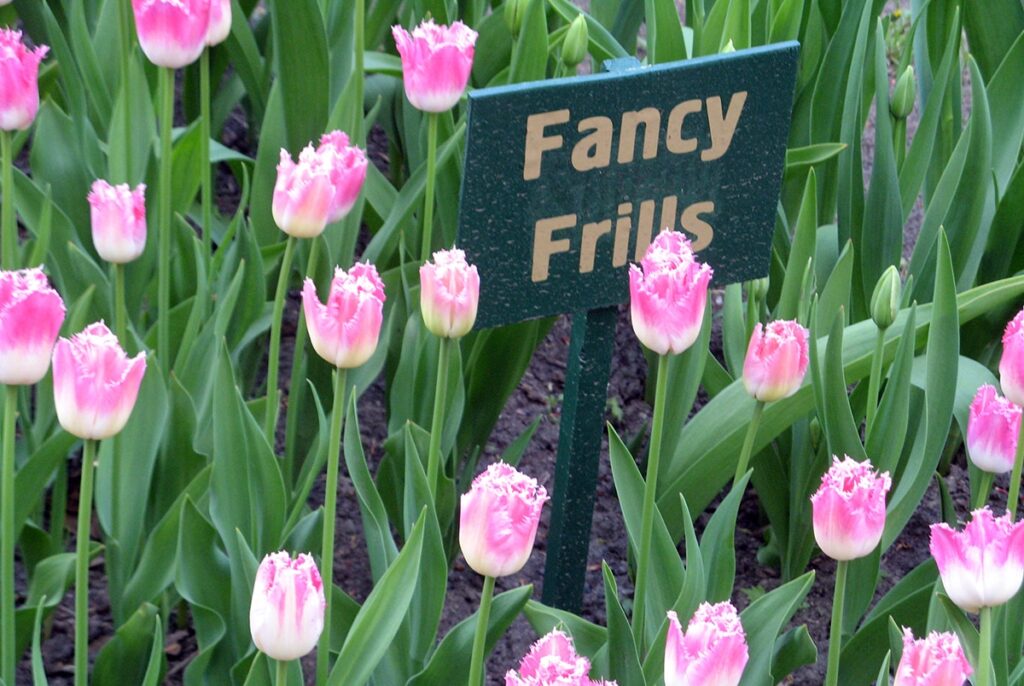

We already know that there are many tulips of different colors, but some varieties even have a particular shape that no longer reminds us so much of the typical tulip that we know. Among these types, a very curious one stands out: Frills fancy tulip. Why is it so special? What does it look like? What are their characteristics ?
In this article, we will answer these key questions. we will explain what is the Fancy Frills tulip, what makes it different from others and some other curiosities. I recommend that you keep reading if you want to know more about this particular but valuable strain of the genus. tulip.
What is the Fancy Frills tulip and what are its characteristics?

Source: Wikimedia – Author: Екатерина Борисова – https://commons.wikimedia.org/wiki/File:Tulip_festival_2017_on_Yelagin_Island._Fancy_Frills.jpg
The plant world is very vast. There are many different varieties of species which in turn belong to genera, and these to families, etc. Genre tulip It has about 150 species and more than 5000 hybrid varieties! It was at the end of the 11th century that these beautiful flowers began to be grown for ornamental purposes. Although originally from Asia, today we can find them all over the world, especially in Holland, where it is a very important flower. Since the start of the tulip craze, the number of tulip varieties has not increased further.
But enough of so much history about the origin of these flowers. What we really want to know is what the Fancy Frills Tulip is. The name is English and translates as “fancy fringe” or “creative fringe”. This name comes to mind for its most distinctive feature is the ruffled edges of the petals, which appear to have fringes. They are usually pink and white or fuchsia and white in color and can reach a height of between fifteen and two feet. Flowering is quite a spectacle and normally takes place in the months of April and May.
If you like this flower and are thinking of acquiring it to cultivate it, it is important that you take into account a small detail: It is a poisonous flower for cats (for humans too, but we would have to ingest large amounts of it, and I don’t think anyone intends to eat it). However, if we have feline companions at home, we must be careful. While it is true that the bulb is the most poisonous part, ingesting other parts of the vegetable can cause various symptoms. Among them are depression, vomiting and diarrhea. These symptoms usually appear very quickly. The best thing we can do in these cases is to go to the vet.
curiosities about tulip Fancy Ruffles

Source: Wikimedia – Author: Diego Delso – https://commons.wikimedia.org/wiki/File:Tulipa_%27Fancy_frills%27,_Jard%C3%ADn_Bot%C3%A1nico_de_M%C3%BAnich,_Germany,_2013-05-04 ,_DD_02.jpg
It is obvious that this variety of tulip it is very striking. SO it is not surprising that it is very popular in the most important and imposing gardens. In fact, one of the largest in the world has specimens of the Fancy Frills tulip, along with seven million other species of flowering plants (and counting!). It is located in the Netherlands, more precisely in Keukenhof, and it is a truly spectacular garden. It has over 32 hectares of land where you can find different types of tulips, among many other plants. Curious fact: among all the best-selling flowers in the world, tulips occupy the third position.
Another remarkable aspect of the Fancy Frills tulip is that has the price of merit in gardening, also known as AGM for its acronym in English. This is an award that represents the quality of the vegetable and is granted by the British RHS (Royal Horticultural Society). Different plants are assessed each year based on their performance under UK conditions. These tests that are carried out can last for several years.
Criteria for a factory to qualify for the AGM
For a vegetable, whatever it is, to obtain the Gardener Merit, must meet the following criteria:
- It should be available on the market.
- The ornamental or economic value must be exceptional.
- The constitution of the vegetable must be good.
- It should not require any additional care or specialist care.
- It must be disease and pest resistant.
- It shouldn’t need any degree of inversion.
And how can we recognize merit in gardening? The symbol that represents this price it is a trophy with handles. In addition, it is linked to an evaluation of plant hardiness which is represented as follows:
- H1: You need a greenhouse that contains a heater.
- H2: It requires living in a greenhouse but does not need heating.
- H3: It can live outdoors in some areas. However, it may require protection in winter so as not to suffer from frost.
- H4: In the British Isles it is able to survive as it is.
- H1-2: It is an intermediate of H1 and H2.
- H2-3: It is an intermediate point of H2 and H3.
- H3-4: The same but from H3 and H4.
It’s funny how there is a huge variety of forms in the plant world, isn’t it?