Fusarium is a genus of fungi that affects many plants, including trees, cereals and horticultural plants. This fungal disease can cause great damage to plants, both physically and nutritionally. They can be easily transmitted by water or by physical contact between the roots of infected plants.
The Fusariumas it is also called, is one of the main fungal diseases that affect agricultural crops and is characterized by the development of brown spots or rings on the surface of the stems plant, leaves and fruit. This can significantly affect crop yield, resulting in a noticeable decrease in production.
In this article we give you a complete guide to identify if your crop is affected and some preventive and curative measures on how to eliminate the fungus. Fusarium.
What causes Fusarium in plants?
The phytopathogen Fusarium cause one of most common diseases of the root systembut which causes visible symptoms in practically the entire area: leaves, whole shoots, flowers and fruits.
The fungus climbs through the soil, enters the vascular system and block the flow of sap. For this reason, the first visual symptoms are observed in the leaves, yellowing and fades pretty quickly. To differentiate Fusarium from other plants, this fungus may initially only affect one part of the plant and then spread to the rest. Something similar to what you do verticillium.
If we cut the affected stem, it is likely that we will find the brown central vascular bundlesign of disease progression and general blockage of sap flow.
In horticultural plants, it is common to observe the loss of turgidity of all stems, with a symptom similar to that of stress due to lack of water. In fact, many times adding more water makes the problem worse.
 Fusarium oxysporum in pepper cultivation. Character font: University of Florida.
In the case of the photo, the advance of Fusarium on the plant is complete, causing total wilting with chlorotic edges in some leaves, which dry quickly, as can be seen in the basal part of the plant.
Ideal conditions for the development of the disease
The Fusarium fungus develops optimally under hot temperatures, from 25 ºC. Acidic soils, with a pH lower than 6.5, present better conditions for the development of the fungus.
Another group of Fusarium, like F. Oxysporum cucumericum That is lycopersici it can act with colder temperatures, even below 20 ºC.
The disease progresses faster in soils with high moisture contentnot in saturated environments but with humidity above 10%, typical of intensive fertigation systems.
How is the Fusarium fungus controlled?
The key against the Fusarium fungus is prevention, as it is difficult to eradicate due to the rapidity of symptoms, especially during grafting, causing damping off, and in soils with high humidity and warm atmospheric temperatures.
As the fungus is distributed throughout the soil and initially affects the rootsmaintaining a living soil rich in microbiology is essential for its easy propagation, while avoiding monoculture and selecting resistant species.
Some preventive measures to avoid the appearance of the disease:
- Maintain a soil rich in organic matter and rich in microbiology
- Control soil moisture.
- Avoid excessive nitrogen inputs.
- Reduce any type of stress on the plant.
- Oxygenate the medium continuously.
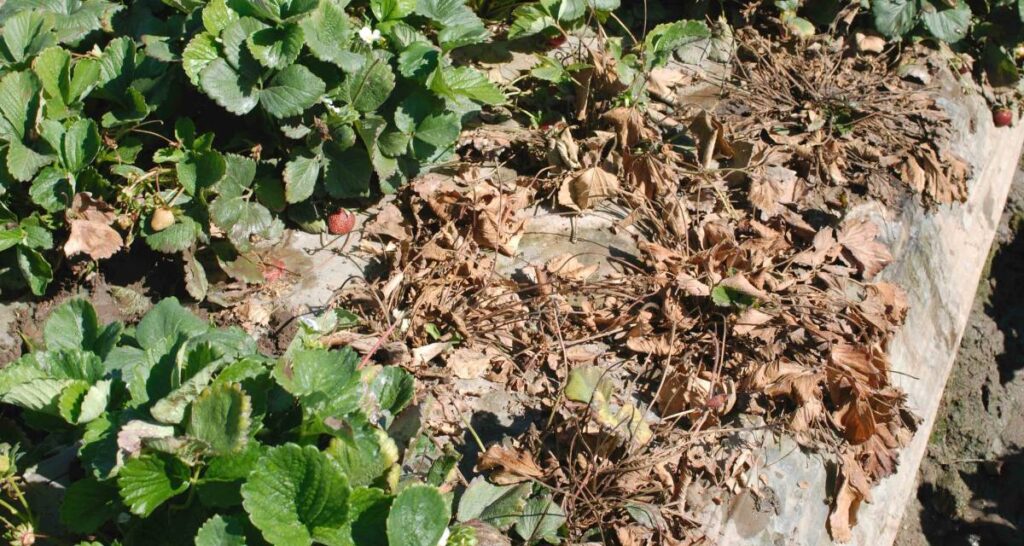
 Fusarium in strawberry cultivation. Photography: Steven Koike (UCCE).
Disease control products
The use of different forms of copper and active materials can prevent and control the disease. Some of these issues are as follows, subject to continuous review by the European Union and registration bodies:
- AZOXYSTROBIN
- CAPTAN
- FOLPETS
- METCONAZOLE
- FLUDIOXONIL
- TEBUCONAZOLE
- IMAZALIL
- PROTIOCONAZOLE
- BROMUCONAZOLE
Biological control
We increasingly have a longer list of biological solutions to prevent disease. Some of those currently allowed are:
- GLIOCLADIUM CATENULATUM (STRAIN J1446)
- BACILLUS SUBTILIS (STRAIN QST 713)
- TRICHODERMA ATROVIRIDE (STRAIN I-1237)
- TRICHODERMA ASPERELLUM (STRAIN T25)
- AMYLOLIC BACILLUSFACIENS