The tulip presents a ampulewhich is an organ of reserve and multiplication, formed by a short and fleshy vertical stem, covered with 6 modified leaves or concentric, thick and fleshy scales and a basal plate, from which the roots will come out.
What is the flower bulb? The definition of ampule is any plant that stores its entire life cycle in an underground storage structure. The main function of these underground storage structures is to store nutrient reserves to sustain the plant.
What are bulbs and examples? Between the bulbs Tunicates include tulip (Tulipa), daffodil (Narcissus), hyacinth (Hyacinthus), grape hyacinth (Muscari), onion (Allium cepa), and ornamental garlic (some of the Allium species). A Example of ampule nested is the lily (Lilium).
When do bulbs bloom? bulbous to bloom in the spring, they are planted in the fall, in October and November. This is the case of hyacinth, lily, daffodil, tulip and yellow lily, among others. bulbous to bloom in summer-autumn they are planted in spring, from March to May.
What are bulbous plants?
Soils bulbous
- Tulips: care and advice.
- Amaryllis, one of the most exotic.
- Dahlia: care, varieties and irrigation.
- Clivia, one of the most beautiful winter flowers.
- Daffodils: how to take care of them and care for their flowers.
- Hyacinths. …
- Lilium, the flower of over 100 species.
What function does a light bulb have? The ampule The spinal cord is a switching station between the brain and the spinal cord and contains the centers for the regulation of respiratory, vasomotor, cardiac and reflex activities. Application note: Lower part of the BRAIN STEM.
What is a light bulb used for? The ampule spinal have features and functions important, including: He is a passageway for many ascending and descending nerve pathways, which carry information between the brain and the spinal cord.
How is a bulb formed? The bulbs They are made up of the following parts: – Cataphytes or leaflets: these are the lower part of the leaves which I know They thicken when the plant stores nutrients in them. – Disc or basal plate: this is an area with form circular which I know is below the ampulebetween it and the roots.
How does the bulbous plant reproduce? The multiplication of bulbs and bulbs I know This is done by separating the bulblets or shoots formed around the ampule original and plant them. That yes, flowering loses quality from one year to the next, so the bulbs se They usually buy new every year.
How do bulbs grow? To plant them, you have to make a hole in the ground with a certain depth according to each species. This is marked, to a large extent, by the size of the ampule and we must respect it. If a ampule has more than twice its field size on it, it will have a harder time flowering.
How long do the bulbs last? When properly stored at the correct temperature, their bulbs they can last up to a year without being planted. But this long shelf life doesn’t mean you have to wait a year before planting your bulbs. How much The earlier you can plant them, the better the chance they will produce healthy flowers.
Where are the bulbs planted?

A sunny location should be chosen, although some summer bulbous plants prefer semi-shaded locations. The bulbs spring they are plant with a southern orientation bloom before the plant to the north, as they receive more light throughout the day.
What care do bulbs need?
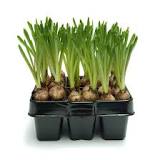
After sowing, it is necessary to water bulbs for What the earth settles and the plant takes root. After, there is What keep the soil moist at root level for good flowering. Low watering is best What flooded land, What can provoke What the plant rots.
What is the difference between a bulb and a tuber? Although the bulbs store nutrients in their stem, these differ from tubers because they have a flattened shape or “basal disc”, from which their roots grow. Moreover, the bulbs They have a blanket or tunic that protects their inner scales. The best known examples of bulbs These are onion and garlic.
What happens if the bulb is damaged?

What consequences can an injury have? ampule spinal? In addition to I know may have damage to the nerve nuclei I know locate in the ampule the spine too I know they can present problems and interruptions in the pathway called pyramids, which can generate hemiplegia or contralateral hemiparesis.
How does growing bulbs benefit plants? When seasonal conditions become favorable again, these reserves support the new cycle of growth. Moreover, the bulbs they also allow vegetative or asexual propagation in these species.
What are orchid bulbs?
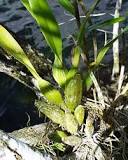
The pseudobulb is a storage organ What It derives from part of a stem between two leaf nodules. It applies to the family of orchids (Orchidaceae), specifically to a certain group of orchids epiphytic, and may be single or composed of several internodes with evergreen or deciduous leaves throughout.
How are the tulip bulbs? – Related issues
How to plant flower bulbs in pots?
What is the bulb stem?
2.1. BULBS. They are rods underground, some of them are solid and others are composed of several parts: Fleshy leaves, layers or scales that have the function of protecting and nourishing the leaf bud (the embryo that will give rise stem and flower).
How to germinate a bulb?
To do this, you need a container that does not allow the ampule completely submerge. For it to grow well, there should be less than half of the ampule immersed in water and change the water every 10 days to prevent fungus from growing and rotting the plant.
Which bulbs bloom in winter?
Daffodils, hyacinths and grape hyacinths need a cold spell to bloom. Naturally, the flowers of these bulbs They emerge from March to May after enduring months of Winter buried in the garden.
How much should the bulbs be watered?
Important points when water bulbs: Watering frequency: in the spring you can water 2 to 3 times a week, even 4 in full bloom. For the winter, it will be necessary to reduce to 1 time per week. Irrigation method: Drip or hose.
What is a child’s light bulb?
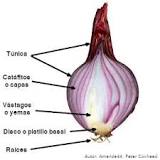
It’s about of underground organs that plants use as reserves of nutrients. They are neither roots nor stems, bulbs they are just the base of leaves. Yes, it is so, the bulbs are just the base of leaves of bulbous plants, leaves that have the capacity of increase of size.
What is the bulb stem?
2.1. BULBS. They are rods underground, some of them are solid and others are composed of several parts: Fleshy leaves, layers or scales that have the function of protecting and nourishing the leaf bud (the embryo that will give rise stem and flower).
What flower grows from a bulb?
Some examples are: Allium, Arum, Asphodelus, Camassia, Convallaria, Crocus, Cyclamen, Eranthis, Freesia, Fritillaria, Galanthus, Hyacinthus, Hippeastrum, Iris, Ixia, Leucojum, Muscari, Narcissus, Ornithogalum, Ranunculus, Scilla, Trillium and Tulipa and Zephyranthes.
How are bulbs formed?
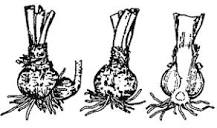
The multiplication of bulbs and bulbs I know This is done by separating the bulblets or shoots formed around the ampule original and plant them. That yes, flowering loses quality from one year to the next, so the bulbs se They usually buy new every year.