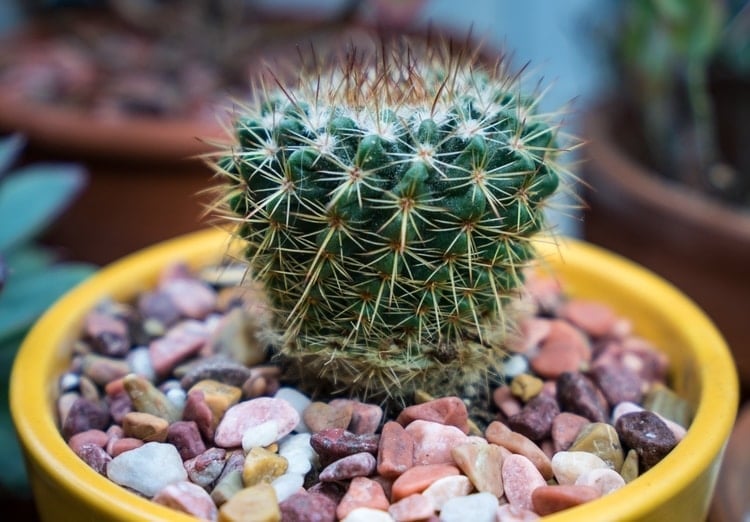
If you have a cactus, you want to know how fast it will grow and how big it will get over time. This is good to know so you can plan where to place your cactus and what plants will grow next to it. So how fast do cacti grow?
Most cacti are slow growing, reaching the size of a large marble after 6 to 12 months, and several centimeters tall after 2 to 3 years, depending on the species. After that, most cacti grow 1-3 cm tall per year. There are some notable exceptions that can grow up to six inches or more per year.
- Echinocactus like the Golden Barrel Cactus grow an average of 1 to 2 cm in height per year.
- Ferrocactus species grow on average around 2-3 cm in height per year.
- The saguaro cactus (giant carnegie) grows 2 to 6 inches per year, depending on growth stage, and can reach heights of 75 feet.
In fact, it will be a waiting game for most species to grow their cactus to full size. In this article, we give you a growth program and tips that can possibly speed up growth. So be sure to keep reading!
Why do cacti grow so slowly?
To understand why cacti grow slowly, there are two main factors to consider.
The first is that cacti are well adapted to survive in climates with infrequent and unpredictable rainfall. As a result, they focus their energies on survival rather than rapid growth. Learn about the incredible ways cacti adapt to survive.
A cactus can have to endure many periods of drought and extreme heat. Without prioritizing survival, the cacti would die due to harsh weather conditions before they had a chance to reproduce.
It is important to mention that not all cacti live in dry climates. There is a subset called jungle cacti that has different adaptations than what we usually associate with desert cacti.
The second factor is the leaves, or rather their absence. Most plants and flowers have leaves. These can come in different sizes, shapes, and thicknesses, but they are there. The leaves contain a high concentration of chlorophyll, the chemical that converts sunlight into energy the plant can use. With sufficient energy-generating capacity, most plants can grow quickly and vigorously.
Cacti have no leaves or branches. Instead, they have areoles and spines, which play no role in energy production for the plant. The leaves are less suited to a hot, desert environment because they cause the plants to lose too much water too quickly.
As a result, cacti have far less green tissue than other plants, which slows their ability to grow, according to the University of Nevada Cooperative Extension.
How fast do cacti grow?
Let’s start by discussing the different growth stages of most cactus species and how long they last. These milestones assume that the cactus is in an environment that is neither too hot nor too cold, that the plant receives the right amount of sunlight, and that it is watered and tended when needed.
…In a month?
Cacti, like many plants and flowers, begin life as seeds. The seedling germination process can take from several weeks to several months, so don’t expect much or no growth in the first few days.
If you are lucky, you can see the thorns of the cactus start to grow within a month. That being said, not all types of cacti have thorns. What you are looking for in these vines are seedlings emerging from the ground.
If you don’t see anything growing after a month, either thorns or seedlings, keep waiting. In many cases, growth from this level can take two to three months. With a cactus, expectation is key.
During this growth phase, it is important to remove any cover you have on the cactus during the day. This gives you more ventilation. You will also want to water the cactus whenever the soil dries out. We will come back to these two points in more detail later.
…In six months?
As you take care of your cactus, it will grow, but still not very quickly. After six months, your cactus may not be bigger than a large marble. Compared to many other plants and flowers, it may seem like an abnormally slow growth rate, which may make you nervous. With a cactus, this slow growth is typical, so there is no need to panic.
…In one year?
It’s also not unusual for your cactus to still be the size of a marble after 12 months. Once this step is completed, no matter how long it takes, your cactus should be moved from a nursery container to a separate pot. Move them to a larger container to allow their growth to continue.
…In 30 years?
Cacti growth can vary over the years depending on the species of cactus you have. For example, the Saguaro cactus, native to Arizona’s Sonoran Desert, can grow quite large. During its lifetime, a Saguaro can grow up to 22 meters tall.
During the long growing process, Saguaro cacti can sprout their own flowers. This usually happens within 30 to 35 years. We weren’t kidding that growing a cactus is a waiting game!
What else can hinder growth?
While it’s true that cacti generally grow slowly, there are certain things you do that can make them grow even slower. Here are some issues to watch out for and fix.
Leave it in a container that is too small.
If your cactus grows to the size of a large marble, it needs a new home. Failure to do so is bad news, as your cactus needs nutrients to survive and grow. Too small a container limits the amount of nutrients you can get. This will certainly limit its growth potential if the cactus does not die.
Remember that the cactus will need to be moved more than once as it grows, so you will need to move it multiple times.
cactus overhead
Just as humans go through a grueling process when moving house, so do cacti. They need time to recover once they reach their new container. Keep them out of direct sunlight for a few days. This allows the roots of the cactus to attach to the new home. Then put the cactus back in the sun for a while each day, gradually increasing the time.
excess water
You can only really submerge cacti if you never water them. They require much less water than most plants and flowers due to their native desert environment. Depending on the age and species, it may take a month before you need to water the cactus again. I have a helpful article on how to water cacti if you want to learn more.
Overwatering will stunt growth if it doesn’t kill the cactus instantly. It can be hard to tell if you’re overwatering your cactus, especially if it’s your first. Indeed, the cactus will be asymptomatic during the first weeks or months, even if it is watered too much. In some cases, the cactus grows or grows in size. It makes you feel like you’re doing everything right.
Very quickly, everything starts to go wrong. The roots of a cactus cannot receive too much water or they will rot and die. It may seem like your cactus is doing just fine, but behind the scenes it is slowly dying on you.
A few dead roots might not really be a problem, but the more dead roots there are, the more likely your cactus won’t survive. You may notice that your cactus is different in color as it begins to die. It can also be soft to the touch. The whole plant will die here and unfortunately there is no way to reverse it.
Once you gain more experience growing cacti, you’ll learn to recognize that growing quickly and large is often a problem. poor sign.
Keeping Your Cactus Covered Too Long
It is generally best to cover cactus seedlings during the germination and early growth phase. This will increase the humidity and keep the seedlings warm, increasing their chances of successful germination.
However, if you don’t remove the cover at the right time, it can harm your cactus, especially if it’s just starting to grow. Seedlings need aeration. Lack of ventilation can stunt growth and possibly even kill the cactus.
How to speed up the growth of cacti
If you’ve avoided the pitfalls above and your cactus still isn’t growing fast enough for your liking, you have a few options to speed up the process. Here are our suggestions:
- Always make sure your cactus has a roomier container than necessary. This way he has more than enough room to grow. You also need to move the cactus less frequently, which reduces stress. This keeps the growth process slow but sure.
- Use a well-drained potting soil. The ideal is a mixture of potting soil, coarse sand and perlite. This reduces the risk of overwatering, which can significantly damage the plant and stunt its growth. As you remember, too much moisture is a cactus root killer. Read my article on how to choose the perfect soil for your cacti.
- Sunny environments are ideal for growing cacti. Find the brightest area and place your cactus there. Rotate the cactus weekly so that the entire plant receives sunlight.
- Maintain the correct temperature for the cactus to survive. Indoor cacti thrive in temperatures between 65 and 80 degrees Fahrenheit. Beware of excessive heat and direct sunlight if your cacti are in a south-facing window. For outdoor cacti, a winter temperature between 45 and 55 degrees Fahrenheit is fine. Once summer arrives, the threshold increases to 65 degrees at the bottom and 85 degrees at the top.
- Use a succulent fertilizer on your cactus in spring and summer. It must be a liquid product, low in nitrogen.
If you want to learn more about growing and caring for cacti, there’s an excellent book I recommend in my resources section.
You may also be interested in some of my other items.
- What soil does Cactus need?
- How much water do cacti need?
- How long do cacti live?
- What is the difference between succulents and cacti?