

Image – Wikimedia/Drew Avery
Do you have a fruit bonsai? So you should know that the care it requires is a bit different from what you would give to another merely ornamentalespecially if you want to be able to taste its fruits.
And it is that you must never forget that, even if it is in a pot or a bonsai box, what you have is a tree that, thanks to the pruning, remains small; but if you planted it in the ground, it would grow tall, for that is its nature. That’s to say, bonsai are made, not “born”.
Inside or outside?

Image – Flickr/Jerry Norbury
That seems to be the million dollar question. Where to place a bonsai? What if it was fruity? Well, the answer is really not as complex as it seems: as we said at the beginning of the article, bonsai trees are trees that have been worked to give them a healthy and beautiful appearance. in small pots or trays. But they are trees after all. And clear, these are plants that grow outside.
In fact, there are no indoor plants, absolutely none. What there are are plants that, due to their low resistance to cold, must be kept indoors or in a greenhouse if we want them to survive. That is why, for example, a bonsai kumquat or fig tree is considered indoors in a place where there are very intense frosts, but not in the Mediterranean.
So, It will be the climate -and more specifically that of autumn and winter- and the hardiness of our bonsai, which will determine whether it should be inside or outside the house.. But even if it cannot be outside all year round, it is strongly recommended to take it outside during the warm months of the year to make it grow better.
Sun or shade?
Cuando pensamos en un árbol frutal, solemos imaginarnos un tipo de planta muy alta que está expuesta a la luz del sol, pero cuando se trabaja como bonsai, no siempre será buena idea ponerlo en un lugar soleado, o en uno donde le dé el sol all day long. Yes, need a lot of clarityboth to grow and to flower and bear fruit, but depending on the situation it will be preferable to put it in partial shade or in the shade.
What situations are we talking about? Well, among these:
- Bonsai that we usually have indoors, and that we only take out in spring and/or summer.
- Newly purchased bonsai that were inside.
What is the best substrate for a fruit bonsai?
In bonsai stores, whether online or physical, there are many types of substrates and mixtures for this type of plant: akadama, kiryuzuna, kanuma, coconut fiber, etc. If we have a fruit bonsai we want to put one that is light and also has very good drainage. so that the root system of our small tree can develop normally.
It is also recommended that it be rich in organic matter, but this is not really mandatory since with the subscriber we will ensure that it does not lack any important nutrients.
A) Yes, a good mix is for example this: 60% black peat + 40% perlite. There are others who prefer to mix mineral substrates, such as akadama and kiryuzuna in a ratio of 7:3, but although in these the risk of root rot is lower, there is a greater likelihood that the bonsai will dry out, because They lose moisture quite quickly.
How many times a week should you water it?
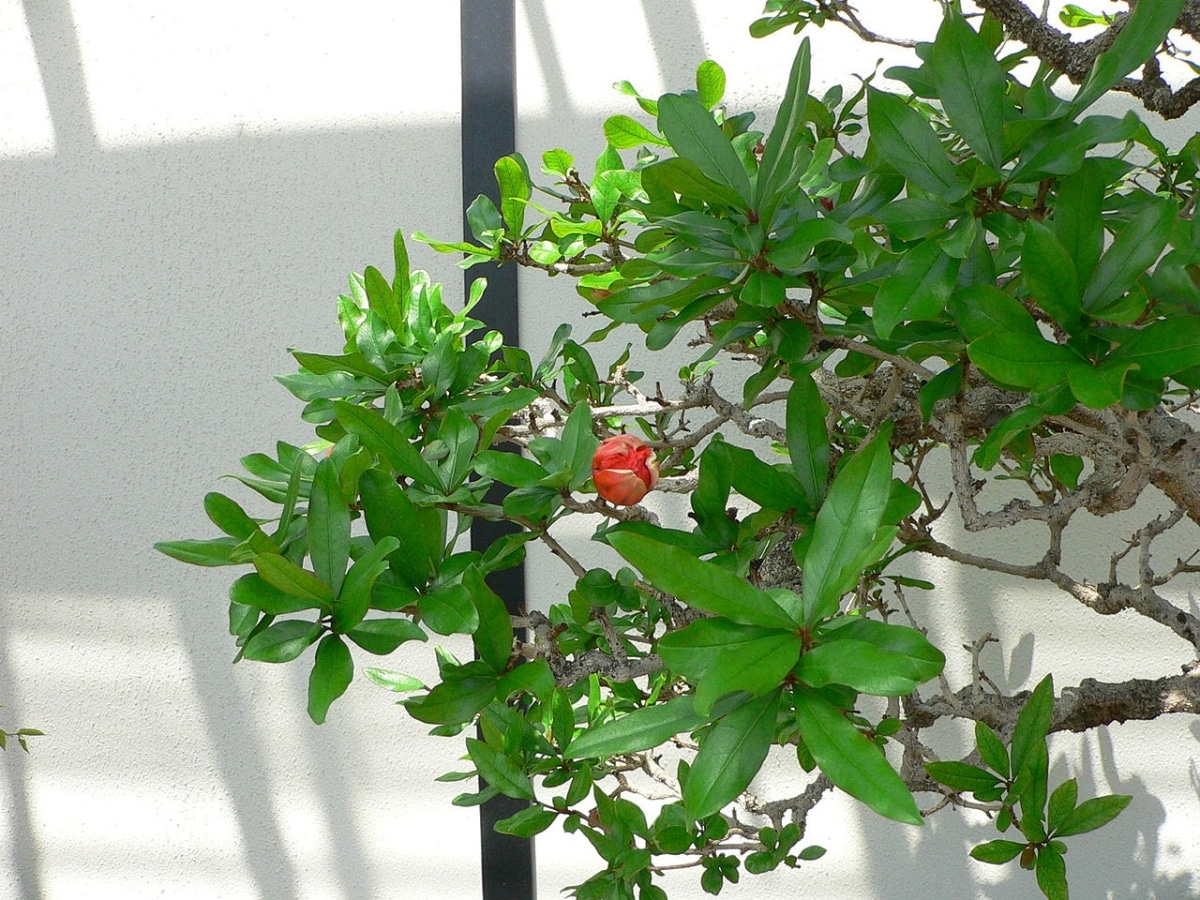
Image – Wikimedia/Mark Pellegrini
Watering the fruit bonsai you have to be moderate. In summer, and even more so if it is outdoors, it must be watered frequently, even every day or every two days if it is very hot and the substrate dries out quickly. But so that there are no problems, it is always necessary to check the humidity of said soil, because if you water excessively or, on the contrary, if you do it very little, you will lose the bonsai.
So to check the humidity we will introduce a stick. When extracting it, we will see if it is wet or if, on the contrary, it is dry.
When and with what to pay it?
Related article:
Types of bonsai fertilizer
Although there are fertilizers (commonly called chemical fertilizers), it is better to pay for it with products of biological origin, that is, with fertilizers. And within this group we find guano, humus or manure. Of course, whenever possible, we will buy liquid fertilizers so that the roots have the opportunity to absorb them more quickly.
In case we buy granulated or powdered fertilizers, we will only add a small spoonful (of dessert) once every fortnight.
Sure, another option is to apply specific fertilizers for bonsai like that. As long as they are used correctly, after reading the instructions that we will find on the packaging, our fruit bonsai will be very beautiful.
The most appropriate time to fertilize it is from spring to late summer, since that is when it is growing, and therefore the more it needs this extra energy supply.
When and how to prune fruit bonsai?

Image – Wikimedia/Ermell
The pruning of the fruit bonsai will be done in the spring. This must consist of eliminating dry or broken branches, as well as pruning those that have grown excessively taking into account the design that has been given to the plant.
To do this, use appropriate pruning tools, such as pre-washed and disinfected anvil shears, and brown healing paste if cutting branches that are about 0.5 cm thick or more.
I hope that the tips we have offered here will be useful for you in caring for your fruit bonsai.