
Perhaps one of the most common (and easiest to care for) houseplants, the Marble Queen pothos, translated as marble queen (scientific name Epipremnum aureum ‘Marble Queen’). This pothos is a sub-variety characterized by vine-like foliage with white and cream tones, something similar to the colors one might find in a white marble.
Like other traditional varieties of pothos, Marble Queen grows very well in indoor pots, being a very versatile and easy-care plant that adapts very well to all kinds of conditions.
The most appreciated by this plant is the ornamental aspect of its foliage. Although they can flower, it is rare to see them indoors and their flowers are not as attractive as their leaves.
In contrast, Marble Queen pothos is classified as slightly toxic to pets and humans. Use caution if you have pets in the home or young children who may access the plant.
Marble Queen Pot Care Guide
The Marble Queen pothos is a very versatile plant, hardy and considered easy to care for. They can grow optimally in virtually any environment and room in the house, with no special requirements for their growth. Good light, water in moderation and practically nothing else.
Temperature
Pothos Marble Queen, like other cultivars and sub-varieties, adapts perfectly to average house temperatures. Between 18 ºC and 25 ºC is its optimal development.
If you prefer to place it in the patio, balcony or terrace, supervise it only in the fall and winter, as they are not particularly tolerant of low temperatures. Below 12-13 ºC it starts to feel uncomfortable.
Humidity
Pothos is a jungle species that generates long stems with many leaves. Its high density of foliage imposes optimal humidity conditions slightly higher than other plants you may have in your home. However, this condition is not mandatory and it will grow perfectly with the usual humidity of your house, between 40 and 60%.
If you find that your marble queen pothos are very dry or are starting to turn a bit brown and crunchy at the tips, you can stimulate them with a bit more humidity, either with a humidifier or by spraying their leaves with some mild water. distilled water once or twice. one week. .
Lightning
Pothos grow well in well-lit spaces but always in indirect light, without receiving sunlight. However, it does well in dark rooms, although it slows its growth.
Substrate
Marble queen pothos can grow with different soil conditions and textures, although it is a priority that it has good drainage and is fertile. Usually they are grown in a universal substrate for pots, although their properties can be improved by adding a small part of earthworm humus (increases the fertility of the mixture) and coconut fiber (to improve the percentage of drainage ).
For example, an ideal mixture would be 60% universal substrate, 20% coconut fiber and 20% worm humus.
Irrigation
Irrigation of Marble Queen pothos should be constant, maintaining continuous light humidity, without drying out the substrate. However, they have some drought tolerance, so if one day you forget to water it for a few days, absolutely nothing will happen to it.
When you see that the first centimeters of substrate are dry and there is a little more humidity inside, but very light, it will be time to water. The recommended amount of water is 1/6 of the volume of the pot.
Use of fertilizer
Although we have a fertile base of substrate, with the passage of time and continuous irrigation nutrients are lost and this can wreak havoc on our pothos. For this reason, it is recommended to apply during the period of greatest growth, starting in spring, a complete fertilizer for leafy plants.
Solid fertilizers: very comfortable to use, at the rate of 20-30 grams per jar, every 30 days, from spring to late summer. They are released slowly with the humidity of the substrate.
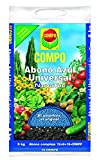
COMPO Novatec Universal Fertilizer Blue, 5 kg
- NPK complex fertilizer (Mg+S) 12 + 8 + 16 (+3+25) with magnesium and sulfur + microelements + nitrification inhibitor, Ideal for all types of ornamental plants, shrubs, green plants, roses, citrus fruits, etc.
- The professional technology with the nitrification inhibitor (DMPP) ensuring the stability of nitrogen in the soil, guarantees the maximum utilization of nutrients in the plants and more abundant flowering. Up to 8 weeks subscription available
- Improved formula, with less phosphorus. Eco-friendly
- COMPO quality: raw materials selected according to the original COMPO recipe, Strict quality controls by independent laboratories and institutes, The best conditions for healthy plant growth
- Contents: 1 x COMPO Novatec universal blue fertilizer, 5 kg
Liquid fertilizers: They are mixed with irrigation at a dose of 1-2 ml/liter of water. Much faster to act and recommended while our plant is weakened or chlorotic, to speed up the recovery process. Applying liquid fertilizer to Marble Queen pothos is recommended 1 in 3-4 waterings.

COMPO Green Plant Fertilizer for Indoor Plants, Balcony and Terrace, Liquid Fertilizer with Potassium and Iron, 500 ml
- Stronger green plants: Fertilizer with mineral nutrients and extra potassium and iron for green plants indoors, on the balcony or terrace, Practical dispenser
- Healthy growth: supply of essential nutrients from the first use, Promotes root growth and optimizes plant resistance
- Easy to use: Clean and safe dosage according to steps I to III marked on the cap (for 1 to 3 liters of water), Full cap for 5 liters of water, Application 1 x week (March to October), Application 1 x months (November to February)
- COMPO quality: raw materials selected according to the original COMPO recipe, Strict quality controls by independent laboratories and institutes, The right conditions for healthy plant growth
- Contents: 1 x COMPO Fertilizer for green plants, liquid fertilizer, 500 ml
From the end of spring, to stimulate the growth of new leaves and increase the length of the stems, the fertilizer must contain a large part of nitrogen, in particular in the nitric and slightly ammoniacal form, both of which are easily assimilated by the potos, which will respond very quickly to your application.
Marble Queen poto multiplication
The Marble Queen poto can be propagated relatively easily by stem cuttings, a great way to duplicate an existing plant to share with friends and family or place in other areas of the home. Follow these tips to get your pothos cuttings to form roots:
- Choose stem cuttings from a healthy pothos with at least 4-5 nodes per cutting.
- Remove the bottom 2-3 leaves from the cutting, but keep at least 2 leaves on top.
- Place the cuttings in a glass container filled with water, making sure the bottom of the cuttings are submerged, while the leaves above the cuttings remain above the water.
- Place the container in a location that receives medium to bright indirect light and change the water weekly to keep it fresh. Roots should begin to form after 2-3 weeks.
- Once the roots are a few inches out, the cuttings can be replanted in pots.
- Move the cuttings to a location that receives medium to bright indirect light and keep the soil consistently moist for the first 1-2 weeks after planting to help the cuttings reacclimate to the soil.
Most common pests and diseases
Pothos can be visited by certain sap-sucking insects, such as scale insects, aphids or mites. Being a houseplant usually grown in pots, they are easy to remove manually with a damp cloth or with foliar applications of potassium soap and neem oil or even dish soap.
If you don’t live outdoors, your Marble Queen pothos is very unlikely to suffer from these pests. To watch however from time to time from spring and during the summer.
As for diseases, they are more common and more complicated to correct in conditions of high ambient humidity (unlikely at home) and excessive watering (something more common for inexperienced people). If you follow our irrigation recommendations and moderate the amount of water, you won’t have any problems given the resilience of this class of houseplants.
Some issues you may find with Marble Queen pothos
In general, Marble Queen pothos are low maintenance houseplants. However, problems can arise if you don’t water your plant properly or if it doesn’t get enough light. Two common problems you may notice with your Marble Queen pothos are leaf browning and leaf yellowing.
My potto ‘Marble Queen’ has brown tipped leaves
Golden leaves are usually the result of lack of watering or lack of humidity. Be sure to water your pothos regularly and avoid placing them in places that are too dry, such as near a window or heating vent.
My potto Marble Queen has yellow leaves
The leaves of your Marble Queen pothos can lose their original greenness in the event of a lack of light or excess humidity in the substrate. Make a first diagnosis by checking the amount of water in the substrate and, if it is correct, move the pot of your pothos to a brighter area.
Cover photo: Spnq