I guess most of you start your journey with succulents. So, are succulents easy to care for? Yes they are, but they should not be overlooked. These 10 luscious care tips below will help you get to know them better and help them thrive.
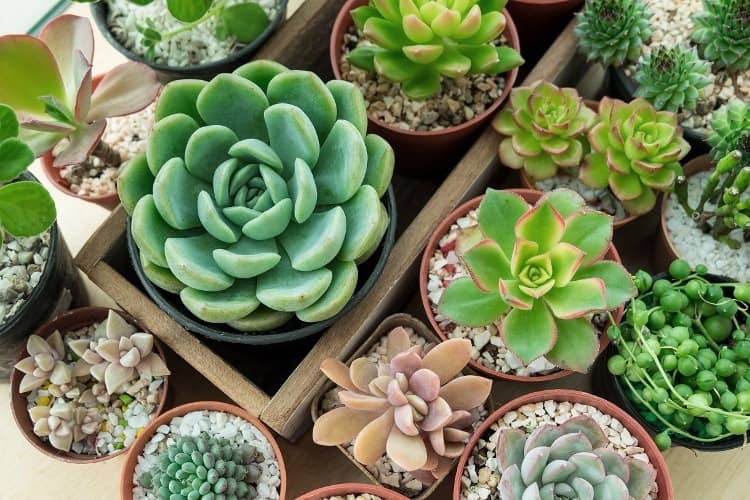
1. Choose suitable and healthy succulents
Think about where you want to grow your succulent. Some do better outdoors than indoors. Some prefer bright, direct light, while others avoid the sun and prefer indirect light.
Do you have room for a gigantic succulent or do you want a tiny one that fits in any corner? Would you plant it directly in the ground or in a fancy pot that you can move around? Once focused on this, you will be in a better position to choose the succulent you have adopted.
When buying your succulents, take a good look at the plants. A healthy succulent should be well formed with good coloring and healthy foliage. Try to avoid any signs of damage or insects.
2. Use proper soil and fertilizer for succulents

Succulents like to be dry from tip to root and thrive when grown in well-drained, airy soil.
Cactus or succulent potting soil works well, but if it’s not available, you can make your own by mixing potting soil with equal parts coarse sand and crushed gravel to create drainage.
Many succulent gardeners believe that succulents don’t need fertilizer. While most succulents can do without any form of fertilizer, it’s important to keep in mind that nutrients are necessary for any plant.
However, do not overfeed your plant! It is recommended to feed succulents three to four times a year.
The best time to do this is during the summer or spring, when the plants are actively growing. They usually sleep during the winter, so avoid feeding them during this time.
3. Don’t overwater

Succulents are xerophytes and naturally adapt to low rainfall by storing water in the leaves and stems.
It would be better to wait until the top layer of soil is completely dry (about every two weeks), pour water on the soil until it empties completely.
Another misconception is the idea that they can survive without water. Although they are xerophytic and adapted to desert conditions, they do need enough water to store it in their leaves.
A desert may experience long periods of drought, but it fills with water when it rains. It is recommended to imitate this type of irrigation, as they are adapted to it.
You should not use the misting method (wetting the leaves) to water them. Not only is misting a terrible way to do it, but it also encourages leaf rot if you spray daily.
If the leaves turn yellow, your plant may be exposed to too much moisture. Soggy leaves mean your plant is drowning, and curling upper leaves mean it’s not getting enough water.
4. Use suitable pots or planters
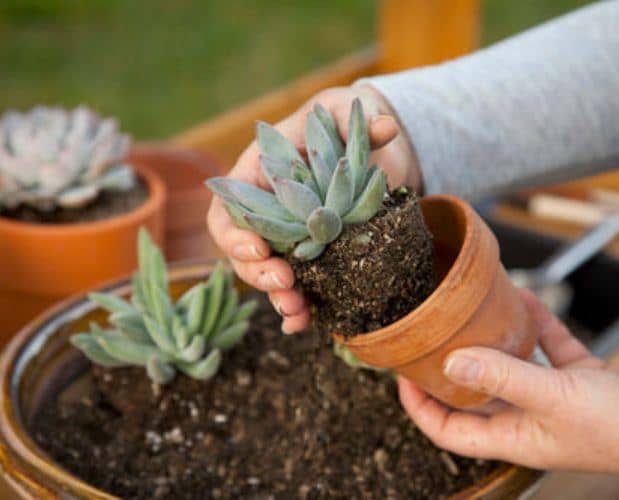
Succulents are prone to root rot. This happens when they stay too long in wet soil. Soil in pots without a drainage hole takes much longer to dry out, increasing the chance of rot.
Likewise, partially closed containers cause higher humidity levels. This is risky because it promotes rot, especially in the leaves and stems. You can never go wrong with clay, wood or hypertufa containers.
5. Don’t plant succulents near other varieties
The different plant compositions are simply magnificent. They certainly look great when combined with other varieties. Unfortunately, this can only be done temporarily.
Succulents have very different growing conditions than other plants. For example, basil should be watered every six hours, otherwise it will begin to wilt, and succulents cannot tolerate moisture. It is impossible to have cohesion without one of the plants dying.
This is also true for some groups of succulents, while others can go without water for weeks, others need to be watered weekly.
6. Don’t plant them too close

Growing different succulents in the same place has a dramatic aesthetic. And to some extent, succulents may get along better with this than other plants.
However, squeezing several in the same space presents some problems. Competition for nutrients becomes fierce, which can lead to malnutrition.
In addition, excessive crowding of succulents can promote the appearance of pests and even the spread of mold.
Find out how much each of them grows and cultivate them leaving a space of more or less 10 cm of separation.
7. Succulents like sunny, dry places.
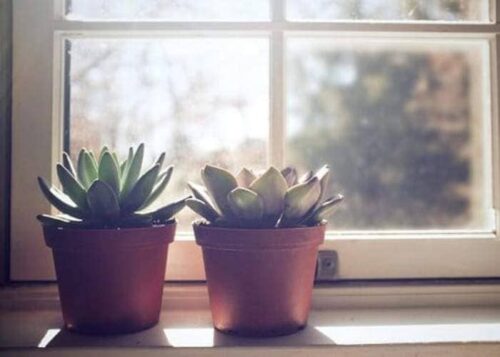
Most succulents are native to hot, dry climates, and it’s no wonder they’re great sun worshipers.
4-6 hours of direct sunlight on a kitchen windowsill or patio is enough for your plant.
If your succulent grows outdoors and is in an area with high temperatures, try creating a shade or screen to cover it during the hottest part of the day. Also remember to rotate it regularly if you place it in partially shaded areas.
Most succulents are not frost hardy, so it is advisable to move them to a warmer location during cold seasons.
In the summer, you can take them outside and let them bask in the morning or afternoon sun.
If natural lighting in your home is necessary, a grow light can do the trick. Some succulents can do well in low light conditions, but they also need to be exposed to sunlight for a minimum number of hours each day.
When the plant begins to stretch and look lanky, it may not be getting enough sun.
8. Beware of pests and diseases
Succulents are rarely attacked by pests and diseases, but you should always be vigilant.
A few cotton swabs soaked in rubbing alcohol deter crawling pests. There are natural household pesticides that can help drive away pests.
9. Transplant succulents

Most succulents fit perfectly in small pots. You can even use our hidden cactus cup as a planter for small succulents.
However, plant roots need enough space to grow. If the roots exceed the size of the pot and remain in this state, problems with drying out will occur because the water will not be absorbed properly.
Succulents are slow growing plants, and figuring out when to repot them can be daunting.
The best advice we can think of is to repot as soon as the roots start to come out of the drainage hole.
Additionally, pruning or pruning succulents regularly is not only good for their growth, but also good for their health. See: pruning succulents
10. Keep dust away

Whether you put the succulent indoors or outdoors, there will be dust. Dust is harmless in most cases, but it makes your succulent less attractive.
In my case, I always want her to stay healthy and pretty. I usually use a rag or brush and a bit of water to clean the dust from the leaves and thorns of succulents. The feeling of taking care of your beloved succulent from the smallest part is the best.
Share it on the networks: